

554
Wagner and Dupont
0
0
0 , 1
0.2
0.3
0.4
,..
".; 0.5
~
"
~0.6
0.7
0.8
0.9
I 1
ODPSite644
orwegilln-Greenland ea
Vllring Plateau
TOC bulk
Tmax
(W1.%)
(OC)
05
1.0
15
:150
400
C--10
12
I~
1(.
~
=0.;;:1M
~
20
<::..
~
_S
;F
~-g
.Ii
450 ~
3
4
0 6
"
'" ;. 7
3
a- S
5 9
10
II
12
13
14
15
ODP Site 962
Eastern Equatorhll Athmtic
Ivory oa tlGhana Transform Margin
TOC bulk
(W I.%)
0.5 1.0 1.5 2.0 2.5
Tmax
(0C)
400 450 500 550
5
illlnl:ltU'-':;UWllurt'I,w.:rrnaILU'C
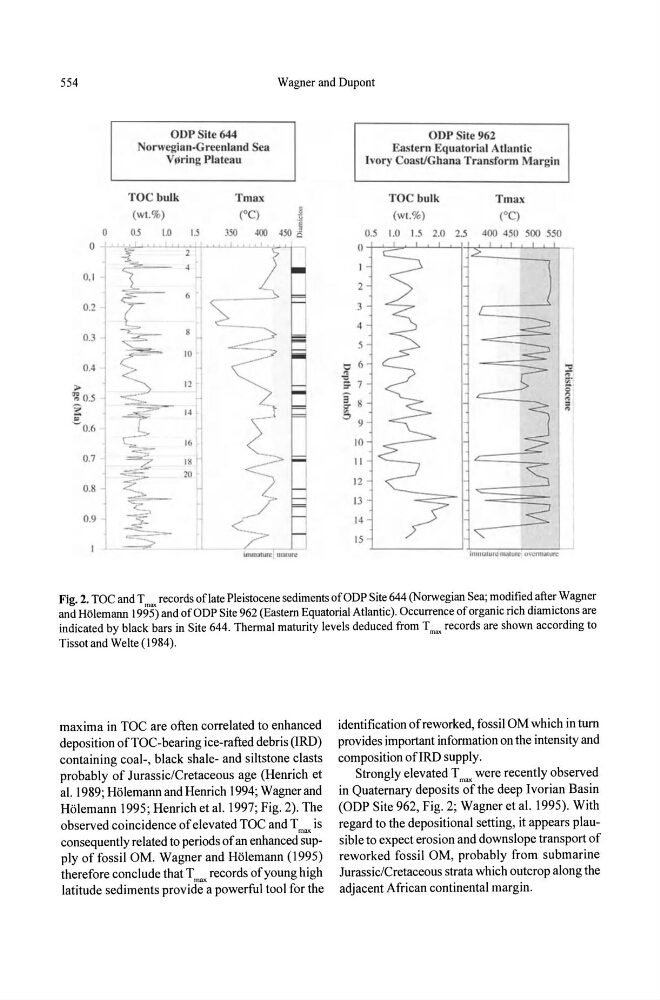
Fig. 2. TOC and T mID< records oflate Pleistocene sediments ofODP Site 644 (Norwegian Sea; modified after Wagner
and Holemann 1995) and ofODP Site 962 (Eastern Equatorial Atlantic). Occurrence of organic rich diamictons are
indicated by black bars in Site 644. Thermal maturity levels deduced from T records are shown according to
Tissot and Welte (1984).
mID<
maxima in TOC are often correlated to enhanced
deposition ofTOC-bearing ice-rafted debris (IRD)
containing coal-, black shale- and siltstone clasts
probably of Jurassic/Cretaceous age (Henrich et
al. 1989; Holemann and Henrich 1994; Wagner and
Holemann 1995; Henrich et al. 1997; Fig. 2). The
observed coincidence of elevated TOC and T is
max
consequently related to periods of an enhanced supply of fossil OM. Wagner and Holemann (1995)
therefore conclude that T max records of young high
latitude sediments provide a powerful tool for the
identification of reworked, fossil OM which in tum
provides important information on the intensity and
composition ofIRD supply.
Strongly elevated T max were recently observed
in Quaternary deposits of the deep Ivorian Basin
(ODP Site 962, Fig. 2; Wagner et al. 1995). With
regard to the depositional setting, it appears plausible to expect erosion and downslope transport of
reworked fossil OM, probably from submarine
Jurassic/Cretaceous strata which outcrop along the
adjacent African continental margin.
Wagner and Dupont
0
0
0 , 1
0.2
0.3
0.4
,..
".; 0.5
~
"
~0.6
0.7
0.8
0.9
I 1
ODPSite644
orwegilln-Greenland ea
Vllring Plateau
TOC bulk
Tmax
(W1.%)
(OC)
05
1.0
15
:150
400
C--10
12
I~
1(.
~
=0.;;:1M
~
20
<::..
~
_S
;F
~-g
.Ii
450 ~
3
4
0 6
"
'" ;. 7
3
a- S
5 9
10
II
12
13
14
15
ODP Site 962
Eastern Equatorhll Athmtic
Ivory oa tlGhana Transform Margin
TOC bulk
(W I.%)
0.5 1.0 1.5 2.0 2.5
Tmax
(0C)
400 450 500 550
5
illlnl:ltU'-':;UWllurt'I,w.:rrnaILU'C
Fig. 2. TOC and T mID< records oflate Pleistocene sediments ofODP Site 644 (Norwegian Sea; modified after Wagner
and Holemann 1995) and ofODP Site 962 (Eastern Equatorial Atlantic). Occurrence of organic rich diamictons are
indicated by black bars in Site 644. Thermal maturity levels deduced from T records are shown according to
Tissot and Welte (1984).
mID<
maxima in TOC are often correlated to enhanced
deposition ofTOC-bearing ice-rafted debris (IRD)
containing coal-, black shale- and siltstone clasts
probably of Jurassic/Cretaceous age (Henrich et
al. 1989; Holemann and Henrich 1994; Wagner and
Holemann 1995; Henrich et al. 1997; Fig. 2). The
observed coincidence of elevated TOC and T is
max
consequently related to periods of an enhanced supply of fossil OM. Wagner and Holemann (1995)
therefore conclude that T max records of young high
latitude sediments provide a powerful tool for the
identification of reworked, fossil OM which in tum
provides important information on the intensity and
composition ofIRD supply.
Strongly elevated T max were recently observed
in Quaternary deposits of the deep Ivorian Basin
(ODP Site 962, Fig. 2; Wagner et al. 1995). With
regard to the depositional setting, it appears plausible to expect erosion and downslope transport of
reworked fossil OM, probably from submarine
Jurassic/Cretaceous strata which outcrop along the
adjacent African continental margin.