

526
Dupont
NE Trade-Wind Transport of Pollen
Aeolian pollen transport to the Atlantic accounts
for a major proportion of the pollen found in marine sediments off Northwest Africa. No large rivers discharge into the ocean from this arid part of
the continent. The southward transport of pollen
grains along the coast of Northwest Africa by the
Canary Current is probably insignificant for two
reasons: firstly, the transport of particles settling
through the water column by surface currents to
the south is counteracted by northbound undercurrents and secondly, particles settle fairly quickly to
the ocean bottom (see above). Lithogenic flux
analyses of sediment traps, set in the water column
at 300 and 3000 m water depth at sites west of
Cape Blanc and north of the Canary Islands,
showed an efficient and fast downward transport
of particulate matter. North ofthe Canary Islands,
however, laterally advected material -probably
originating from surface waters closer to the coast
- was also trapped in the moorings at 300 m water
depth (Ratmeyer et al. in press).
The distribution of many pollen types, such as
Pinus, Artemisia, other Asteraceae (composites),
and Ephedra, in the modern marine surface
sediments reflects the average course of the trajectory of the major wind belts (Hooghiemstra et
al. 1986). The NE-trade winds over the East Atlantic originate from the northwestern fringe ofthe
Sahara and blow basically parallel to the shore line
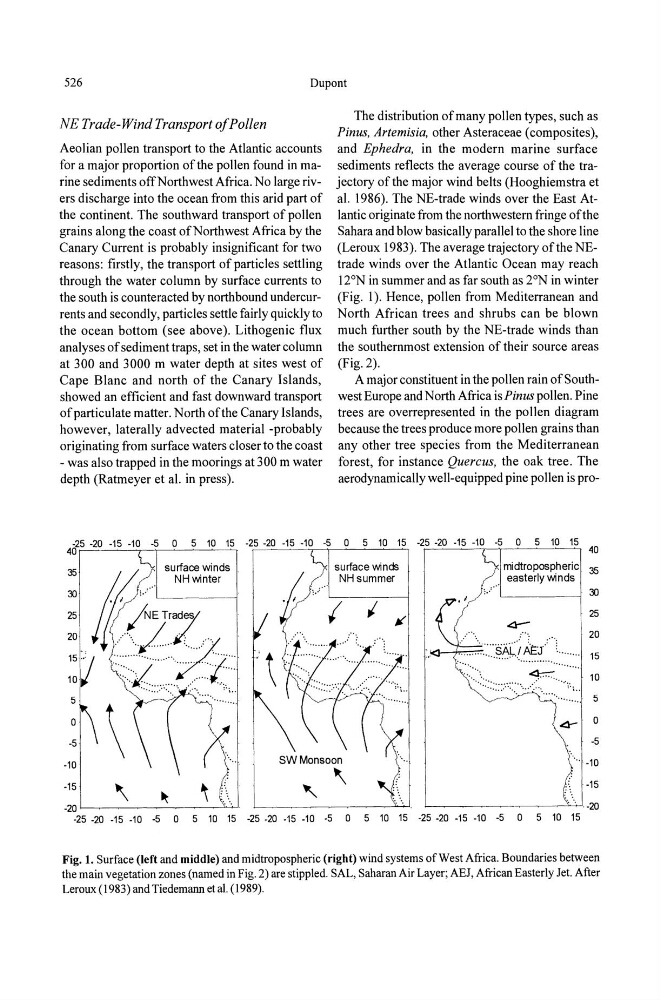
(Leroux 1983). The average trajectory of the NEtrade winds over the Atlantic Ocean may reach
l2°N in summer and as far south as 2°N in winter
(Fig. I). Hence, pollen from Mediterranean and
North African trees and shrubs can be blown
much further south by the NE-trade winds than
the southernmost extension of their source areas
(Fig. 2).
A major constituent in the pollen rain of Southwest Europe and North Africa is Pinus pollen. Pine
trees are overrepresented in the pollen diagram
because the trees produce more pollen grains than
any other tree species from the Mediterranean
forest, for instance Quercus, the oak tree. The
aerodynamically well-equipped pine pollen is pro4~r5_-=20~-1~5_-~107-~-5~~0~5~1~0~1~5 'r=-=--~----'"7--i---,,------,5~1-,-0----,"15=c -25 -20 -15 -10 -5 0 5 10 15 40
35
30
25
20
5
o
-5
-10
-15
\
-20 l--~~-_~ _ _ _ _ '--' :,..J'
surface winds
NHsummer
SWMonsoon
\
'\
~I
midtropospheric 35
easterly wi nds
........... 5
o
-5
.. -10
-15
1...--_~-_ _ _ _ ..J....;..J,_20
-25 -20 -15 -10 -5 0 5 10 15 -25 -20 -15 -10 -5 a 5 10 15 -25 -20 -15 -10 -5 0 5 10 15
Fig. 1. Surface (left and middle) and midtropospheric (right) wind systems of West Africa. Boundaries between
the main vegetation zones (named in Fig. 2) are stippled. SAL, Saharan Air Layer; AEJ, African Easterly Jet. After
Leroux (1983) and Tiedemann et al. (1989).
Dupont
NE Trade-Wind Transport of Pollen
Aeolian pollen transport to the Atlantic accounts
for a major proportion of the pollen found in marine sediments off Northwest Africa. No large rivers discharge into the ocean from this arid part of
the continent. The southward transport of pollen
grains along the coast of Northwest Africa by the
Canary Current is probably insignificant for two
reasons: firstly, the transport of particles settling
through the water column by surface currents to
the south is counteracted by northbound undercurrents and secondly, particles settle fairly quickly to
the ocean bottom (see above). Lithogenic flux
analyses of sediment traps, set in the water column
at 300 and 3000 m water depth at sites west of
Cape Blanc and north of the Canary Islands,
showed an efficient and fast downward transport
of particulate matter. North ofthe Canary Islands,
however, laterally advected material -probably
originating from surface waters closer to the coast
- was also trapped in the moorings at 300 m water
depth (Ratmeyer et al. in press).
The distribution of many pollen types, such as
Pinus, Artemisia, other Asteraceae (composites),
and Ephedra, in the modern marine surface
sediments reflects the average course of the trajectory of the major wind belts (Hooghiemstra et
al. 1986). The NE-trade winds over the East Atlantic originate from the northwestern fringe ofthe
Sahara and blow basically parallel to the shore line
(Leroux 1983). The average trajectory of the NEtrade winds over the Atlantic Ocean may reach
l2°N in summer and as far south as 2°N in winter
(Fig. I). Hence, pollen from Mediterranean and
North African trees and shrubs can be blown
much further south by the NE-trade winds than
the southernmost extension of their source areas
(Fig. 2).
A major constituent in the pollen rain of Southwest Europe and North Africa is Pinus pollen. Pine
trees are overrepresented in the pollen diagram
because the trees produce more pollen grains than
any other tree species from the Mediterranean
forest, for instance Quercus, the oak tree. The
aerodynamically well-equipped pine pollen is pro4~r5_-=20~-1~5_-~107-~-5~~0~5~1~0~1~5 'r=-=--~----'"7--i---,,------,5~1-,-0----,"15=c -25 -20 -15 -10 -5 0 5 10 15 40
35
30
25
20
5
o
-5
-10
-15
\
-20 l--~~-_~ _ _ _ _ '--' :,..J'
surface winds
NHsummer
SWMonsoon
\
'\
~I
midtropospheric 35
easterly wi nds
........... 5
o
-5
.. -10
-15
1...--_~-_ _ _ _ ..J....;..J,_20
-25 -20 -15 -10 -5 0 5 10 15 -25 -20 -15 -10 -5 a 5 10 15 -25 -20 -15 -10 -5 0 5 10 15
Fig. 1. Surface (left and middle) and midtropospheric (right) wind systems of West Africa. Boundaries between
the main vegetation zones (named in Fig. 2) are stippled. SAL, Saharan Air Layer; AEJ, African Easterly Jet. After
Leroux (1983) and Tiedemann et al. (1989).