

496
Bijmaetal.
i!i'0
Ci
~ ·1
•
t
Ambient
Seawater
... ...
r,
I
...
... ...
R 2 =O.99
..... ...
'6 ....
. .
-
iI'C~1.9D.D.DI2ICd,·J
__ l3C = 1.83" 0.014[0:\"]
.5~ __ ~ __ w-__ w-~~-u~~ __ ~
100
150
200
250
300
350
400
450
rCO~'l (J.lmollkg)
~
~
en -2.5
;;o
?f<
'-' -3.0
~
x;O -3.5
~(,CJ
Ambient
Seawater
_
0 18 0 = -l.30 - O.004[CO~·1
'i' ~
R' ~ D.99
....
R 2 =O.99
IS
1- - 8 0 = -1.43 - O.005[CO)1
~Ou-~~~~-u __ ~ __ ~ __ ~ __ -J
100
150
200
250
300
350
400
450
[CO~'l (J.lmollkg)
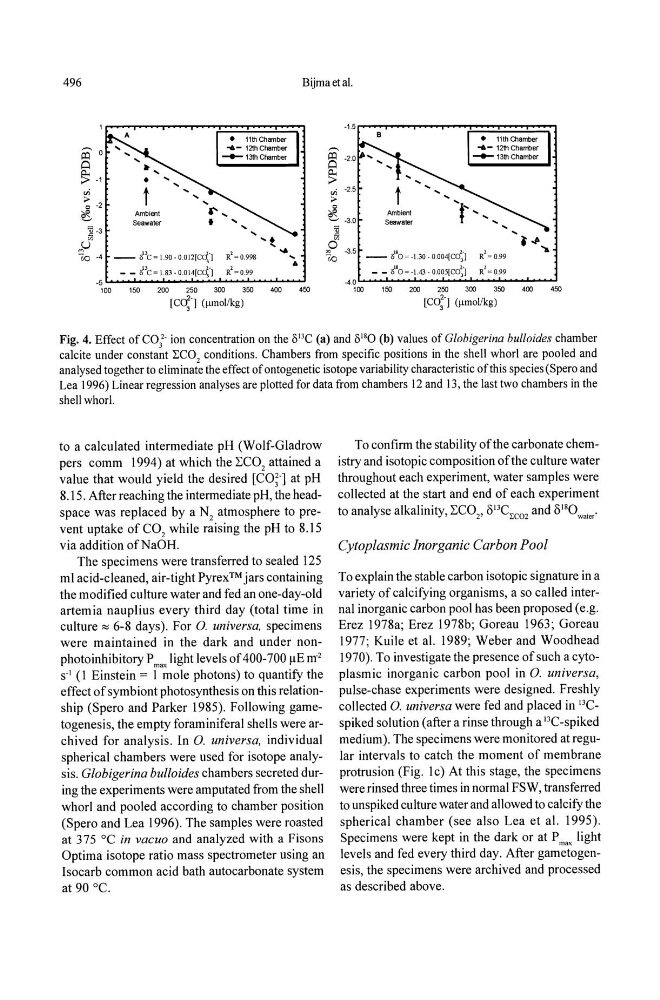
Fig. 4. Effect of CO]" ion concentration on the IilJC (a) and 1i180 (b) values of Globigerina bulloides chamber
calcite under constant LCO, conditions. Chambers from specific positions in the shell whorl are pooled and
analysed together to eliminate the effect of ontogenetic isotope variability characteristic of this species (Spero and
Lea 1996) Linear regression analyses are plotted for data from chambers 12 and 13, the last two chambers in the
shell whorl.
to a calculated intermediate pH (Wolf-Gladrow
pers comm 1994) at which the Z:C0 2 attained a
value that would yield the desired [COi'] at pH
8.15. After reaching the intermediate pH, the headspace was replaced by a N2 atmosphere to prevent uptake of CO 2 while raising the pH to 8.15
via addition ofNaOH.
The specimens were transferred to sealed 125
ml acid-cleaned, air-tight Pyrex™ jars containing
the modified culture water and fed an one-day-old
artemia nauplius every third day (total time in
culture"" 6-8 days). For 0. universa, specimens
were maintained in the dark and under nonphotoinhibitory P max light levels of 400-700 ~E m 2
S·I (1 Einstein = 1 mole photons) to quantify the
effect of symbiont photosynthesis on this relationship (Spero and Parker 1985). Following gametogenesis, the empty foraminiferal shells were archived for analysis. In O. universa, individual
spherical chambers were used for isotope analysis. Globigerina bulla ides chambers secreted during the experiments were amputated from the shell
whorl and pooled according to chamber position
(Spero and Lea 1996). The samples were roasted
at 375°C in vacuo and analyzed with a Fisons
Optima isotope ratio mass spectrometer using an
Isocarb common acid bath autocarbonate system
at 90°C.
To confirm the stability of the carbonate chemistry and isotopic composition ofthe culture water
throughout each experiment, water samples were
collected at the start and end of each experiment
to analyse alkalinity, Z:C0 2 , 8J3CLCD2 and 8 18 0 wa ",
Cytoplasmic Inorganic Carbon Pool
To explain the stable carbon isotopic signature in a
variety of calcifying organisms, a so called internal inorganic carbon pool has been proposed (e.g.
Erez 1978a; Erez 1978b; Goreau 1963; Goreau
1977; Kuile et a!. 1989; Weber and Woodhead
1970). To investigate the presence of such a cytoplasmic inorganic carbon pool in 0. universa,
pulse-chase experiments were designed. Freshly
collected 0. universa were fed and placed in J3C_
spiked solution (after a rinse through a llC-spiked
medium). The specimens were monitored at regular intervals to catch the moment of membrane
protrusion (Fig. 1c) At this stage, the specimens
were rinsed three times in normal FSW, transferred
to unspiked culture water and allowed to calcify the
spherical chamber (see also Lea et a!. 1995).
Specimens were kept in the dark or at P max light
levels and fed every third day. After gametogenesis, the specimens were archived and processed
as described above.
Bijmaetal.
i!i'0
Ci
~ ·1
•
t
Ambient
Seawater
... ...
r,
I
...
... ...
R 2 =O.99
..... ...
'6 ....
. .
-
iI'C~1.9D.D.DI2ICd,·J
__ l3C = 1.83" 0.014[0:\"]
.5~ __ ~ __ w-__ w-~~-u~~ __ ~
100
150
200
250
300
350
400
450
rCO~'l (J.lmollkg)
~
~
en -2.5
;;o
?f<
'-' -3.0
~
x;O -3.5
~(,CJ
Ambient
Seawater
_
0 18 0 = -l.30 - O.004[CO~·1
'i' ~
R' ~ D.99
....
R 2 =O.99
IS
1- - 8 0 = -1.43 - O.005[CO)1
~Ou-~~~~-u __ ~ __ ~ __ ~ __ -J
100
150
200
250
300
350
400
450
[CO~'l (J.lmollkg)
Fig. 4. Effect of CO]" ion concentration on the IilJC (a) and 1i180 (b) values of Globigerina bulloides chamber
calcite under constant LCO, conditions. Chambers from specific positions in the shell whorl are pooled and
analysed together to eliminate the effect of ontogenetic isotope variability characteristic of this species (Spero and
Lea 1996) Linear regression analyses are plotted for data from chambers 12 and 13, the last two chambers in the
shell whorl.
to a calculated intermediate pH (Wolf-Gladrow
pers comm 1994) at which the Z:C0 2 attained a
value that would yield the desired [COi'] at pH
8.15. After reaching the intermediate pH, the headspace was replaced by a N2 atmosphere to prevent uptake of CO 2 while raising the pH to 8.15
via addition ofNaOH.
The specimens were transferred to sealed 125
ml acid-cleaned, air-tight Pyrex™ jars containing
the modified culture water and fed an one-day-old
artemia nauplius every third day (total time in
culture"" 6-8 days). For 0. universa, specimens
were maintained in the dark and under nonphotoinhibitory P max light levels of 400-700 ~E m 2
S·I (1 Einstein = 1 mole photons) to quantify the
effect of symbiont photosynthesis on this relationship (Spero and Parker 1985). Following gametogenesis, the empty foraminiferal shells were archived for analysis. In O. universa, individual
spherical chambers were used for isotope analysis. Globigerina bulla ides chambers secreted during the experiments were amputated from the shell
whorl and pooled according to chamber position
(Spero and Lea 1996). The samples were roasted
at 375°C in vacuo and analyzed with a Fisons
Optima isotope ratio mass spectrometer using an
Isocarb common acid bath autocarbonate system
at 90°C.
To confirm the stability of the carbonate chemistry and isotopic composition ofthe culture water
throughout each experiment, water samples were
collected at the start and end of each experiment
to analyse alkalinity, Z:C0 2 , 8J3CLCD2 and 8 18 0 wa ",
Cytoplasmic Inorganic Carbon Pool
To explain the stable carbon isotopic signature in a
variety of calcifying organisms, a so called internal inorganic carbon pool has been proposed (e.g.
Erez 1978a; Erez 1978b; Goreau 1963; Goreau
1977; Kuile et a!. 1989; Weber and Woodhead
1970). To investigate the presence of such a cytoplasmic inorganic carbon pool in 0. universa,
pulse-chase experiments were designed. Freshly
collected 0. universa were fed and placed in J3C_
spiked solution (after a rinse through a llC-spiked
medium). The specimens were monitored at regular intervals to catch the moment of membrane
protrusion (Fig. 1c) At this stage, the specimens
were rinsed three times in normal FSW, transferred
to unspiked culture water and allowed to calcify the
spherical chamber (see also Lea et a!. 1995).
Specimens were kept in the dark or at P max light
levels and fed every third day. After gametogenesis, the specimens were archived and processed
as described above.