

494
Bijmaetal.
of geochemical information for paleoceanographic
reconstructions (Bard et al. 1987; Kallel et al. 1988;
Sautter and ThunellI991). ContraIyto most spinose
species, an important part of its diet consists of algae
as evidenced by the olive green to brownish coloration of the cytoplasm of freshly collected specimens. Recently, a study on the population dynamics (Schiebel et al. 1997) demonstrated a lunar
periodicity of reproduction in this species as well.
As evidenced by SEM, gametogenic calcification
is much less pronounced than in 0. universa, but
the extent of GAM calcite addition has yet to be
quantified.
Culture Protocol
Three sets of experiments were designed to investigate the effect of the carbonate chemistry on shell
isotopic fractionation. Culture procedures followed
standard protocols (e.g. Bemis et al. 1998;
Hemleben et al. 1989). Briefy, O. universa and G.
bulla ides were collected by scuba divers from
surface waters of the San Pedro Basin, Southern
California Bight, U.S.A. and were maintained in
laboratory culture at 17°C and 22 °C (± 0.2 0C).
Specimens were grown in 0.8 llm filtered sea water (FSW) whose carbonate chemistry was modified. Sea water LC0 2 and total alkalinity (al~)
were modified via the addition ofNa 2 C0 3 and/or
titration with HCl or NaOH. The pH of the water
was determined potentiometrically whereas al~ and
LC0 2 were determined by titration and equilibrium
calculations respectively. Coulometric determinations of a few sea water samples confirmed
the accuracy of the calculated LC0 2 values
O(A. Sanyal, pers. comm. 1994). During the experiments, Southern California Bight ambient surface
water pH was 8.13 ± 0.02 (at 22°C) and ambient
(alk, was 2241 ± 19 lleq/kg (n=64). Calculated
LC0 2 was 2010 ± 18 llmollkg, while
[COn was calculated to have varied between
153-184 llmol/kg.
The first two sets of experiments were designed
to vary [CO;·] at constant alk t or at constant
LCO r Because [COn and pH covary linearly
across the relevant pH range in sea water (e.g. 7.98.8), these two experiments did not allow us to
mechanistically distinguish between pH and
[COn as a controlling factor. Therefore we designed a third set of experiments at constant pH.
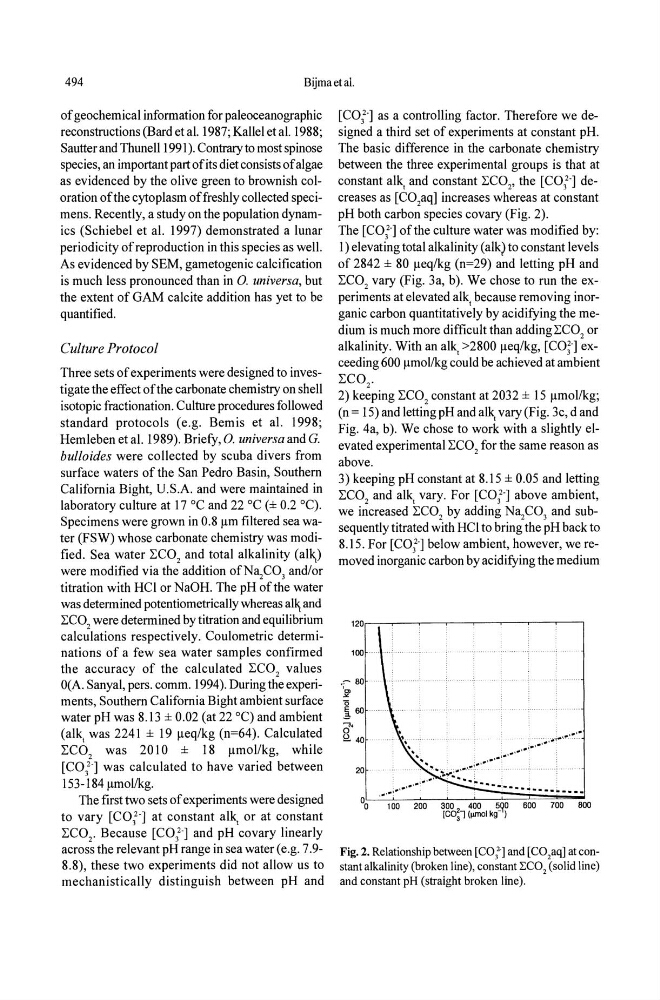
The basic difference in the carbonate chemistry
between the three experimental groups is that at
constant alk, and constant LC0 2 , the [COn decreases as [C0 2 aq] increases whereas at constant
pH both carbon species covary (Fig. 2).
The [CO;·] of the culture water was modified by:
1) elevating total alkalinity (alk) to constant levels
of 2842 ± 80 lleq/kg (n=29) and letting pH and
LC0 2 vary (Fig. 3a, b). We chose to run the experiments at elevated alk t because removing inorganic carbon quantitatively by acidifying the medium is much more difficult than adding LC0 2 or
alkalinity. With an alk t >2800 lleq/kg, [CO;·] exceeding 600 llmol/kg could be achieved at ambient
LC0 2 •
2) keeping LC0 2 constant at 2032 ± 15 llmol/kg;
(n = 15) and letting pH and al~ vary (Fig. 3c, d and
Fig. 4a, b). We chose to work with a slightly elevated experimental LC0 2 for the same reason as
above.
3) keeping pH constant at 8.15 ± 0.05 and letting
LC0 2 and alk, vary. For [COn above ambient,
we increased LC0 2 by adding Na 2 C0 3 and subsequently titrated with HCl to bring the pH back to
8.15. For [COn below ambient, however, we removed inorganic carbon by acidifying the medium
120..-:---..--.--...,--,.............,,...----..--.--,
100
20
100
200
30~2 400
5fl!l
600
700
800
(cual bunal kg- )
Fig. 2. Relationship between [CO,2-] and [C0 2 aq] at constant alkalinity (broken line), constant LC0 2 (solid line)
and constant pH (straight broken line).
Bijmaetal.
of geochemical information for paleoceanographic
reconstructions (Bard et al. 1987; Kallel et al. 1988;
Sautter and ThunellI991). ContraIyto most spinose
species, an important part of its diet consists of algae
as evidenced by the olive green to brownish coloration of the cytoplasm of freshly collected specimens. Recently, a study on the population dynamics (Schiebel et al. 1997) demonstrated a lunar
periodicity of reproduction in this species as well.
As evidenced by SEM, gametogenic calcification
is much less pronounced than in 0. universa, but
the extent of GAM calcite addition has yet to be
quantified.
Culture Protocol
Three sets of experiments were designed to investigate the effect of the carbonate chemistry on shell
isotopic fractionation. Culture procedures followed
standard protocols (e.g. Bemis et al. 1998;
Hemleben et al. 1989). Briefy, O. universa and G.
bulla ides were collected by scuba divers from
surface waters of the San Pedro Basin, Southern
California Bight, U.S.A. and were maintained in
laboratory culture at 17°C and 22 °C (± 0.2 0C).
Specimens were grown in 0.8 llm filtered sea water (FSW) whose carbonate chemistry was modified. Sea water LC0 2 and total alkalinity (al~)
were modified via the addition ofNa 2 C0 3 and/or
titration with HCl or NaOH. The pH of the water
was determined potentiometrically whereas al~ and
LC0 2 were determined by titration and equilibrium
calculations respectively. Coulometric determinations of a few sea water samples confirmed
the accuracy of the calculated LC0 2 values
O(A. Sanyal, pers. comm. 1994). During the experiments, Southern California Bight ambient surface
water pH was 8.13 ± 0.02 (at 22°C) and ambient
(alk, was 2241 ± 19 lleq/kg (n=64). Calculated
LC0 2 was 2010 ± 18 llmollkg, while
[COn was calculated to have varied between
153-184 llmol/kg.
The first two sets of experiments were designed
to vary [CO;·] at constant alk t or at constant
LCO r Because [COn and pH covary linearly
across the relevant pH range in sea water (e.g. 7.98.8), these two experiments did not allow us to
mechanistically distinguish between pH and
[COn as a controlling factor. Therefore we designed a third set of experiments at constant pH.
The basic difference in the carbonate chemistry
between the three experimental groups is that at
constant alk, and constant LC0 2 , the [COn decreases as [C0 2 aq] increases whereas at constant
pH both carbon species covary (Fig. 2).
The [CO;·] of the culture water was modified by:
1) elevating total alkalinity (alk) to constant levels
of 2842 ± 80 lleq/kg (n=29) and letting pH and
LC0 2 vary (Fig. 3a, b). We chose to run the experiments at elevated alk t because removing inorganic carbon quantitatively by acidifying the medium is much more difficult than adding LC0 2 or
alkalinity. With an alk t >2800 lleq/kg, [CO;·] exceeding 600 llmol/kg could be achieved at ambient
LC0 2 •
2) keeping LC0 2 constant at 2032 ± 15 llmol/kg;
(n = 15) and letting pH and al~ vary (Fig. 3c, d and
Fig. 4a, b). We chose to work with a slightly elevated experimental LC0 2 for the same reason as
above.
3) keeping pH constant at 8.15 ± 0.05 and letting
LC0 2 and alk, vary. For [COn above ambient,
we increased LC0 2 by adding Na 2 C0 3 and subsequently titrated with HCl to bring the pH back to
8.15. For [COn below ambient, however, we removed inorganic carbon by acidifying the medium
120..-:---..--.--...,--,.............,,...----..--.--,
100
20
100
200
30~2 400
5fl!l
600
700
800
(cual bunal kg- )
Fig. 2. Relationship between [CO,2-] and [C0 2 aq] at constant alkalinity (broken line), constant LC0 2 (solid line)
and constant pH (straight broken line).