

Clues to Ocean History: a Brief Overview of Proxies
39
pheric and oceanic circulation in the western equatorial Atlantic. Jansen et al. (1989) obtained valuable information relating to climate variability in
tropical Africa over the past 225,000 years through
the analysis of phytoliths and fresh-water diatoms
in sediments off the Congo. These studies, and
others, indicate significantly arid conditions in tropical Africa during the glacials.
Pollen in the sediments provides even more
detailed information relating to past climate. They
do not provide just an estimate of arid vs. humid
conditions, but permit mapping of vegetation zones
for pasttime slices (Rossignol-Strick 1983; Dupont
1993 ; Dupont this volume).
Conclusions
In recent decades, a large number of proxies have
been developed for the reconstruction of past environmental conditions. Major improvements have
been made in the attempt to understand climatic
conditions ofthe past, especially with regard to the
role of the oceans in the global climate system. One
example is the reconstruction of surface-water
temperatures for the Last Glacial Maximum by the
CLIMAP group (1976). For a long time this data
set has been the backbone for modeling the glacial
ocean. Improved data sets are now available that
confirm the basic major characteristics of this reconstruction, but result in significantly different
Canary Islands
Cape Blanc
Cape Verde
S km
SAL
=Trade wi nds
-- Ocean
S
.~
========~
~~~
~I
1
60 _ 260 '
I~~~
0.8
Sediment
0.8 - 1.6 '
0.4 - 0.8"
• e
~~~'~i ~~~~~~~
< N
JO' N
IIOOkm
24 ' N
800km
17' N
8OO'm
10' N
It ow Ptllm SdliJIZ fI ( '" (IQIU). PtM~o & CUlM (1 972). 1.eR* (1875)
:rt H"Of~LI$I~ w Q~bIhtlCI5IW.n.rSdtUtl."aL(1MI)
Il1o C., .. iInIm Koopnwn (1111). s.mthei! .1I. 11H2)
unl! ." P&o II Yi!'a,
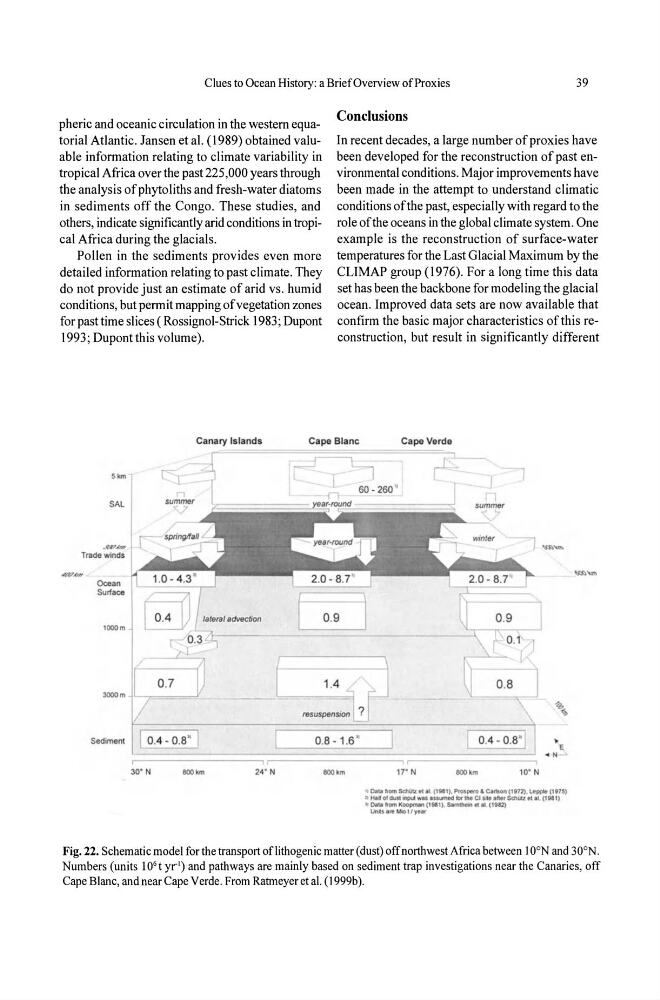
Fig. 22. Schematic model for the transport oflithogenic matter (dust) off northwest Africa between lOO N and 30 0 N.
Numbers (units 10 6 t yrt) and pathways are mainly based on sediment trap investigations near the Canaries, off
Cape Blanc, and near Cape Verde. From Ratmeyer et al. (1999b).
39
pheric and oceanic circulation in the western equatorial Atlantic. Jansen et al. (1989) obtained valuable information relating to climate variability in
tropical Africa over the past 225,000 years through
the analysis of phytoliths and fresh-water diatoms
in sediments off the Congo. These studies, and
others, indicate significantly arid conditions in tropical Africa during the glacials.
Pollen in the sediments provides even more
detailed information relating to past climate. They
do not provide just an estimate of arid vs. humid
conditions, but permit mapping of vegetation zones
for pasttime slices (Rossignol-Strick 1983; Dupont
1993 ; Dupont this volume).
Conclusions
In recent decades, a large number of proxies have
been developed for the reconstruction of past environmental conditions. Major improvements have
been made in the attempt to understand climatic
conditions ofthe past, especially with regard to the
role of the oceans in the global climate system. One
example is the reconstruction of surface-water
temperatures for the Last Glacial Maximum by the
CLIMAP group (1976). For a long time this data
set has been the backbone for modeling the glacial
ocean. Improved data sets are now available that
confirm the basic major characteristics of this reconstruction, but result in significantly different
Canary Islands
Cape Blanc
Cape Verde
S km
SAL
=Trade wi nds
-- Ocean
S
.~
========~
~~~
~I
1
60 _ 260 '
I~~~
0.8
Sediment
0.8 - 1.6 '
0.4 - 0.8"
• e
~~~'~i ~~~~~~~
< N
JO' N
IIOOkm
24 ' N
800km
17' N
8OO'm
10' N
It ow Ptllm SdliJIZ fI ( '" (IQIU). PtM~o & CUlM (1 972). 1.eR* (1875)
:rt H"Of~LI$I~ w Q~bIhtlCI5IW.n.rSdtUtl."aL(1MI)
Il1o C., .. iInIm Koopnwn (1111). s.mthei! .1I. 11H2)
unl! ." P&o II Yi!'a,
Fig. 22. Schematic model for the transport oflithogenic matter (dust) off northwest Africa between lOO N and 30 0 N.
Numbers (units 10 6 t yrt) and pathways are mainly based on sediment trap investigations near the Canaries, off
Cape Blanc, and near Cape Verde. From Ratmeyer et al. (1999b).