

Alkenone ol3e as a Proxy for Past peo, in Surface Waters
475
sea water conditions this assumption is reliable for
important marine alkenone producers (Paasche
1964; Bidigare et al. 1997; Nimer and Merrett
1996; Nimer et al. 1996; Nimer et al. 1997).
(3)
Eris quite well known as the combined fractionation due to the enzyms Rubisco and (3-carboxylase, and its likely value is between 25-28 %0
(Goericke et al. 1994). An E(value of about 25 %0
was obtained by Bidigare et al. (1997) for the
alkenone-producing coccolithophorid E. huxleyi.
Higher growth rates lead to higher b-values
(Rau et al. 1996; Bidigare et al. 1997). Based on
chemostat experiments with the coccolithophorid
E. huxleyi, Bidigare et al. (1997) found a close correlation between Ep of the total organic carbon of
the coccolithophorid and l!ic e , where !l is the growth
rate and c e is the external concentration of dissolved
CO 2 (C e = [C0 2 (aq)]):
Ep = 24.6 - 137.9 * !lICe
(4)
Calculation of Paleo-PC0 2
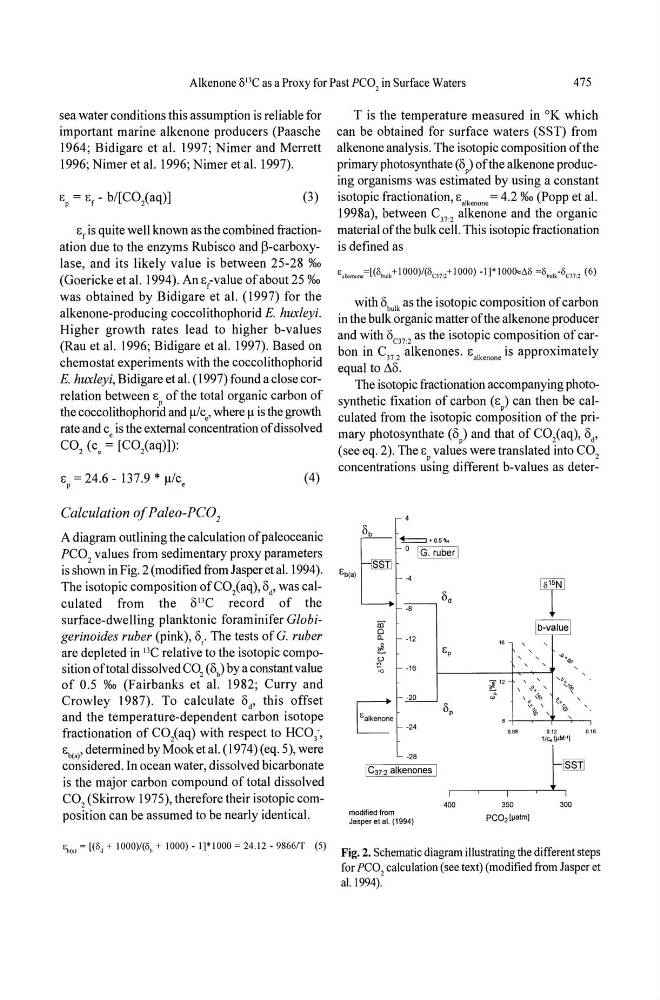
A diagram outlining the calculation of paleoceanic
PC0 2 values from sedimentary proxy parameters
is shown in Fig. 2 (modified from Jasper et al. 1994).
The isotopic composition ofCOiaq),od' was calculated from the 013C record of the
surface-dwelling planktonic foraminifer Globigerinoides ruber (pink), 0, The tests of G. ruber
are depleted in 13C relative to the isotopic composition of total dissolved CO, (Ob) by a constant value
of 0.5 %0 (Fairbanks et al. 1982; Curry and
Crowley 1987). To calculate 0d' this offset
and the temperature-dependent carbon isotope
fractionation of CO,(aq) with respect to HC0 3 ·,
Eb(a)' determined by Mook et al. (1974) (eq. 5), were
considered. In ocean water, dissolved bicarbonate
is the major carbon compound of total dissolved
CO 2 (Skirrow 1975), therefore their isotopic composition can be assumed to be nearly identical.
T is the temperature measured in OK which
can be obtained for surface waters (SST) from
alkenone analysis. The isotopic composition ofthe
primary photosynthate (0 p) of the alkenone producing organisms was estimated by using a constant
isotopic fractionation, Ealkenone = 4.2 %0 (Popp et al.
1998a), between C m alkenone and the organic
material of the bulk cell. This isotopic fractionation
is defined as
with 0bulk as the isotopic composition of carbon
in the bulk organic matter of the alkenone producer
and with oem as the isotopic composition of carbon in C 37 : 2 alkenones. Ealkenone is approximately
equal to ~O.
The isotopic fractionation accompanying photosynthetic fixation of carbon (Ep) can then be calculated from the isotopic composition of the primary photosynthate (Op) and that of CO,(aq), 0d'
(see eq. 2). The Ep values were translated into CO,
concentrations using different b-values as deter4
E
'i::::::::::J+05'L
o IG. ruberl
Eb(a)
-4
!
Od
·8
Iii"
b-value
0
a.
·12
16
l
Ep
,
"-..,
;?
, ,
"'
·16
~12
, , ".
, \"~ , \~
I "alkeno:e
·20
"
{~
~.
,
Op
" , ~ ,
~ ,
·24
0.12
0.16
1/ee[IJM-11
·28
t~
I C37:2 alkenones I
I
I
400
350
300
modified from
PCO,[~atml
Jasper et al. (1994)
"b(.) = [(8, + 1000)/(8b + 1000) - 1]*1000 = 24.12 - 9866rr (5) Fig. 2. Schematic diagram illustrating the different steps
for peo, calculation (see text) (modified from Jasper et
al.1994).
475
sea water conditions this assumption is reliable for
important marine alkenone producers (Paasche
1964; Bidigare et al. 1997; Nimer and Merrett
1996; Nimer et al. 1996; Nimer et al. 1997).
(3)
Eris quite well known as the combined fractionation due to the enzyms Rubisco and (3-carboxylase, and its likely value is between 25-28 %0
(Goericke et al. 1994). An E(value of about 25 %0
was obtained by Bidigare et al. (1997) for the
alkenone-producing coccolithophorid E. huxleyi.
Higher growth rates lead to higher b-values
(Rau et al. 1996; Bidigare et al. 1997). Based on
chemostat experiments with the coccolithophorid
E. huxleyi, Bidigare et al. (1997) found a close correlation between Ep of the total organic carbon of
the coccolithophorid and l!ic e , where !l is the growth
rate and c e is the external concentration of dissolved
CO 2 (C e = [C0 2 (aq)]):
Ep = 24.6 - 137.9 * !lICe
(4)
Calculation of Paleo-PC0 2
A diagram outlining the calculation of paleoceanic
PC0 2 values from sedimentary proxy parameters
is shown in Fig. 2 (modified from Jasper et al. 1994).
The isotopic composition ofCOiaq),od' was calculated from the 013C record of the
surface-dwelling planktonic foraminifer Globigerinoides ruber (pink), 0, The tests of G. ruber
are depleted in 13C relative to the isotopic composition of total dissolved CO, (Ob) by a constant value
of 0.5 %0 (Fairbanks et al. 1982; Curry and
Crowley 1987). To calculate 0d' this offset
and the temperature-dependent carbon isotope
fractionation of CO,(aq) with respect to HC0 3 ·,
Eb(a)' determined by Mook et al. (1974) (eq. 5), were
considered. In ocean water, dissolved bicarbonate
is the major carbon compound of total dissolved
CO 2 (Skirrow 1975), therefore their isotopic composition can be assumed to be nearly identical.
T is the temperature measured in OK which
can be obtained for surface waters (SST) from
alkenone analysis. The isotopic composition ofthe
primary photosynthate (0 p) of the alkenone producing organisms was estimated by using a constant
isotopic fractionation, Ealkenone = 4.2 %0 (Popp et al.
1998a), between C m alkenone and the organic
material of the bulk cell. This isotopic fractionation
is defined as
with 0bulk as the isotopic composition of carbon
in the bulk organic matter of the alkenone producer
and with oem as the isotopic composition of carbon in C 37 : 2 alkenones. Ealkenone is approximately
equal to ~O.
The isotopic fractionation accompanying photosynthetic fixation of carbon (Ep) can then be calculated from the isotopic composition of the primary photosynthate (Op) and that of CO,(aq), 0d'
(see eq. 2). The Ep values were translated into CO,
concentrations using different b-values as deter4
E
'i::::::::::J+05'L
o IG. ruberl
Eb(a)
-4
!
Od
·8
Iii"
b-value
0
a.
·12
16
l
Ep
,
"-..,
;?
, ,
"'
·16
~12
, , ".
, \"~ , \~
I "alkeno:e
·20
"
{~
~.
,
Op
" , ~ ,
~ ,
·24
0.12
0.16
1/ee[IJM-11
·28
t~
I C37:2 alkenones I
I
I
400
350
300
modified from
PCO,[~atml
Jasper et al. (1994)
"b(.) = [(8, + 1000)/(8b + 1000) - 1]*1000 = 24.12 - 9866rr (5) Fig. 2. Schematic diagram illustrating the different steps
for peo, calculation (see text) (modified from Jasper et
al.1994).