

Clues to Ocean History: a BriefOverview of Proxies
37
Thus, paleo-surface water PC0 2 reconstructions obviously require at least the knowledge of
phytoplankton growth rates and cell geometry
(Popp et al. 1998), both parameters which are difficult to obtain from the sedimentary record. In this
volume, Andersen et aI., who provide an introduction on surface water PC0 2 reconstructions, describe a method using species-specific biomarker
(alkenone) liI3C values and lilSN ratios (approximation of a growth-related b-value) to reconstruct
past surface water PC0 2 variations in the South
Atlantic. They also outline the advantages of this
technique in comparison to the measurement and
application ofbulk-liI3C values. The latter values
which may reflect the lil3C of multiple organic
carbon sources (from diatoms, coccolithophorids,
secondary producers etc.) may further be influenced by some unknown contribution of terrigenous
carbon (with very low values) in particular in nearcoastal environments. On the other hand, relationships ofbulk-liI3C to ambient CO 2 and/or growth
rates are presently better established than calibrations from specific biomarkers. In addition,
alkenone-liI3C values cannot be utilized for PC0 2
reconstructions for example in high-latitude envi400
Estimated surface water PC02
at site 1016-3, Angola Basin
350
E
~
300
OJ
0 250
15.
ronments (i.e. the Southern Ocean) where no stable biomarker is presently available nor is there any
calibration.
To define the carbonate system in seawater, that
is, to be able to determinepC0 2 , two elements of
the system have to be known besides temperature.
These can be any combination of total CO 2 , alkalinity, pH, or derived parameters dependent on these
three. To reconstruct pH, the boron isotope composition of carbonates has been used.
The isotopic composition of boron in
foraminifersl shells is pH-dependent (Hemming and
Hanson 1992). The mechanism is based on the fact
that the uncharged species B(OH)3 is enriched in
liB by about 20 0 / 00 over the charged borate species, B(OH); (Kakihana et al. 1977). As the fraction ofthe boron species changes with pH, so must
their respective compositions. It is assumed that
only the uncharged borate species is incorporated
into biogenic calcite and that this incorporation
occurs with a small and nearly constant isotopic
fractionation. Thus, the isotopic composition of
borate from foraminifersl calcite should serve as
an indicator of paleo-acidity. In a step towards
establishing lillB of foraminifersl shells as a tool
200
- - VOSTOK ice core {CO2
+ 70 ~atm
150
0
50
100
150
200
AGE (ka)
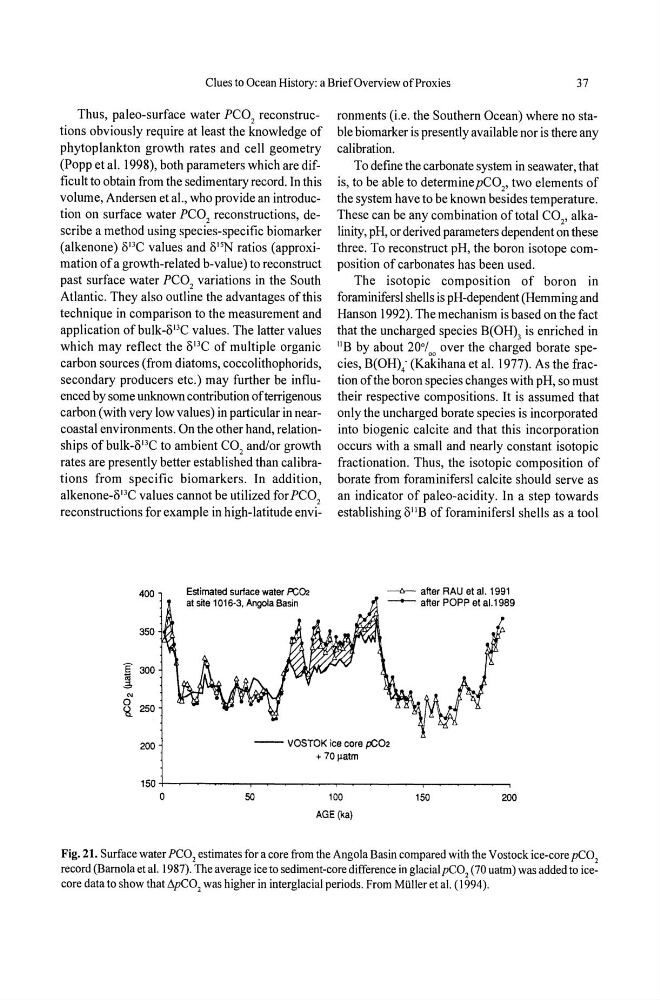
Fig. 21. Surface water PC0 2 estimates for a core from the Angola Basin compared with the Vostock ice-core pC0 2
record (Barnola et al. 1987). The average ice to sediment-core difference in glacial pC0 2 (70 uatm) was added to icecore data to show that t1pC0 2 was higher in interglacial periods. From Miiller et al. (1994).
37
Thus, paleo-surface water PC0 2 reconstructions obviously require at least the knowledge of
phytoplankton growth rates and cell geometry
(Popp et al. 1998), both parameters which are difficult to obtain from the sedimentary record. In this
volume, Andersen et aI., who provide an introduction on surface water PC0 2 reconstructions, describe a method using species-specific biomarker
(alkenone) liI3C values and lilSN ratios (approximation of a growth-related b-value) to reconstruct
past surface water PC0 2 variations in the South
Atlantic. They also outline the advantages of this
technique in comparison to the measurement and
application ofbulk-liI3C values. The latter values
which may reflect the lil3C of multiple organic
carbon sources (from diatoms, coccolithophorids,
secondary producers etc.) may further be influenced by some unknown contribution of terrigenous
carbon (with very low values) in particular in nearcoastal environments. On the other hand, relationships ofbulk-liI3C to ambient CO 2 and/or growth
rates are presently better established than calibrations from specific biomarkers. In addition,
alkenone-liI3C values cannot be utilized for PC0 2
reconstructions for example in high-latitude envi400
Estimated surface water PC02
at site 1016-3, Angola Basin
350
E
~
300
OJ
0 250
15.
ronments (i.e. the Southern Ocean) where no stable biomarker is presently available nor is there any
calibration.
To define the carbonate system in seawater, that
is, to be able to determinepC0 2 , two elements of
the system have to be known besides temperature.
These can be any combination of total CO 2 , alkalinity, pH, or derived parameters dependent on these
three. To reconstruct pH, the boron isotope composition of carbonates has been used.
The isotopic composition of boron in
foraminifersl shells is pH-dependent (Hemming and
Hanson 1992). The mechanism is based on the fact
that the uncharged species B(OH)3 is enriched in
liB by about 20 0 / 00 over the charged borate species, B(OH); (Kakihana et al. 1977). As the fraction ofthe boron species changes with pH, so must
their respective compositions. It is assumed that
only the uncharged borate species is incorporated
into biogenic calcite and that this incorporation
occurs with a small and nearly constant isotopic
fractionation. Thus, the isotopic composition of
borate from foraminifersl calcite should serve as
an indicator of paleo-acidity. In a step towards
establishing lillB of foraminifersl shells as a tool
200
- - VOSTOK ice core {CO2
+ 70 ~atm
150
0
50
100
150
200
AGE (ka)
Fig. 21. Surface water PC0 2 estimates for a core from the Angola Basin compared with the Vostock ice-core pC0 2
record (Barnola et al. 1987). The average ice to sediment-core difference in glacial pC0 2 (70 uatm) was added to icecore data to show that t1pC0 2 was higher in interglacial periods. From Miiller et al. (1994).