

Reconstruction of Surface Ocean Nitrate Utilization
461
b)
8
28
26
G
0
24 ;:en
en
22
10
9
'0'8
20
~
z 7
III
~ 6
5
5
-
4
4 ~
- c:
3
a
..0 .....
ro
2
<.)
.52
c:
ro
1
OJ
.....
0
0
0
50
100
150
200
250
300
Age (kyr)
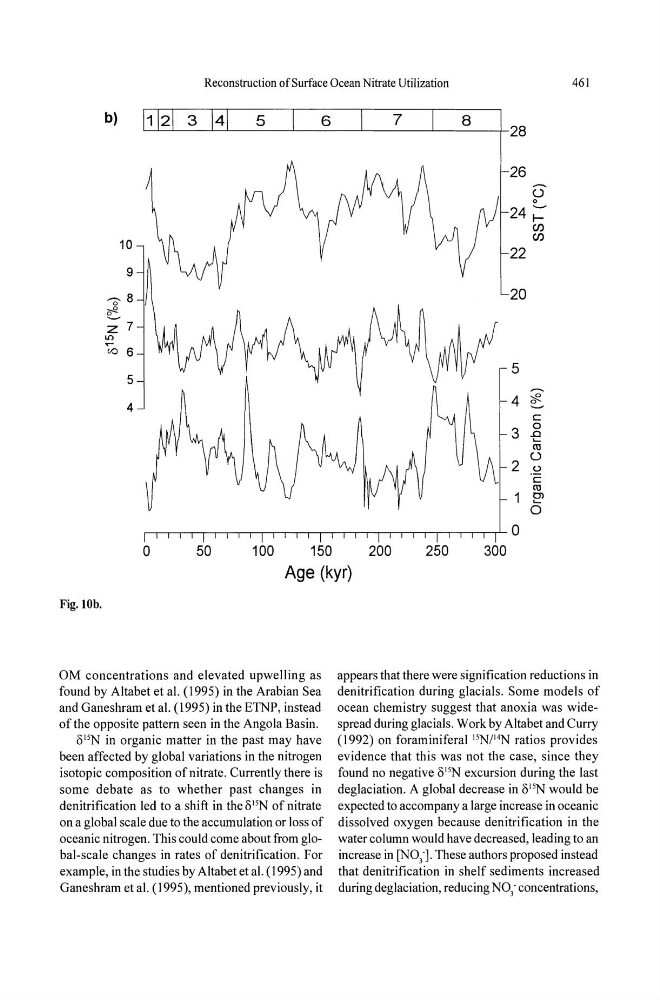
Fig. lOb.
OM concentrations and elevated upwelling as
found by Altabet et al. (1995) in the Arabian Sea
and Ganeshram et al. (1995) in the EINP, instead
of the opposite pattern seen in the Angola Basin.
8 15 N in organic matter in the past may have
been affected by global variations in the nitrogen
isotopic composition of nitrate. Currently there is
some debate as to whether past changes in
denitrification led to a shift in the 8 15 N of nitrate
on a global scale due to the accumulation or loss of
oceanic nitrogen. This could come about from global-scale changes in rates of denitrification. For
example, in the studies by Altabetet al. (1995) and
Ganeshram et al. (1995), mentioned previously, it
appears that there were signification reductions in
denitrification during glacials. Some models of
ocean chemistry suggest that anoxia was widespread during glacials. Work by Altabet and Curry
(1992) on foraminiferal 15 N/14N ratios provides
evidence that this was not the case, since they
found no negative 8 15 N excursion during the last
deglaciation. A global decrease in 8 15 N would be
expected to accompany a large increase in oceanic
dissolved oxygen because denitrification in the
water column would have decreased, leading to an
increase in [N03']. These authors proposed instead
that denitrification in shelf sediments increased
during deglaciation, reducing NO; concentrations,
461
b)
8
28
26
G
0
24 ;:en
en
22
10
9
'0'8
20
~
z 7
III
~ 6
5
5
-
4
4 ~
- c:
3
a
..0 .....
ro
2
<.)
.52
c:
ro
1
OJ
.....
0
0
0
50
100
150
200
250
300
Age (kyr)
Fig. lOb.
OM concentrations and elevated upwelling as
found by Altabet et al. (1995) in the Arabian Sea
and Ganeshram et al. (1995) in the EINP, instead
of the opposite pattern seen in the Angola Basin.
8 15 N in organic matter in the past may have
been affected by global variations in the nitrogen
isotopic composition of nitrate. Currently there is
some debate as to whether past changes in
denitrification led to a shift in the 8 15 N of nitrate
on a global scale due to the accumulation or loss of
oceanic nitrogen. This could come about from global-scale changes in rates of denitrification. For
example, in the studies by Altabetet al. (1995) and
Ganeshram et al. (1995), mentioned previously, it
appears that there were signification reductions in
denitrification during glacials. Some models of
ocean chemistry suggest that anoxia was widespread during glacials. Work by Altabet and Curry
(1992) on foraminiferal 15 N/14N ratios provides
evidence that this was not the case, since they
found no negative 8 15 N excursion during the last
deglaciation. A global decrease in 8 15 N would be
expected to accompany a large increase in oceanic
dissolved oxygen because denitrification in the
water column would have decreased, leading to an
increase in [N03']. These authors proposed instead
that denitrification in shelf sediments increased
during deglaciation, reducing NO; concentrations,