

428
Mulitza et a!.
changes, it is necessary to understand the oceanic
carbon system. An important tracer of the carbon
system is the ratio of the stable carbon isotopes IlCI
l2C. Through the fractionation effects involved in
the transfer of carbon between reservoirs, this ratio yields important information regarding the environment from which a sample comes. Like many
marine organisms, single-celled planktic
foraminifera use the dissolved carbon to build their
calcium carbonate skeletons. For this reason, and
because they are widely distributed on the sea floor,
planktic foraminifera have the potential to preserve
the carbon isotope ratios of ancient water masses
in their shells and to provide information about the
past oceanic carbon system and its role in climate
change. This paper reviews the present-day distribution of 8 1l C in the ocean, the recording of 8 1l C
by planktic foraminifera and the late Quaternary
carbon isotope record of planktic foraminifera in the
tropical and South Atlantic.
Carbon Isotopes
Isotopes are variations of an element containing
different numbers of neutrons. There are three different carbon isotopes: l2C, IlC and l4C. l2C is the
most abundant, while l3C and l4C only comprise 1 %
and 10. 10 % of the total carbon, respectively. Our
study concentrates on the two stable isotopes l2C
and l3C. Due to the different atomic weight,
fractionation during the geochemical transfer of
carbon produces variations in the distribution of the
isotopes of carbon. Craig (1953) first identified that
certain biochemical processes alter the equilibrium
between the carbon isotopes. Some processes, such
as photosynthesis, favor one isotope over another,
so after photosynthesis, the isotope l3C is depleted
by 1.8% in comparison to its natural ratios in the
atmosphere (Harkness 1979). Conversely, the inorganic carbon dissolved in the oceans is generally
enriched by 0.7% in l3C relative to atmospheric
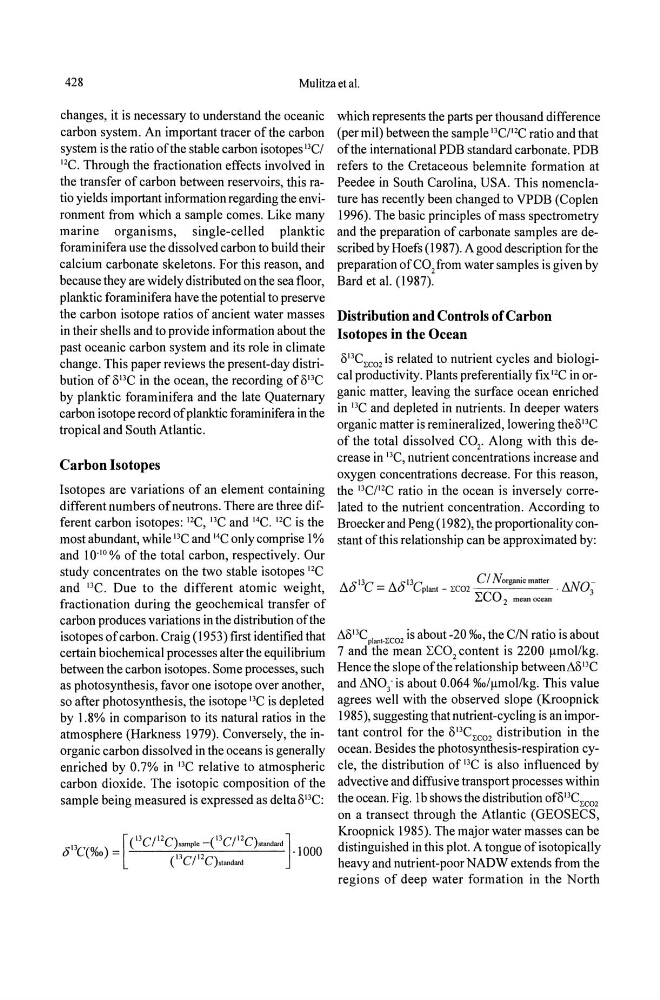
carbon dioxide. The isotopic composition of the
sample being measured is expressed as delta8llC:
which represents the parts per thousand difference
(per mil) between the sample llet l2 C ratio and that
ofthe international PDB standard carbonate. PDB
refers to the Cretaceous belemnite formation at
Peedee in South Carolina, USA. This nomenclature has recently been changed to VPDB (Coplen
1996). The basic principles of mass spectrometry
and the preparation of carbonate samples are described by Hoefs (1987). A good description for the
preparation of CO 2 from water samples is given by
Bard et aI. (1987).
Distribution and Controls of Carbon
Isotopes in the Ocean
8IlC~C02 is related to nutrient cycles and biological productivity. Plants preferentially fix l2C in organic matter, leaving the surface ocean enriched
in IlC and depleted in nutrients. In deeper waters
organic matter is remineralized, lowering the81lC
of the total dissolved CO 2 . Along with this decrease in l3C, nutrient concentrations increase and
oxygen concentrations decrease. For this reason,
the l3CI'2C ratio in the ocean is inversely correlated to the nutrient concentration. According to
Broecker and Peng (1982), the proportionality constant of this relationship can be approximated by:
A Je'l3c _ A Je'l3c
CI Norganicmatter A ATOUU
- uu
plant - Le02
. IJJ.V' 3
LCO 2 mean ocean
118IlCplant_~C02 is about -20 %0, the C/N ratio is about
7 and the mean LC0 2 content is 2200 Ilmollkg.
Hence the slope ofthe relationship betweenl18 13 C
and I1N0 3 - is about 0.064 %o/llmol/kg. This value
agrees well with the observed slope (Kroopnick
1985), suggesting that nutrient-cycling is an important control for the 8l3C~C02 distribution in the
ocean. Besides the photosynthesis-respiration cycle, the distribution of l3C is also influenced by
advective and diffusive transport processes within
the ocean. Fig. 1 b shows the distribution of813Cl:C02
on a transect through the Atlantic (GEOSECS,
Kroopnick 1985). The major water masses can be
distinguished in this plot. A tongue of isotopically
heavy and nutrient-poor NADW extends from the
regions of deep water formation in the North
Mulitza et a!.
changes, it is necessary to understand the oceanic
carbon system. An important tracer of the carbon
system is the ratio of the stable carbon isotopes IlCI
l2C. Through the fractionation effects involved in
the transfer of carbon between reservoirs, this ratio yields important information regarding the environment from which a sample comes. Like many
marine organisms, single-celled planktic
foraminifera use the dissolved carbon to build their
calcium carbonate skeletons. For this reason, and
because they are widely distributed on the sea floor,
planktic foraminifera have the potential to preserve
the carbon isotope ratios of ancient water masses
in their shells and to provide information about the
past oceanic carbon system and its role in climate
change. This paper reviews the present-day distribution of 8 1l C in the ocean, the recording of 8 1l C
by planktic foraminifera and the late Quaternary
carbon isotope record of planktic foraminifera in the
tropical and South Atlantic.
Carbon Isotopes
Isotopes are variations of an element containing
different numbers of neutrons. There are three different carbon isotopes: l2C, IlC and l4C. l2C is the
most abundant, while l3C and l4C only comprise 1 %
and 10. 10 % of the total carbon, respectively. Our
study concentrates on the two stable isotopes l2C
and l3C. Due to the different atomic weight,
fractionation during the geochemical transfer of
carbon produces variations in the distribution of the
isotopes of carbon. Craig (1953) first identified that
certain biochemical processes alter the equilibrium
between the carbon isotopes. Some processes, such
as photosynthesis, favor one isotope over another,
so after photosynthesis, the isotope l3C is depleted
by 1.8% in comparison to its natural ratios in the
atmosphere (Harkness 1979). Conversely, the inorganic carbon dissolved in the oceans is generally
enriched by 0.7% in l3C relative to atmospheric
carbon dioxide. The isotopic composition of the
sample being measured is expressed as delta8llC:
which represents the parts per thousand difference
(per mil) between the sample llet l2 C ratio and that
ofthe international PDB standard carbonate. PDB
refers to the Cretaceous belemnite formation at
Peedee in South Carolina, USA. This nomenclature has recently been changed to VPDB (Coplen
1996). The basic principles of mass spectrometry
and the preparation of carbonate samples are described by Hoefs (1987). A good description for the
preparation of CO 2 from water samples is given by
Bard et aI. (1987).
Distribution and Controls of Carbon
Isotopes in the Ocean
8IlC~C02 is related to nutrient cycles and biological productivity. Plants preferentially fix l2C in organic matter, leaving the surface ocean enriched
in IlC and depleted in nutrients. In deeper waters
organic matter is remineralized, lowering the81lC
of the total dissolved CO 2 . Along with this decrease in l3C, nutrient concentrations increase and
oxygen concentrations decrease. For this reason,
the l3CI'2C ratio in the ocean is inversely correlated to the nutrient concentration. According to
Broecker and Peng (1982), the proportionality constant of this relationship can be approximated by:
A Je'l3c _ A Je'l3c
CI Norganicmatter A ATOUU
- uu
plant - Le02
. IJJ.V' 3
LCO 2 mean ocean
118IlCplant_~C02 is about -20 %0, the C/N ratio is about
7 and the mean LC0 2 content is 2200 Ilmollkg.
Hence the slope ofthe relationship betweenl18 13 C
and I1N0 3 - is about 0.064 %o/llmol/kg. This value
agrees well with the observed slope (Kroopnick
1985), suggesting that nutrient-cycling is an important control for the 8l3C~C02 distribution in the
ocean. Besides the photosynthesis-respiration cycle, the distribution of l3C is also influenced by
advective and diffusive transport processes within
the ocean. Fig. 1 b shows the distribution of813Cl:C02
on a transect through the Atlantic (GEOSECS,
Kroopnick 1985). The major water masses can be
distinguished in this plot. A tongue of isotopically
heavy and nutrient-poor NADW extends from the
regions of deep water formation in the North