

32
Weferetal.
tion as to whether the correlations are stable from
one ocean basin to another, and through geologic
time. Fundamentally, the reason for the correlation
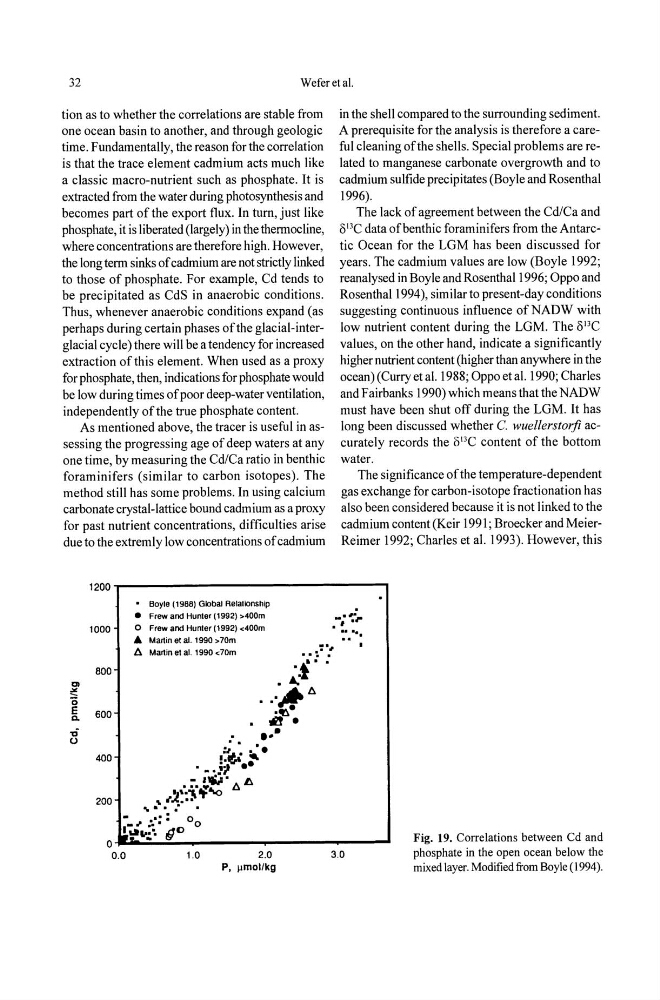
is that the trace element cadmium acts much like
a classic macro-nutrient such as phosphate. It is
extracted from the water during photosynthesis and
becomes part of the export flux. In tum, just like
phosphate, it is liberated (largely) in the thermocline,
where concentrations are therefore high. However,
the long term sinks of cadmium are not strictly linked
to those of phosphate. For example, Cd tends to
be precipitated as CdS in anaerobic conditions.
Thus, whenever anaerobic conditions expand (as
perhaps during certain phases ofthe glacial-interglacial cycle) there will be a tendency for increased
extraction of this element. When used as a proxy
for phosphate, then, indications for phosphate would
be low during times of poor deep-water ventilation,
independently of the true phosphate content.
As mentioned above, the tracer is useful in assessing the progressing age of deep waters at any
one time, by measuring the Cd/Ca ratio in benthic
foraminifers (similar to carbon isotopes). The
method still has some problems. In using calcium
carbonate crystal-lattice bound cadmium as a proxy
for past nutrient concentrations, difficulties arise
due to the extremly low concentrations of cadmium
in the shell compared to the surrounding sediment.
A prerequisite for the analysis is therefore a careful cleaning ofthe shells. Special problems are related to manganese carbonate overgrowth and to
cadmium sulfide precipitates (Boyle and Rosenthal
1996).
The lack of agreement between the Cd/Ca and
& l3 C data of benthic foraminifers from the Antarctic Ocean for the LGM has been discussed for
years. The cadmium values are low (Boyle 1992;
reanalysed in Boyle and Rosenthal 1996; Oppo and
Rosenthal 1994), sim ilar to present-day conditions
suggesting continuous influence ofNADW with
low nutrient content during the LGM. The &13C
values, on the other hand, indicate a significantly
higher nutrient content (higher than anywhere in the
ocean)(CurryetaI. 1988;Oppoetal. 1990; Charles
and Fairbanks 1990) which means that the NADW
must have been shut off during the LGM. It has
long been discussed whether C. wuellerstorfi accurately records the &l3C content of the bottom
water.
The significance ofthe temperature-dependent
gas exchange for carbon-isotope fractionation has
also been considered because it is not linked to the
cadmium content (Keir 1991; Broecker and MeierReimer 1992; Charles et al. 1993). However, this
1200~--------------------------------'
""
~
"0
E
Co
,;
U
1000
800
600
400
200
• Boyle (1988) Global Relalionship
-
Frew and Hunter(1992) >400m
o Frew and Hunter (1992) <400m
•
Martin et al. 1990 > 70m
.-; ~.:'. -'I
I:;. Martin et al. 1990 < 70m
.:'.,
. '. .
'! .
.-'
,·AI:;. .tt;.'Ii! -
. . ...
:;'~ .' .
I.~ "
. i;t.- ;,,==. I!.
• ~'.j';"o.o I:;.
, .. l ...
.. II . :
•
-_ ' " ::=: 00
~~'":~ GO
o~~~~~------~------~----~
0.0
1.0
2.0
3.0
P, ~mollkg
Fig. 19. Correlations between Cd and
phosphate in the open ocean below the
mixed layer. Modified from Boyle (1994).
Weferetal.
tion as to whether the correlations are stable from
one ocean basin to another, and through geologic
time. Fundamentally, the reason for the correlation
is that the trace element cadmium acts much like
a classic macro-nutrient such as phosphate. It is
extracted from the water during photosynthesis and
becomes part of the export flux. In tum, just like
phosphate, it is liberated (largely) in the thermocline,
where concentrations are therefore high. However,
the long term sinks of cadmium are not strictly linked
to those of phosphate. For example, Cd tends to
be precipitated as CdS in anaerobic conditions.
Thus, whenever anaerobic conditions expand (as
perhaps during certain phases ofthe glacial-interglacial cycle) there will be a tendency for increased
extraction of this element. When used as a proxy
for phosphate, then, indications for phosphate would
be low during times of poor deep-water ventilation,
independently of the true phosphate content.
As mentioned above, the tracer is useful in assessing the progressing age of deep waters at any
one time, by measuring the Cd/Ca ratio in benthic
foraminifers (similar to carbon isotopes). The
method still has some problems. In using calcium
carbonate crystal-lattice bound cadmium as a proxy
for past nutrient concentrations, difficulties arise
due to the extremly low concentrations of cadmium
in the shell compared to the surrounding sediment.
A prerequisite for the analysis is therefore a careful cleaning ofthe shells. Special problems are related to manganese carbonate overgrowth and to
cadmium sulfide precipitates (Boyle and Rosenthal
1996).
The lack of agreement between the Cd/Ca and
& l3 C data of benthic foraminifers from the Antarctic Ocean for the LGM has been discussed for
years. The cadmium values are low (Boyle 1992;
reanalysed in Boyle and Rosenthal 1996; Oppo and
Rosenthal 1994), sim ilar to present-day conditions
suggesting continuous influence ofNADW with
low nutrient content during the LGM. The &13C
values, on the other hand, indicate a significantly
higher nutrient content (higher than anywhere in the
ocean)(CurryetaI. 1988;Oppoetal. 1990; Charles
and Fairbanks 1990) which means that the NADW
must have been shut off during the LGM. It has
long been discussed whether C. wuellerstorfi accurately records the &l3C content of the bottom
water.
The significance ofthe temperature-dependent
gas exchange for carbon-isotope fractionation has
also been considered because it is not linked to the
cadmium content (Keir 1991; Broecker and MeierReimer 1992; Charles et al. 1993). However, this
1200~--------------------------------'
""
~
"0
E
Co
,;
U
1000
800
600
400
200
• Boyle (1988) Global Relalionship
-
Frew and Hunter(1992) >400m
o Frew and Hunter (1992) <400m
•
Martin et al. 1990 > 70m
.-; ~.:'. -'I
I:;. Martin et al. 1990 < 70m
.:'.,
. '. .
'! .
.-'
,·AI:;. .tt;.'Ii! -
. . ...
:;'~ .' .
I.~ "
. i;t.- ;,,==. I!.
• ~'.j';"o.o I:;.
, .. l ...
.. II . :
•
-_ ' " ::=: 00
~~'":~ GO
o~~~~~------~------~----~
0.0
1.0
2.0
3.0
P, ~mollkg
Fig. 19. Correlations between Cd and
phosphate in the open ocean below the
mixed layer. Modified from Boyle (1994).