

412
Frank et al.
12~h", adsorbed to particles (vertical flux) I
fP
fP
+FP
I bottom currents I~
Fa Fp-Fw ~Fa FP~Fa Fp+Ff
eroded +
winnowed ~undisturbed~ focused
sediments ~ sediments ~sediments
'f' FalFp < I ~ 'I' FalFp l~ 'f' FalFp> 1
North Atlantic (Francois and Bacon 1994) and peak
opal productivity periods in the Atlantic sector of
the Antarctic Zone of the ACC (Frank et al. 1996).
There are, however, several assumptions and
problems that lead to uncertainties in calculating rain
rates. The correction of the accumulation rates of
components, such as biogenic carbonate or opal
based on the 230Th", flux (eq.l ), does not account
for the differential dissolution of these compounds
because the ratio between the weight fraction of
carbonate or opal and the initial concentration of
23 0 Th" is changed by this process (Yang et al.
1990). Therefore, the resulting rain rates are referred to as "preserved" or "buried" rain rates
(Kumar 1994). [n addition, a fractionation of part icles may occur during the redistribution depending
on their grain sizes which results in a preferential
dislocation of fine - grained particles that carry
more adsorbed 230Th ex as compared to coarser
grained ones (Scholten et al. 1994). As a consequence, the rain rates represent minimum estimations in the case offocussing, and maximum estimations in the case of winnowing (Frank et al.
1996). We expect the effects of grain size
fractionation to decrease with increasing bottom
current speeds (above about 10 cm/s, see Pudsey
1992) because then all size fractions would be dislocated to the same extent (Frank et at. 1995).
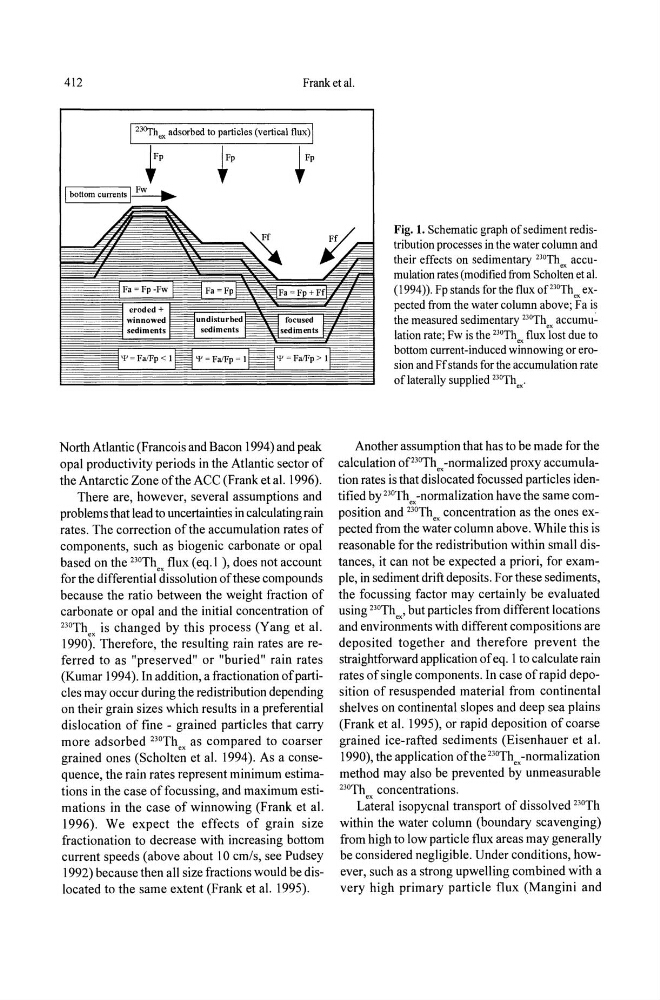
Fig. L Schematic graph of sediment redistribution processes in the water column and
their effects on sedimentary 230Th accumulation rates (modified from Scholt~n et al.
(1994». Fp stands for the flux of 23 °Th expected from the water column above; Fa is
the measured sedimentary 230Th accumulation rate; Fw is the 2JOTh" flux 'fost due to
bottom current-induced winnowing or erosion and Ff stands for the accumulation rate
oflaterally supplied 23°Th",.
Another assumption that has to be made for the
calculation of 230 The x-normalized proxy accumulation rates is that dislocated focussed particles identified by 23°Th cx -normalization have the same composition and 230Th", concentration as the ones expected from the water column above. While this is
reasonable for the redistribution within small distances, it can not be expected a priori, for example, in sediment drift deposits. For these sediments,
the focussing factor may certainly be evaluated
using 230Th", but particles from different locations
and environments with different compositions are
deposited together and therefore prevent the
straightforward application of eq. 1 to calculate rain
rates of single components. In case of rapid deposition of resuspended material from continental
shelves on continental slopes and deep sea plains
(Frank et al. 1995), or rapid deposition of coarse
grained ice-rafted sediments (Eisenhauer et at.
1990), the application ofthe230Thex-normalization
method may also be prevented by unmeasurable
230Th concentrations.
ox
Lateral isopycnal transport of dissolved 23°Th
within the water column (boundary scavenging)
from high to low particle flux areas may generally
be considered negligible. Under conditions, however, such as a strong upwelling combined with a
very high primary particle flux (Mangini and
Frank et al.
12~h", adsorbed to particles (vertical flux) I
fP
fP
+FP
I bottom currents I~
Fa Fp-Fw ~Fa FP~Fa Fp+Ff
eroded +
winnowed ~undisturbed~ focused
sediments ~ sediments ~sediments
'f' FalFp < I ~ 'I' FalFp l~ 'f' FalFp> 1
North Atlantic (Francois and Bacon 1994) and peak
opal productivity periods in the Atlantic sector of
the Antarctic Zone of the ACC (Frank et al. 1996).
There are, however, several assumptions and
problems that lead to uncertainties in calculating rain
rates. The correction of the accumulation rates of
components, such as biogenic carbonate or opal
based on the 230Th", flux (eq.l ), does not account
for the differential dissolution of these compounds
because the ratio between the weight fraction of
carbonate or opal and the initial concentration of
23 0 Th" is changed by this process (Yang et al.
1990). Therefore, the resulting rain rates are referred to as "preserved" or "buried" rain rates
(Kumar 1994). [n addition, a fractionation of part icles may occur during the redistribution depending
on their grain sizes which results in a preferential
dislocation of fine - grained particles that carry
more adsorbed 230Th ex as compared to coarser
grained ones (Scholten et al. 1994). As a consequence, the rain rates represent minimum estimations in the case offocussing, and maximum estimations in the case of winnowing (Frank et al.
1996). We expect the effects of grain size
fractionation to decrease with increasing bottom
current speeds (above about 10 cm/s, see Pudsey
1992) because then all size fractions would be dislocated to the same extent (Frank et at. 1995).
Fig. L Schematic graph of sediment redistribution processes in the water column and
their effects on sedimentary 230Th accumulation rates (modified from Scholt~n et al.
(1994». Fp stands for the flux of 23 °Th expected from the water column above; Fa is
the measured sedimentary 230Th accumulation rate; Fw is the 2JOTh" flux 'fost due to
bottom current-induced winnowing or erosion and Ff stands for the accumulation rate
oflaterally supplied 23°Th",.
Another assumption that has to be made for the
calculation of 230 The x-normalized proxy accumulation rates is that dislocated focussed particles identified by 23°Th cx -normalization have the same composition and 230Th", concentration as the ones expected from the water column above. While this is
reasonable for the redistribution within small distances, it can not be expected a priori, for example, in sediment drift deposits. For these sediments,
the focussing factor may certainly be evaluated
using 230Th", but particles from different locations
and environments with different compositions are
deposited together and therefore prevent the
straightforward application of eq. 1 to calculate rain
rates of single components. In case of rapid deposition of resuspended material from continental
shelves on continental slopes and deep sea plains
(Frank et al. 1995), or rapid deposition of coarse
grained ice-rafted sediments (Eisenhauer et at.
1990), the application ofthe230Thex-normalization
method may also be prevented by unmeasurable
230Th concentrations.
ox
Lateral isopycnal transport of dissolved 23°Th
within the water column (boundary scavenging)
from high to low particle flux areas may generally
be considered negligible. Under conditions, however, such as a strong upwelling combined with a
very high primary particle flux (Mangini and