

402
Walteretal.
of 230Th over 231Pa on particles. The F-factor is
defined as
(5)
The few data on F-factors available from the
literature (Anderson et al. 1983a,b; Nozaki and
Nakanishi 1985; Scholten et al. 1995) show that
this assumption holds for large areas of the world's
oceans. However, in the Atlantic Sector of the
Southern Ocean it has been shown to be no longer
valid (Rutgers van der Loeff and Berger 1993;
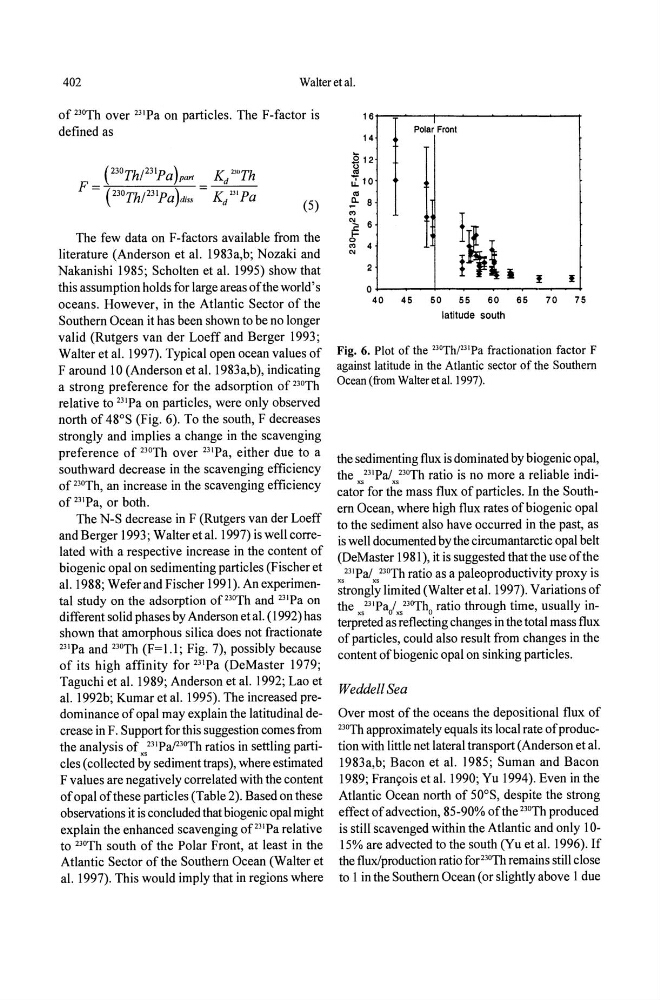
Walter et al. 1997). Typical open ocean values of
F around 10 (Anderson et al. 1983a,b), indicating
a strong preference for the adsorption of 23°Th
relative to 231Pa on particles, were only observed
north of 48°S (Fig. 6). To the south, F decreases
strongly and implies a change in the scavenging
preference of 23°Th over 231Pa, either due to a
southward decrease in the scavenging efficiency
of 23 0Th, an increase in the scavenging efficiency
of 231Pa, or both.
The N-S decrease in F (Rutgers van der Loeff
and Berger 1993; Walter et al. 1997) is well correlated with a respective increase in the content of
biogenic opal on sedimenting particles (Fischer et
al. 1988; Wefer and Fischer1991). An experimental study on the adsorption of2 3 0Th and 231Pa on
different solid phases by Anderson et al. (1992) has
shown that amorphous silica does not fractionate
231Pa and 230Th (F=l.l; Fig. 7), possibly because
of its high affinity for 231Pa (DeMaster 1979;
Taguchi et al. 1989; Anderson et al. 1992; Lao et
al. 1992b; Kumar et al. 1995). The increased predominance of opal may explain the latitudinal decrease in F. Support forthis suggestion comes from
the analysis of ,,23 I PaJ230Th ratios in settling particles (collected by sediment traps), where estimated
F values are negatively correlated with the content
of opal of these particles (Table 2). Based on these
observations it is concluded that biogenic opal might
explain the enhanced scavenging op31Pa relative
to 230Th south of the Polar Front, at least in the
Atlantic Sector of the Southern Ocean (Walter et
al. 1997). This would imply that in regions where
16
POlar
l Front
14
I
.9 12
0
' "
;:[ 10
' "
!=- 8
'"
i~l
1: 6
~
0
'"
4
'"
i
f
~
0
40
45
50
55
60
65
70
75
latitude south
Fig. 6. Plot of the 230Thp3lPa fractionation factor F
against latitude in the Atlantic sector of the Southern
Ocean (from Walter et al. 1997).
the sedimenting flux is dominated by biogenic opal,
the 231paJ 230Th ratio is no more a reliable indixs
xs
cator for the mass flux of particles. In the Southern Ocean, where high flux rates of biogenic opal
to the sediment also have occurred in the past, as
is well documented by the circumantarctic opal belt
(DeMaster 1981), it is suggested that the use ofthe
,,23IPaJ,,230Th ratio as a paleoproductivity proxy is
strongly limited (Walter et al. 1997). Variations of
the ,, 23I Pa/ x ,230Th o ratio through time, usually interpreted as reflecting changes in the total mass flux
of particles, could also result from changes in the
content ofbiogenic opal on sinking particles.
Weddell Sea
Over most of the oceans the depositional flux of
23 0 Th approximately equals its local rate of production with little net lateral transport (Anderson et al.
1983a,b; Bacon et al. 1985; Suman and Bacon
1989; Franyois et al. 1990; Yu 1994). Even in the
Atlantic Ocean north of 50 0 S, despite the strong
effect of advection, 85-90% of the 230Th produced
is still scavenged within the Atlantic and only 1015% are advected to the south (Yu et al. 1996). If
the flux/production ratio for 23 0Th remains still close
to 1 in the Southern Ocean (or slightly above 1 due
Walteretal.
of 230Th over 231Pa on particles. The F-factor is
defined as
(5)
The few data on F-factors available from the
literature (Anderson et al. 1983a,b; Nozaki and
Nakanishi 1985; Scholten et al. 1995) show that
this assumption holds for large areas of the world's
oceans. However, in the Atlantic Sector of the
Southern Ocean it has been shown to be no longer
valid (Rutgers van der Loeff and Berger 1993;
Walter et al. 1997). Typical open ocean values of
F around 10 (Anderson et al. 1983a,b), indicating
a strong preference for the adsorption of 23°Th
relative to 231Pa on particles, were only observed
north of 48°S (Fig. 6). To the south, F decreases
strongly and implies a change in the scavenging
preference of 23°Th over 231Pa, either due to a
southward decrease in the scavenging efficiency
of 23 0Th, an increase in the scavenging efficiency
of 231Pa, or both.
The N-S decrease in F (Rutgers van der Loeff
and Berger 1993; Walter et al. 1997) is well correlated with a respective increase in the content of
biogenic opal on sedimenting particles (Fischer et
al. 1988; Wefer and Fischer1991). An experimental study on the adsorption of2 3 0Th and 231Pa on
different solid phases by Anderson et al. (1992) has
shown that amorphous silica does not fractionate
231Pa and 230Th (F=l.l; Fig. 7), possibly because
of its high affinity for 231Pa (DeMaster 1979;
Taguchi et al. 1989; Anderson et al. 1992; Lao et
al. 1992b; Kumar et al. 1995). The increased predominance of opal may explain the latitudinal decrease in F. Support forthis suggestion comes from
the analysis of ,,23 I PaJ230Th ratios in settling particles (collected by sediment traps), where estimated
F values are negatively correlated with the content
of opal of these particles (Table 2). Based on these
observations it is concluded that biogenic opal might
explain the enhanced scavenging op31Pa relative
to 230Th south of the Polar Front, at least in the
Atlantic Sector of the Southern Ocean (Walter et
al. 1997). This would imply that in regions where
16
POlar
l Front
14
I
.9 12
0
' "
;:[ 10
' "
!=- 8
'"
i~l
1: 6
~
0
'"
4
'"
i
f
~
0
40
45
50
55
60
65
70
75
latitude south
Fig. 6. Plot of the 230Thp3lPa fractionation factor F
against latitude in the Atlantic sector of the Southern
Ocean (from Walter et al. 1997).
the sedimenting flux is dominated by biogenic opal,
the 231paJ 230Th ratio is no more a reliable indixs
xs
cator for the mass flux of particles. In the Southern Ocean, where high flux rates of biogenic opal
to the sediment also have occurred in the past, as
is well documented by the circumantarctic opal belt
(DeMaster 1981), it is suggested that the use ofthe
,,23IPaJ,,230Th ratio as a paleoproductivity proxy is
strongly limited (Walter et al. 1997). Variations of
the ,, 23I Pa/ x ,230Th o ratio through time, usually interpreted as reflecting changes in the total mass flux
of particles, could also result from changes in the
content ofbiogenic opal on sinking particles.
Weddell Sea
Over most of the oceans the depositional flux of
23 0 Th approximately equals its local rate of production with little net lateral transport (Anderson et al.
1983a,b; Bacon et al. 1985; Suman and Bacon
1989; Franyois et al. 1990; Yu 1994). Even in the
Atlantic Ocean north of 50 0 S, despite the strong
effect of advection, 85-90% of the 230Th produced
is still scavenged within the Atlantic and only 1015% are advected to the south (Yu et al. 1996). If
the flux/production ratio for 23 0Th remains still close
to 1 in the Southern Ocean (or slightly above 1 due