

Reliability of the 231Pa P 30 Th Activity Ratio
399
deposition) of dated sediment cores have been used
to assess variability through time of particle fluxes
as an indicator for paleoproductivity (Lao et al.
1992b; Kumar et al. 1993, 1995; Franc;ois et al.
1993; Kumar 1994; Yu 1994; Yang et al. 1995).
Lao et al. (1992b) have applied this model in the
Pacific Ocean over the last 25000 years. They
found higher ,,231Paixs230Tho ratios in open ocean
sediments during the last glacial period, which were
partly compensated by lower x,231Paix/30Tho ratios at the margins. These findings were interpreted
as reflecting reduced boundary scavenging op31Pa
during the last glacial period, caused by a generally higher particle flux, thus enabling more 231 Pa
to be scavenged in the open ocean waters.
Atlantic Ocean
A comprehensive study of x,231Pa! xs 230Th ratios in
Holocene sediments by Yu et al. (1996) has revealed that, in contrast to the Pacific, boundary
scavenging is suppressed in the Atlantic (Fig. 5a)
(compiled data are from Ku 1966; Ku et al. 1972;
DeMaster 1979; Bacon and Rosholt 1982;
Anderson et al. 1983, 1994; Mangini and
Dieter-Haass 1983; Kumar 1994; Legeleux 1994;
Yu 1994; Scholten et al. 1995; Walter et a11997;
Scholten unpubl. Data are available under
www.pangaea.de/Projects/SFB261). Even in
the upwelling region off Western Africa where
the primary production reaches values of more than
200 gCm· 2 a·1, the x,231Pa! xs230Th ratios of surface
sediments only barely reach their production ratio
in the water column (Fig. 5b). These fmdings agree
well with an earlier study in the same area by
Legeleux (1994) who found evidence for boundary scavenging op31Pa only at one location on the
continental slope (2000m water depth), with a
231Pa! 230Th ratio in the sediment of 0.16 and a
xs
xs
flux/production ratio for 231Pa of 1.4. Yu et al.
(1996) have explained the lack of expression of
intense boundary scavenging in the Atlantic by the
short mean residence time ofNADW (ca. 200
years; Broecker 1979; Stuiver et al. 1984), which
is similar to both the scavenging residence time of
231Pa and the time required for basin-wide lateral
mixing. As a result, diffusive transport and
advection are equally important in removing 231 Pa
from the Atlantic water column. From the mean
231Pa! 230Th ratio in surface sediments north of
xs
xs
50 0 S, they estimate that about half of the 231Pa
produced in the Atlantic north of 50 0 S is deposited
in the underlying sediments and the remainder is
advected to the south within the North Atlantic
Deep Water (NADW). Consequently, in addition
to its local production, Yu et al. (1996) suggest that
the South Atlantic south of 50 0 S receives a fraction of dissolved 231Pa imported from the north that
is scavenged from the water column after entering the Antarctic Circumpolar Current (ACC) south
of 50 oS (Yu et al. 1996, see also chapter Southern
Ocean).
The effect of advection on boundary scavenging can be illustrated by modifying model A in the
way that the interior ocean (i) is ventilated at a rate
v f of 0.005a· 1 (lIv f = 200 years, the estimated residence time of deep waters in the Atlantic) with
water that does not contain any 231Pa and 23 0 Th
(CoP' and CoTh=O), e.g. newly formed NADW
(model B in Fig. 1). All other model parameters are
taken to be equal to model A. The new material
balance for 230Th (again, equivalent eqs. hold for
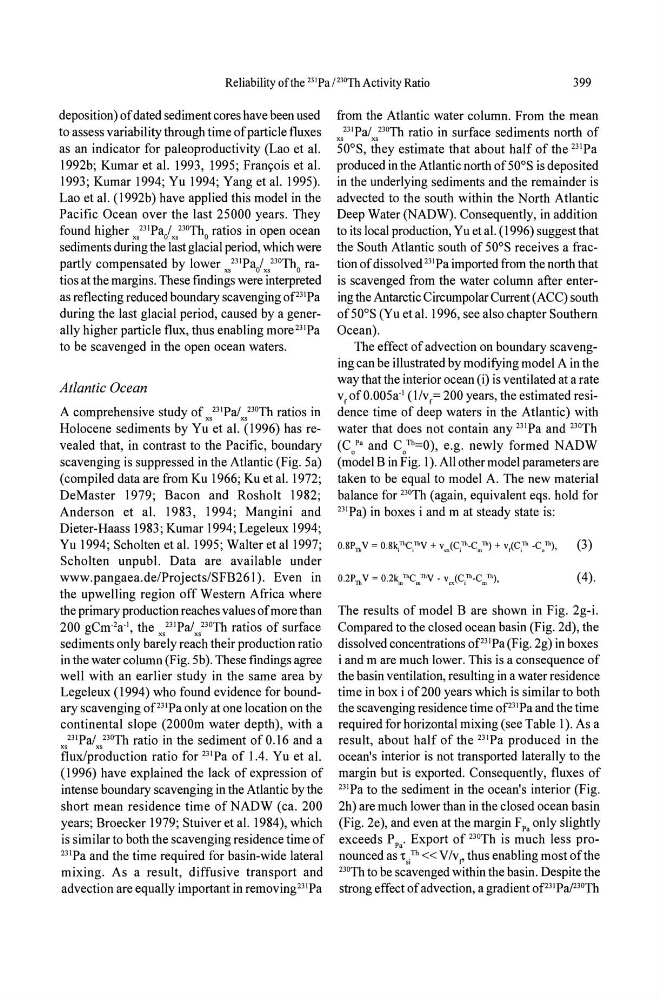
231Pa) in boxes i and m at steady state is:
The results of model B are shown in Fig. 2g-i.
Compared to the closed ocean basin (Fig. 2d), the
dissolved concentrations op31Pa (Fig. 2g) in boxes
i and m are much lower. This is a consequence of
the basin ventilation, resulting in a water residence
time in box i of200 years which is similar to both
the scavenging residence time of231Pa and the time
required for horizontal mixing (see Table 1). As a
result, about half of the 231Pa produced in the
ocean's interior is not transported laterally to the
margin but is exported. Consequently, fluxes of
231Pa to the sediment in the ocean's interior (Fig.
2h) are much lower than in the closed ocean basin
(Fig. 2e), and even at the margin F p, only slightly
exceeds Ppa Export of 230Th is much less pronounced as "iTh «V/v£", thus enabling most ofthe
230Th to be scavenged within the basin. Despite the
strong effect of advection, a gradient of231Paf230Th
399
deposition) of dated sediment cores have been used
to assess variability through time of particle fluxes
as an indicator for paleoproductivity (Lao et al.
1992b; Kumar et al. 1993, 1995; Franc;ois et al.
1993; Kumar 1994; Yu 1994; Yang et al. 1995).
Lao et al. (1992b) have applied this model in the
Pacific Ocean over the last 25000 years. They
found higher ,,231Paixs230Tho ratios in open ocean
sediments during the last glacial period, which were
partly compensated by lower x,231Paix/30Tho ratios at the margins. These findings were interpreted
as reflecting reduced boundary scavenging op31Pa
during the last glacial period, caused by a generally higher particle flux, thus enabling more 231 Pa
to be scavenged in the open ocean waters.
Atlantic Ocean
A comprehensive study of x,231Pa! xs 230Th ratios in
Holocene sediments by Yu et al. (1996) has revealed that, in contrast to the Pacific, boundary
scavenging is suppressed in the Atlantic (Fig. 5a)
(compiled data are from Ku 1966; Ku et al. 1972;
DeMaster 1979; Bacon and Rosholt 1982;
Anderson et al. 1983, 1994; Mangini and
Dieter-Haass 1983; Kumar 1994; Legeleux 1994;
Yu 1994; Scholten et al. 1995; Walter et a11997;
Scholten unpubl. Data are available under
www.pangaea.de/Projects/SFB261). Even in
the upwelling region off Western Africa where
the primary production reaches values of more than
200 gCm· 2 a·1, the x,231Pa! xs230Th ratios of surface
sediments only barely reach their production ratio
in the water column (Fig. 5b). These fmdings agree
well with an earlier study in the same area by
Legeleux (1994) who found evidence for boundary scavenging op31Pa only at one location on the
continental slope (2000m water depth), with a
231Pa! 230Th ratio in the sediment of 0.16 and a
xs
xs
flux/production ratio for 231Pa of 1.4. Yu et al.
(1996) have explained the lack of expression of
intense boundary scavenging in the Atlantic by the
short mean residence time ofNADW (ca. 200
years; Broecker 1979; Stuiver et al. 1984), which
is similar to both the scavenging residence time of
231Pa and the time required for basin-wide lateral
mixing. As a result, diffusive transport and
advection are equally important in removing 231 Pa
from the Atlantic water column. From the mean
231Pa! 230Th ratio in surface sediments north of
xs
xs
50 0 S, they estimate that about half of the 231Pa
produced in the Atlantic north of 50 0 S is deposited
in the underlying sediments and the remainder is
advected to the south within the North Atlantic
Deep Water (NADW). Consequently, in addition
to its local production, Yu et al. (1996) suggest that
the South Atlantic south of 50 0 S receives a fraction of dissolved 231Pa imported from the north that
is scavenged from the water column after entering the Antarctic Circumpolar Current (ACC) south
of 50 oS (Yu et al. 1996, see also chapter Southern
Ocean).
The effect of advection on boundary scavenging can be illustrated by modifying model A in the
way that the interior ocean (i) is ventilated at a rate
v f of 0.005a· 1 (lIv f = 200 years, the estimated residence time of deep waters in the Atlantic) with
water that does not contain any 231Pa and 23 0 Th
(CoP' and CoTh=O), e.g. newly formed NADW
(model B in Fig. 1). All other model parameters are
taken to be equal to model A. The new material
balance for 230Th (again, equivalent eqs. hold for
231Pa) in boxes i and m at steady state is:
The results of model B are shown in Fig. 2g-i.
Compared to the closed ocean basin (Fig. 2d), the
dissolved concentrations op31Pa (Fig. 2g) in boxes
i and m are much lower. This is a consequence of
the basin ventilation, resulting in a water residence
time in box i of200 years which is similar to both
the scavenging residence time of231Pa and the time
required for horizontal mixing (see Table 1). As a
result, about half of the 231Pa produced in the
ocean's interior is not transported laterally to the
margin but is exported. Consequently, fluxes of
231Pa to the sediment in the ocean's interior (Fig.
2h) are much lower than in the closed ocean basin
(Fig. 2e), and even at the margin F p, only slightly
exceeds Ppa Export of 230Th is much less pronounced as "iTh «V/v£", thus enabling most ofthe
230Th to be scavenged within the basin. Despite the
strong effect of advection, a gradient of231Paf230Th