

Reliability of the 231Pa/2JOTh Activity Ratio
397
gin, where it is scavenged more efficiently by the
higher vertical fluxes, resulting in F Pa strongly exceeding P Pa' This simple model illustrates how the
differential partitioning of2 30 Th and 231Pa between
a vertical and a lateral flux leads to a basin-wide
fractionation of the two radionuclides (Fig. 2f). In
the ocean's interior, where particle fluxes are low,
23lpaf230Th ratios on sinking particles do not reach
the production ratio of 0.093, whereas values far
exceed 0.093 at the margin, where particle fluxes
are much higher.
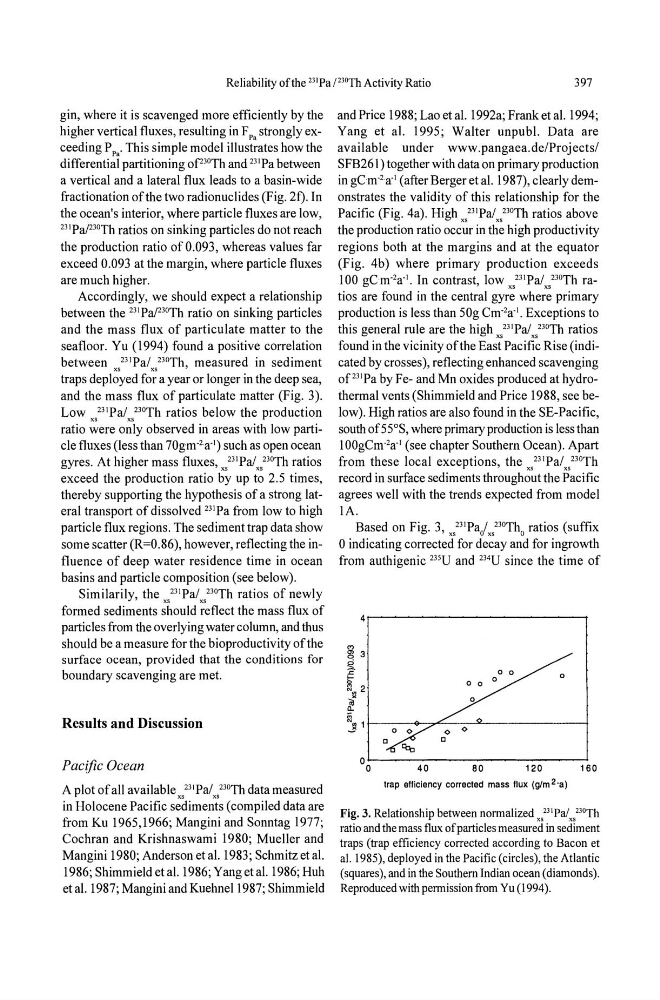
Accordingly, we should expect a relationship
between the 231Paf230Th ratio on sinking particles
and the mass flux of particulate matter to the
seafloor. Yu (1994) found a positive correlation
between xs23IPalx,230Th, measured in sediment
traps deployed for a year or longer in the deep sea,
and the mass flux of particulate matter (Fig. 3).
Low x,23IPal x ,230Th ratios below the production
ratio were only observed in areas with low particle fluxes (less than 70gm- 2 'a- l ) such as open ocean
gyres. At higher mass fluxes, x,23IPal x ,230Th ratios
exceed the production ratio by up to 2.5 times,
thereby supporting the hypothesis of a strong lateral transport of dissolved 231Pa from low to high
particle flux regions. The sediment trap data show
some scatter (R=0.86), however, reflecting the influence of deep water residence time in ocean
basins and particle composition (see below).
Similarily, the x,23IPal x ,230Th ratios of newly
formed sediments should reflect the mass flux of
particles from the overlying water column, and thus
should be a measure for the bioproductivity of the
surface ocean, provided that the conditions for
boundary scavenging are met.
Results and Discussion
Pacific Ocean
A plot of all available ",23IPal x , 23 "Th data measured
in Holocene Pacific sediments (compiled data are
from Ku 1965,1966; Mangini and Sonntag 1977;
Cochran and Krishnaswami 1980; Mueller and
Mangini 1980; Anderson et al. 1983; Schmitz et al.
1986; Shimmieldetal.1986; Yang et al. 1986; Huh
eta1.1987; Mangini and Kuehnel 1987; Shimmield
and Price 1988; Lao etal. 1992a; Franket al. 1994;
Yang et al. 1995; Walter unpubl. Data are
available under www.pangaea.deiProjectsi
SFB261) together with data on primary production
in gCm- 2 a- 1 (after Berger et al. 1987), clearly demonstrates the validity of this relationship for the
Pacific (Fig. 4a). High x,231PaI ",230Th ratios above
the production ratio occur in the high productivity
regions both at the margins and at the equator
(Fig. 4b) where primary production exceeds
100 gCm- 2 a- l . In contrast, low x,231Pal x ,230Th ratios are found in the central gyre where primary
production is less than 50g Cm- 2 a- l . Exceptions to
this general rule are the high x,231Pal x ,230Th ratios
found in the vicinity ofthe East Pacific Rise (indicated by crosses), reflecting enhanced scavenging
of231Pa by Fe- and Mn oxides produced at hydrothermal vents (Shimmield and Price 1988, see below). High ratios are also found in the SE-Pacific,
south of 55°S, where primary production is less than
100gCm- 2 a- 1 (see chapter Southern Ocean). Apart
from these local exceptions, the xs231Paix,230Th
record in surface sediments throughout the Pacific
agrees well with the trends expected from model
lA.
Based on Fig. 3, 231Pa I 230Th o ratios (suffix
xs
dxs
o indicating corrected for decay and for ingrowth
from authigenic 235U and 234U since the time of
4r---------------------------,
trap efficiency corrected mass flux (glm 2'a)
Fig. 3. Relationship between normalized 2l1Pa! 2loTh
ratio and the mass flux of particles measured in sedIment
traps (trap efficiency corrected according to Bacon et
al. 1985), deployed in the Pacific (circles), the Atlantic
(squares), and in the Southern Indian ocean (diamonds).
Reproduced with permission from Yu (1994).
397
gin, where it is scavenged more efficiently by the
higher vertical fluxes, resulting in F Pa strongly exceeding P Pa' This simple model illustrates how the
differential partitioning of2 30 Th and 231Pa between
a vertical and a lateral flux leads to a basin-wide
fractionation of the two radionuclides (Fig. 2f). In
the ocean's interior, where particle fluxes are low,
23lpaf230Th ratios on sinking particles do not reach
the production ratio of 0.093, whereas values far
exceed 0.093 at the margin, where particle fluxes
are much higher.
Accordingly, we should expect a relationship
between the 231Paf230Th ratio on sinking particles
and the mass flux of particulate matter to the
seafloor. Yu (1994) found a positive correlation
between xs23IPalx,230Th, measured in sediment
traps deployed for a year or longer in the deep sea,
and the mass flux of particulate matter (Fig. 3).
Low x,23IPal x ,230Th ratios below the production
ratio were only observed in areas with low particle fluxes (less than 70gm- 2 'a- l ) such as open ocean
gyres. At higher mass fluxes, x,23IPal x ,230Th ratios
exceed the production ratio by up to 2.5 times,
thereby supporting the hypothesis of a strong lateral transport of dissolved 231Pa from low to high
particle flux regions. The sediment trap data show
some scatter (R=0.86), however, reflecting the influence of deep water residence time in ocean
basins and particle composition (see below).
Similarily, the x,23IPal x ,230Th ratios of newly
formed sediments should reflect the mass flux of
particles from the overlying water column, and thus
should be a measure for the bioproductivity of the
surface ocean, provided that the conditions for
boundary scavenging are met.
Results and Discussion
Pacific Ocean
A plot of all available ",23IPal x , 23 "Th data measured
in Holocene Pacific sediments (compiled data are
from Ku 1965,1966; Mangini and Sonntag 1977;
Cochran and Krishnaswami 1980; Mueller and
Mangini 1980; Anderson et al. 1983; Schmitz et al.
1986; Shimmieldetal.1986; Yang et al. 1986; Huh
eta1.1987; Mangini and Kuehnel 1987; Shimmield
and Price 1988; Lao etal. 1992a; Franket al. 1994;
Yang et al. 1995; Walter unpubl. Data are
available under www.pangaea.deiProjectsi
SFB261) together with data on primary production
in gCm- 2 a- 1 (after Berger et al. 1987), clearly demonstrates the validity of this relationship for the
Pacific (Fig. 4a). High x,231PaI ",230Th ratios above
the production ratio occur in the high productivity
regions both at the margins and at the equator
(Fig. 4b) where primary production exceeds
100 gCm- 2 a- l . In contrast, low x,231Pal x ,230Th ratios are found in the central gyre where primary
production is less than 50g Cm- 2 a- l . Exceptions to
this general rule are the high x,231Pal x ,230Th ratios
found in the vicinity ofthe East Pacific Rise (indicated by crosses), reflecting enhanced scavenging
of231Pa by Fe- and Mn oxides produced at hydrothermal vents (Shimmield and Price 1988, see below). High ratios are also found in the SE-Pacific,
south of 55°S, where primary production is less than
100gCm- 2 a- 1 (see chapter Southern Ocean). Apart
from these local exceptions, the xs231Paix,230Th
record in surface sediments throughout the Pacific
agrees well with the trends expected from model
lA.
Based on Fig. 3, 231Pa I 230Th o ratios (suffix
xs
dxs
o indicating corrected for decay and for ingrowth
from authigenic 235U and 234U since the time of
4r---------------------------,
trap efficiency corrected mass flux (glm 2'a)
Fig. 3. Relationship between normalized 2l1Pa! 2loTh
ratio and the mass flux of particles measured in sedIment
traps (trap efficiency corrected according to Bacon et
al. 1985), deployed in the Pacific (circles), the Atlantic
(squares), and in the Southern Indian ocean (diamonds).
Reproduced with permission from Yu (1994).