

Clues to Ocean History: a Brief Overview of Proxies
29
Reconstruction of Nutrient Availability in
the Ocean
A distinction needs to be made between productivity, with the dimension offlux, and the availability of nutrients, measured as a concentration.
Berger et al. (1997) use the term thermocline "fertility" to indicate the relative nutrient enrichment in
waters underlying the mixed layer. We adopt this
term to generally denote the richness of waters in
nutrients (much as one speaks of "fertile soil"). The
distributions of productivity and of fertility will coincide on a large scale. However, differences in
their distributions provide additional clues to how
the upper ocean operates, especially regarding the
intensity of mixing and therefore the intensity of
wind (Berger et al. 1994; Herguera and Berger
1994).
Carbon Isotopes
The classical marker for the fertility of surface
waters (sea surface fertility, SSF) is the carbon
isotope ratio of carbonate secreting organisms,
l3Cf1 2 C, expressed as Ol3C. Within the water, this
ratio is set by competing processes of CO 2 exchange with the air, removal of carbon in solids by
export production, and resupply of dissolved carbon from subsurface waters. As a result of these
fluxes and associated fractionation, the surface
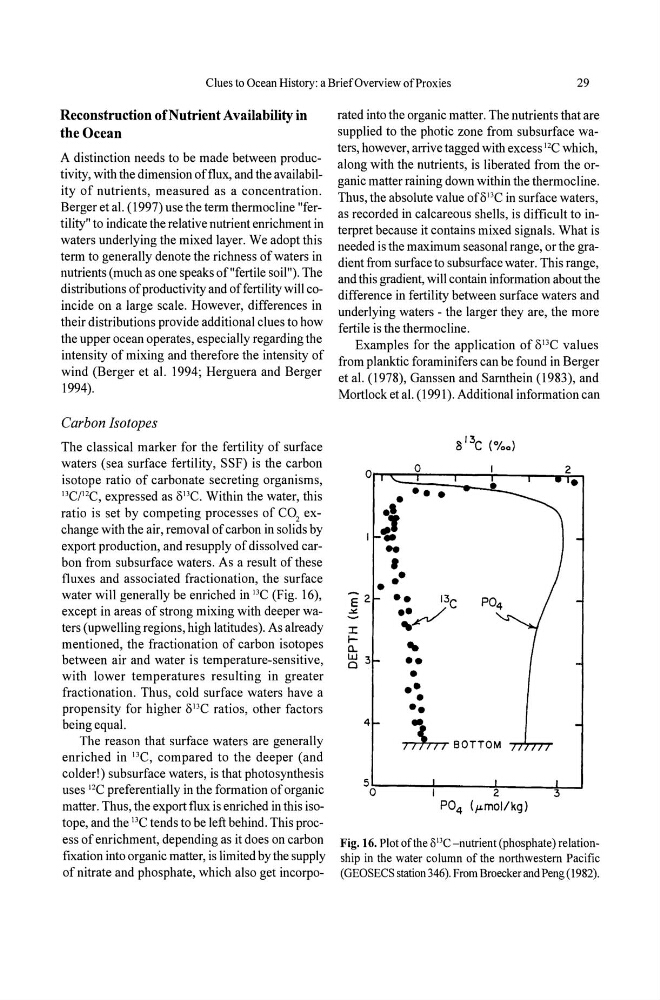
water will generally be enriched in l3C (Fig. 16),
except in areas of strong mixing with deeper waters (upwelling regions, high latitudes). As already
mentioned, the fractionation of carbon isotopes
between air and water is temperature-sensitive,
with lower temperatures resulting in greater
fractionation. Thus, cold surface waters have a
propensity for higher Ol3C ratios, other factors
being equal.
The reason that surface waters are generally
enriched in l3C, compared to the deeper (and
colder!) subsurface waters, is that photosynthesis
uses 12C preferentially in the formation of organic
matter. Thus, the export flux is enriched in this isotope, and the l3C tends to be left behind. This process of enrichment, depending as it does on carbon
fIxation into organic matter, is limited by the supply
of nitrate and phosphate, which also get incorporated into the organic matter. The nutrients that are
supplied to the photic zone from subsurface waters, however, arrive tagged with excess 12C which,
along with the nutrients, is liberated from the organic matter raining down within the thermocline.
Thus, the absolute value ofo l3 C in surface waters,
as recorded in calcareous shells, is diffIcult to interpret because it contains mixed signals. What is
needed is the maximum seasonal range, or the gradient from surface to subsurface water. This range,
and this gradient, will contain information about the
difference in fertility between surface waters and
underlying waters - the larger they are, the more
fertile is the thermocline.
Examples for the application of Ol3C values
from planktic foraminifers can be found in Berger
et al. (1978), Ganssen and Sarnthein (1983), and
Mortlock et al. (1991). Additional information can
a '3 c (%0)
0
0
•
• •• •
j
- . .
, •
••
e 2 • • 13 C
~
.. ~
J:
,
I..
a..
~ 3
••
•
•• •
••
4
~80TTOM
5~----~----~~----4-~ o
I
2
3
P0 4 (jLmol/kg)
Fig. 16. Plot of the olJC -nutrient (phosphate) relationship in the water column of the northwestern Pacific
(GEOSECS station 346). From Broecker and Peng (1982).
29
Reconstruction of Nutrient Availability in
the Ocean
A distinction needs to be made between productivity, with the dimension offlux, and the availability of nutrients, measured as a concentration.
Berger et al. (1997) use the term thermocline "fertility" to indicate the relative nutrient enrichment in
waters underlying the mixed layer. We adopt this
term to generally denote the richness of waters in
nutrients (much as one speaks of "fertile soil"). The
distributions of productivity and of fertility will coincide on a large scale. However, differences in
their distributions provide additional clues to how
the upper ocean operates, especially regarding the
intensity of mixing and therefore the intensity of
wind (Berger et al. 1994; Herguera and Berger
1994).
Carbon Isotopes
The classical marker for the fertility of surface
waters (sea surface fertility, SSF) is the carbon
isotope ratio of carbonate secreting organisms,
l3Cf1 2 C, expressed as Ol3C. Within the water, this
ratio is set by competing processes of CO 2 exchange with the air, removal of carbon in solids by
export production, and resupply of dissolved carbon from subsurface waters. As a result of these
fluxes and associated fractionation, the surface
water will generally be enriched in l3C (Fig. 16),
except in areas of strong mixing with deeper waters (upwelling regions, high latitudes). As already
mentioned, the fractionation of carbon isotopes
between air and water is temperature-sensitive,
with lower temperatures resulting in greater
fractionation. Thus, cold surface waters have a
propensity for higher Ol3C ratios, other factors
being equal.
The reason that surface waters are generally
enriched in l3C, compared to the deeper (and
colder!) subsurface waters, is that photosynthesis
uses 12C preferentially in the formation of organic
matter. Thus, the export flux is enriched in this isotope, and the l3C tends to be left behind. This process of enrichment, depending as it does on carbon
fIxation into organic matter, is limited by the supply
of nitrate and phosphate, which also get incorporated into the organic matter. The nutrients that are
supplied to the photic zone from subsurface waters, however, arrive tagged with excess 12C which,
along with the nutrients, is liberated from the organic matter raining down within the thermocline.
Thus, the absolute value ofo l3 C in surface waters,
as recorded in calcareous shells, is diffIcult to interpret because it contains mixed signals. What is
needed is the maximum seasonal range, or the gradient from surface to subsurface water. This range,
and this gradient, will contain information about the
difference in fertility between surface waters and
underlying waters - the larger they are, the more
fertile is the thermocline.
Examples for the application of Ol3C values
from planktic foraminifers can be found in Berger
et al. (1978), Ganssen and Sarnthein (1983), and
Mortlock et al. (1991). Additional information can
a '3 c (%0)
0
0
•
• •• •
j
- . .
, •
••
e 2 • • 13 C
~
.. ~
J:
,
I..
a..
~ 3
••
•
•• •
••
4
~80TTOM
5~----~----~~----4-~ o
I
2
3
P0 4 (jLmol/kg)
Fig. 16. Plot of the olJC -nutrient (phosphate) relationship in the water column of the northwestern Pacific
(GEOSECS station 346). From Broecker and Peng (1982).