

26
Weferetal.
0.5
a 18 0 [%0]
-0.5
-1.5
TOC[wt.%]
-2.5 0
1
O~~~~~~~~~
50
150
200
Biogenic Ba [ppm]
Opal [wt.%]
o 200 400 600
G. ruber (pink)
0.5 1.5 2.5 3.5 4.5
MOC[wt.%]
o 5 10 15 20 25
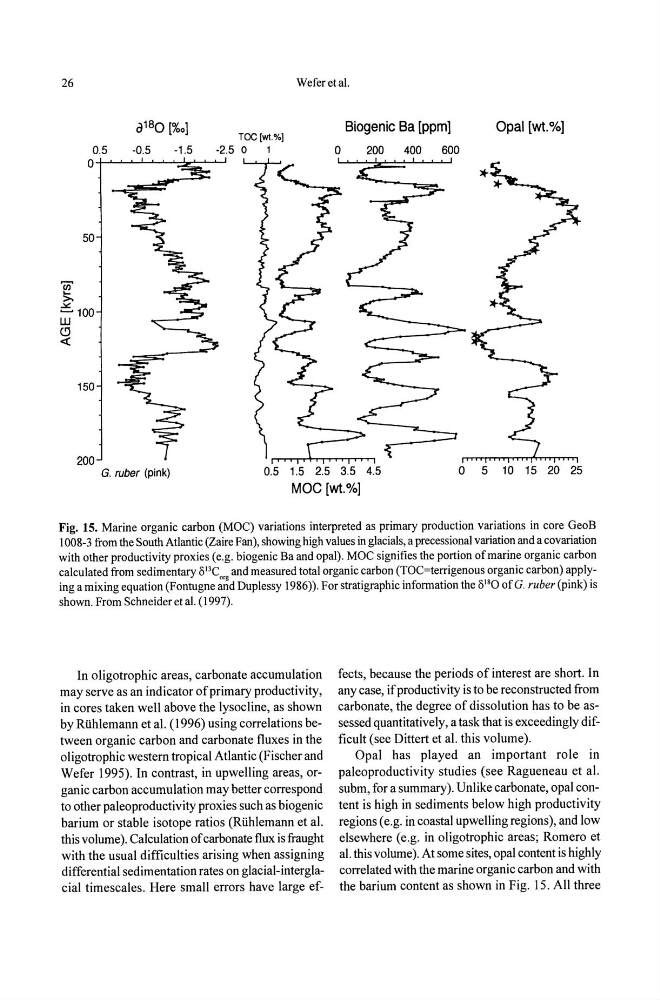
Fig. 15. Marine organic carbon (MOC) variations interpreted as primary production variations in core GeoB
1008-3 from the South Atlantic (Zaire Fan), showing high values in glacials, a precessional variation and a covariation
with other productivity proxies (e.g. biogenic Ba and opal). MOC signifies the portion of marine organic carbon
calculated from sedimentary /iJJC m , and measured total organic carbon (TOC=terrigenous organic carbon) applying a mixing equation (F ontugne and Duplessy 1986)). For stratigraphic information the /i180 of G. ruber (pink) is
shown. From Schneider et al. (1997).
In oligotrophic areas, carbonate accumulation
may serve as an indicator of primary productivity,
in cores taken well above the lysocline, as shown
by Rlihlemann et al. (1996) using correlations between organic carbon and carbonate fluxes in the
oligotrophic western tropical Atlantic (Fischer and
We fer 1995). In contrast, in upwelling areas, organic carbon accumulation may better correspond
to other paleoproductivity proxies such as biogenic
barium or stable isotope ratios (Rlihlemann et al.
this volume). Calculation of carbonate flux is fraught
with the usual difficulties arising when assigning
differential sedimentation rates on glacial-interglacial timescales. Here small errors have large effects, because the periods of interest are short. In
any case, if productivity is to be reconstructed from
carbonate, the degree of dissolution has to be assessed quantitatively, a task that is exceedingly difficult (see Dittert et al. this volume).
Opal has played an important role in
paleoproductivity studies (see Ragueneau et al.
subm, for a summary). Unlike carbonate, opal content is high in sediments below high productivity
regions (e.g. in coastal upwelling regions), and low
elsewhere (e.g. in oligotrophic areas; Romero et
al. this volume). At some sites, opal content is highly
correlated with the marine organic carbon and with
the barium content as shown in Fig. 15. All three
Weferetal.
0.5
a 18 0 [%0]
-0.5
-1.5
TOC[wt.%]
-2.5 0
1
O~~~~~~~~~
50
150
200
Biogenic Ba [ppm]
Opal [wt.%]
o 200 400 600
G. ruber (pink)
0.5 1.5 2.5 3.5 4.5
MOC[wt.%]
o 5 10 15 20 25
Fig. 15. Marine organic carbon (MOC) variations interpreted as primary production variations in core GeoB
1008-3 from the South Atlantic (Zaire Fan), showing high values in glacials, a precessional variation and a covariation
with other productivity proxies (e.g. biogenic Ba and opal). MOC signifies the portion of marine organic carbon
calculated from sedimentary /iJJC m , and measured total organic carbon (TOC=terrigenous organic carbon) applying a mixing equation (F ontugne and Duplessy 1986)). For stratigraphic information the /i180 of G. ruber (pink) is
shown. From Schneider et al. (1997).
In oligotrophic areas, carbonate accumulation
may serve as an indicator of primary productivity,
in cores taken well above the lysocline, as shown
by Rlihlemann et al. (1996) using correlations between organic carbon and carbonate fluxes in the
oligotrophic western tropical Atlantic (Fischer and
We fer 1995). In contrast, in upwelling areas, organic carbon accumulation may better correspond
to other paleoproductivity proxies such as biogenic
barium or stable isotope ratios (Rlihlemann et al.
this volume). Calculation of carbonate flux is fraught
with the usual difficulties arising when assigning
differential sedimentation rates on glacial-interglacial timescales. Here small errors have large effects, because the periods of interest are short. In
any case, if productivity is to be reconstructed from
carbonate, the degree of dissolution has to be assessed quantitatively, a task that is exceedingly difficult (see Dittert et al. this volume).
Opal has played an important role in
paleoproductivity studies (see Ragueneau et al.
subm, for a summary). Unlike carbonate, opal content is high in sediments below high productivity
regions (e.g. in coastal upwelling regions), and low
elsewhere (e.g. in oligotrophic areas; Romero et
al. this volume). At some sites, opal content is highly
correlated with the marine organic carbon and with
the barium content as shown in Fig. 15. All three