

354
Gingele et al.
"'''''
solid phase Ba [g/kgl
., e
O>~
0
0,2
0 ,4
0.6
0.8
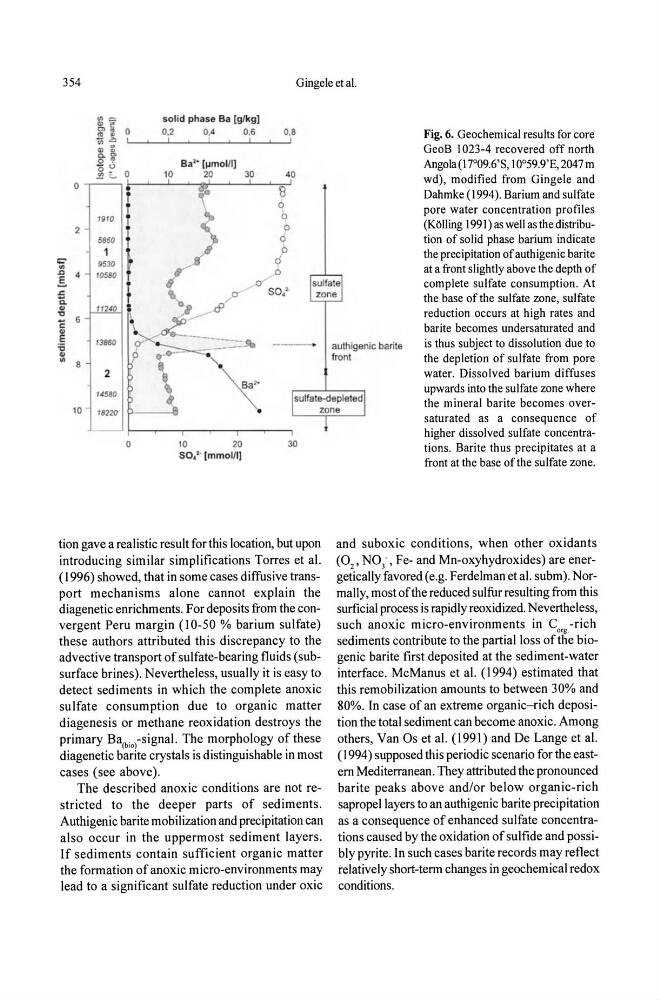
Fig, 6, Geochemical results for core
'" ~
I
I
I
~
GeoB 1023-4 recovered off north
' " "
c. '"
o ~
Ba'- [Ilmol/II
Angola(17°09.6'S,lO o 59.9'E,2047m
- u
~ L 0
10
20
30
40
wd), modified from Gingele and
0
'8
Dahmke (1994). Barium and sulfate
0
pore water concentration profiles
1910
b
2
P
(Kolling 1991) as well as the distribu5860
9
tion of solid phase barium indicate
1
I
the precipitation of authigenic barite
I::'
'"
9530
at a front slightly above the depth of
.c 4
10580
§.
/ 0
. 0 so.' .
sulfate
complete sulfate consumption. At
.J:.
zone
the base of the sulfate zone, sulfate
ii . . 11240
't:I
6
C
'3860
'6
OJ
'" 8
2
14580
10 - 18220
0
10
20
30
so." [mmol/II
tion gave a realistic result for this location, but upon
introducing similar simplifications Torres et al.
(1996) showed, that in some cases diffusive transport mechanisms alone cannot explain the
diagenetic enrichments. For deposits from the convergent Peru margin (10-50 % barium sulfate)
these authors attributed this discrepancy to the
advective transport of sulfate-bearing fluids (subsurface brines). Nevertheless, usually it is easy to
detect sediments in which the complete anoxic
sulfate consumption due to organic matter
diagenesis or methane reoxidation destroys the
primary Ba(b;O)-signal. The morphology of these
diagenetic barite crystals is distinguishable in most
cases (see above).
The described anoxic conditions are not restricted to the deeper parts of sediments.
Authigenic barite mobilization and precipitation can
also occur in the uppermost sediment layers .
If sediments contain sufficient organic matter
the formation of anoxic micro-environments may
lead to a significant sulfate reduction under oxic
reduction occurs at high rates and
barite becomes undersaturated and
aUlhigenic barite
is thus subject to dissolution due to
fronl
the depletion of sulfate from pore
water. Dissolved barium diffuses
upwards into the sulfate zone where
the mineral barite becomes oversaturated as a consequence of
higher dissolved sulfate concentrations. Barite thus precipitates at a
front at the base of the sulfate zone.
and suboxic conditions, when other oxidants
(° 2 , N0 3 ', Fe- and Mn-oxyhydroxides) are energetically favored (e.g. Ferdelman et a!. subm). Normally, most ofthe reduced sulfur resulting from this
surficial process is rapidly reoxidized. Nevertheless,
such anoxic micro-environments in C -rich
org.
sediments contribute to the partial loss of the biogenic barite first deposited at the sediment-water
interface. McManus et a!. (1994) estimated that
this remobilization amounts to between 30% and
80%. In case of an extreme organic-rich deposition the total sediment can become anoxic. Among
others, Van Os et al. (1991) and De Lange et al.
(1994) supposed this periodic scenario for the eastern Mediterranean. They attributed the pronounced
barite peaks above and/or below organic-rich
sapropel layers to an authigenic barite precipitation
as a consequence of enhanced sulfate concentrations caused by the oxidation of sulfide and possibly pyrite. In such cases barite records may reflect
relatively short-term changes in geochemical redox
conditions.
Gingele et al.
"'''''
solid phase Ba [g/kgl
., e
O>~
0
0,2
0 ,4
0.6
0.8
Fig, 6, Geochemical results for core
'" ~
I
I
I
~
GeoB 1023-4 recovered off north
' " "
c. '"
o ~
Ba'- [Ilmol/II
Angola(17°09.6'S,lO o 59.9'E,2047m
- u
~ L 0
10
20
30
40
wd), modified from Gingele and
0
'8
Dahmke (1994). Barium and sulfate
0
pore water concentration profiles
1910
b
2
P
(Kolling 1991) as well as the distribu5860
9
tion of solid phase barium indicate
1
I
the precipitation of authigenic barite
I::'
'"
9530
at a front slightly above the depth of
.c 4
10580
§.
/ 0
. 0 so.' .
sulfate
complete sulfate consumption. At
.J:.
zone
the base of the sulfate zone, sulfate
ii . . 11240
't:I
6
C
'3860
'6
OJ
'" 8
2
14580
10 - 18220
0
10
20
30
so." [mmol/II
tion gave a realistic result for this location, but upon
introducing similar simplifications Torres et al.
(1996) showed, that in some cases diffusive transport mechanisms alone cannot explain the
diagenetic enrichments. For deposits from the convergent Peru margin (10-50 % barium sulfate)
these authors attributed this discrepancy to the
advective transport of sulfate-bearing fluids (subsurface brines). Nevertheless, usually it is easy to
detect sediments in which the complete anoxic
sulfate consumption due to organic matter
diagenesis or methane reoxidation destroys the
primary Ba(b;O)-signal. The morphology of these
diagenetic barite crystals is distinguishable in most
cases (see above).
The described anoxic conditions are not restricted to the deeper parts of sediments.
Authigenic barite mobilization and precipitation can
also occur in the uppermost sediment layers .
If sediments contain sufficient organic matter
the formation of anoxic micro-environments may
lead to a significant sulfate reduction under oxic
reduction occurs at high rates and
barite becomes undersaturated and
aUlhigenic barite
is thus subject to dissolution due to
fronl
the depletion of sulfate from pore
water. Dissolved barium diffuses
upwards into the sulfate zone where
the mineral barite becomes oversaturated as a consequence of
higher dissolved sulfate concentrations. Barite thus precipitates at a
front at the base of the sulfate zone.
and suboxic conditions, when other oxidants
(° 2 , N0 3 ', Fe- and Mn-oxyhydroxides) are energetically favored (e.g. Ferdelman et a!. subm). Normally, most ofthe reduced sulfur resulting from this
surficial process is rapidly reoxidized. Nevertheless,
such anoxic micro-environments in C -rich
org.
sediments contribute to the partial loss of the biogenic barite first deposited at the sediment-water
interface. McManus et a!. (1994) estimated that
this remobilization amounts to between 30% and
80%. In case of an extreme organic-rich deposition the total sediment can become anoxic. Among
others, Van Os et al. (1991) and De Lange et al.
(1994) supposed this periodic scenario for the eastern Mediterranean. They attributed the pronounced
barite peaks above and/or below organic-rich
sapropel layers to an authigenic barite precipitation
as a consequence of enhanced sulfate concentrations caused by the oxidation of sulfide and possibly pyrite. In such cases barite records may reflect
relatively short-term changes in geochemical redox
conditions.