

294
Diekmann et al.
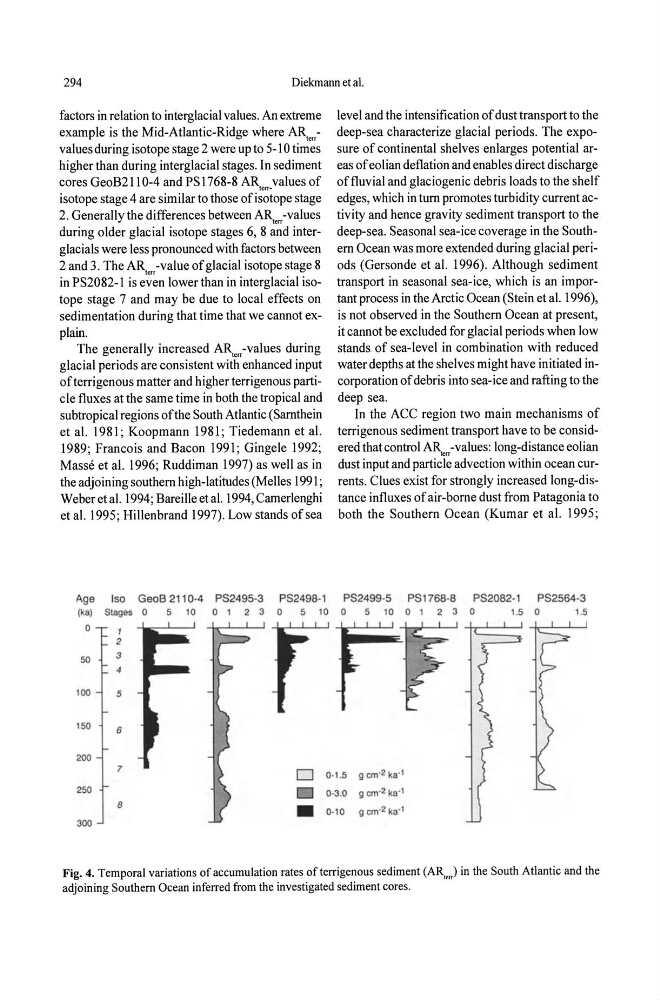
factors in relation to interglacial values. An extreme
example is the Mid-Atlantic-Ridge where AR I ,,,values during isotope stage 2 were up to 5-10 times
higher than during interglacial stages. In sediment
cores GeoB2110-4 and PS 1768-8 AR values of
terrisotope stage 4 are similar to those of isotope stage
2. Generally the differences between ARI,,,-values
during older glacial isotope stages 6, 8 and interglacials were less pronounced with factors between
2 and 3. The AR",,-value of glacial isotope stage 8
in PS2082-1 is even lower than in interglacial isotope stage 7 and may be due to local effects on
sedimentation during that time that we cannot explain.
The generally increased AR",,-values during
glacial periods are consistent with enhanced input
of terrigenous matter and higher terrigenous particle fluxes at the same time in both the tropical and
subtropical regions of the South Atlantic (Sarnthein
et at. 1981; Koopmann 1981; Tiedemann et at.
1989; Francois and Bacon 1991; Gingele 1992;
Masse et at. 1996; Ruddiman 1997) as well as in
the adjoining southern high-latitudes (Melles 1991;
Weber et at. 1994; Bareille et at. 1994, Camerlenghi
et at. 1995; Hillenbrand 1997). Low stands of sea
level and the intensification of dust transport to the
deep-sea characterize glacial periods. The exposure of continental shelves enlarges potential areas of eolian deflation and enables direct discharge
of fluvial and glaciogenic debris loads to the shelf
edges, which in tum promotes turbidity current activity and hence gravity sediment transport to the
deep-sea. Seasonal sea-ice coverage in the Southern Ocean was more extended during glacial periods (Gersonde et at. 1996). Although sediment
transport in seasonal sea-ice, which is an important process in the Arctic Ocean (Stein et at. 1996),
is not observed in the Southern Ocean at present,
it cannot be excluded for glacial periods when low
stands of sea-level in combination with reduced
water depths at the shelves might have initiated incorporation of debris into sea-ice and rafting to the
deep sea.
In the ACC region two main mechanisms of
terrigenous sediment transport have to be considered that control Al\,,,-values: long-distance eolian
dust input and particle advection within ocean currents. Clues exist for strongly increased long-distance influxes of air-borne dust from Patagonia to
both the Southern Ocean (Kumar et at. 1995;
Age
Ike)
o
Iso GeoB 2110-4 PS2495-3 PS2498-1
PS2499-5 PS1768-8
PS2082-1
PS2564-3
50
100
150
200
250
300
Stages 0
5
10
0 1
2 3 0
5 10 0
5
10 0 1 2 3 0
,
2
3
4
5
6
7
8
D 0·1.5
0-3.0
•
0·10
1.5 0
1.5
Fig. 4. Temporal variations of accumulation rates of terrigenous sediment CAR",,) in the South Atlantic and the
adjoining Southern Ocean inferred from the investigated sediment cores.
Diekmann et al.
factors in relation to interglacial values. An extreme
example is the Mid-Atlantic-Ridge where AR I ,,,values during isotope stage 2 were up to 5-10 times
higher than during interglacial stages. In sediment
cores GeoB2110-4 and PS 1768-8 AR values of
terrisotope stage 4 are similar to those of isotope stage
2. Generally the differences between ARI,,,-values
during older glacial isotope stages 6, 8 and interglacials were less pronounced with factors between
2 and 3. The AR",,-value of glacial isotope stage 8
in PS2082-1 is even lower than in interglacial isotope stage 7 and may be due to local effects on
sedimentation during that time that we cannot explain.
The generally increased AR",,-values during
glacial periods are consistent with enhanced input
of terrigenous matter and higher terrigenous particle fluxes at the same time in both the tropical and
subtropical regions of the South Atlantic (Sarnthein
et at. 1981; Koopmann 1981; Tiedemann et at.
1989; Francois and Bacon 1991; Gingele 1992;
Masse et at. 1996; Ruddiman 1997) as well as in
the adjoining southern high-latitudes (Melles 1991;
Weber et at. 1994; Bareille et at. 1994, Camerlenghi
et at. 1995; Hillenbrand 1997). Low stands of sea
level and the intensification of dust transport to the
deep-sea characterize glacial periods. The exposure of continental shelves enlarges potential areas of eolian deflation and enables direct discharge
of fluvial and glaciogenic debris loads to the shelf
edges, which in tum promotes turbidity current activity and hence gravity sediment transport to the
deep-sea. Seasonal sea-ice coverage in the Southern Ocean was more extended during glacial periods (Gersonde et at. 1996). Although sediment
transport in seasonal sea-ice, which is an important process in the Arctic Ocean (Stein et at. 1996),
is not observed in the Southern Ocean at present,
it cannot be excluded for glacial periods when low
stands of sea-level in combination with reduced
water depths at the shelves might have initiated incorporation of debris into sea-ice and rafting to the
deep sea.
In the ACC region two main mechanisms of
terrigenous sediment transport have to be considered that control Al\,,,-values: long-distance eolian
dust input and particle advection within ocean currents. Clues exist for strongly increased long-distance influxes of air-borne dust from Patagonia to
both the Southern Ocean (Kumar et at. 1995;
Age
Ike)
o
Iso GeoB 2110-4 PS2495-3 PS2498-1
PS2499-5 PS1768-8
PS2082-1
PS2564-3
50
100
150
200
250
300
Stages 0
5
10
0 1
2 3 0
5 10 0
5
10 0 1 2 3 0
,
2
3
4
5
6
7
8
D 0·1.5
0-3.0
•
0·10
1.5 0
1.5
Fig. 4. Temporal variations of accumulation rates of terrigenous sediment CAR",,) in the South Atlantic and the
adjoining Southern Ocean inferred from the investigated sediment cores.