

Kaolinite and Chlorite as Tracers of Modern and Late Quaternary Deep Water Circulation
291
Kaolinite/Chlorite Ratios
IO .15-0.ij
0
E
~ 2
.r:.
0. 3
Q)
0
Q;
iii
4
~ 5
6
0
E
~ 2
.r:.
15. Q) 3
0
Q; 4
iii
~ 5
6
70
60
50
40
30
20
10
0
Latitude (O S )
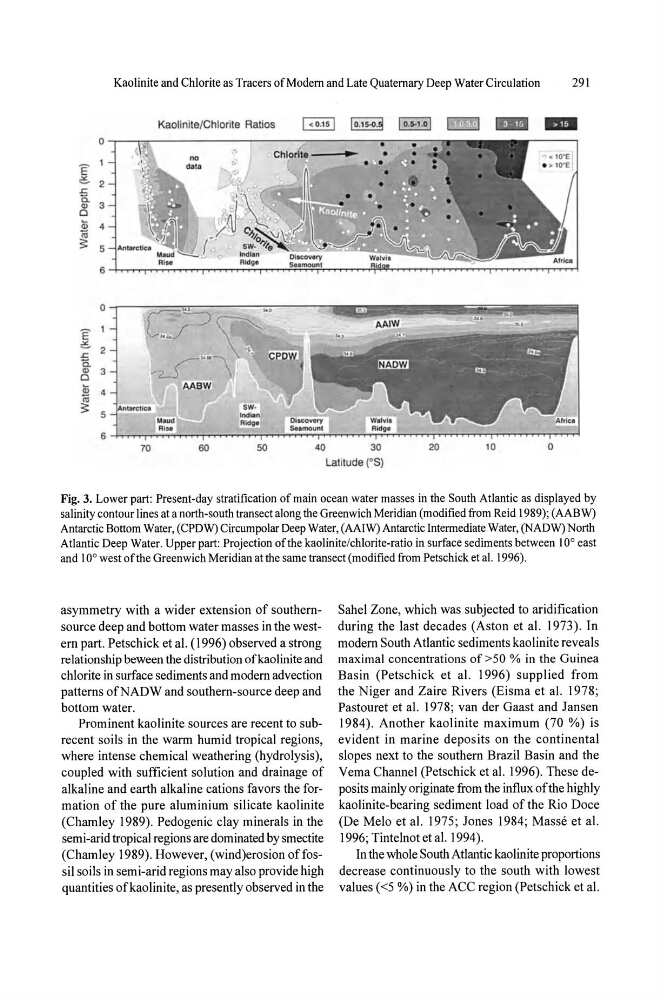
Fig. 3. Lower part: Present-day stratification of main ocean water masses in the South Atlantic as displayed by
salinity contour lines at a north-south transect along the Greenwich Meridian (modified from Reid 1989); (AABW)
Antarctic Bottom Water. (CPDW) Circumpolar Deep Water, (AAIW) Antarctic Intennediate Water, (NADW) North
Atlantic Deep Water. Upper part: Projection ofthe kaolinite/chlorite-ratio in surface sediments between 10° east
and 10° west of the Greenwich Meridian at the same transect (modified from Petschick et al. 1996).
asymmetry with a wider extension of southernsource deep and bottom water masses in the western part. Petschick et al. (1996) observed a strong
relationship beween the distribution of kaolinite and
chlorite in surface sediments and modern advection
patterns ofNADW and southern-source deep and
bottom water.
Prominent kaolinite sources are recent to subrecent soils in the warm humid tropical regions,
where intense chemical weathering (hydrolysis),
coupled with sufficient solution and drainage of
alkaline and earth alkaline cations favors the formation of the pure aluminium silicate kaolinite
(Charnley 1989). Pedogenic clay minerals in the
semi-arid tropical regions are dominated by smectite
(Chamley 1989). However, (wind)erosion offossil soils in semi-arid regions may also provide high
quantities of kaolinite, as presently observed in the
Sahel Zone, which was subjected to aridification
during the last decades (Aston et al. 1973). In
modem South Atlantic sediments kaolinite reveals
maximal concentrations of >50 % in the Guinea
Basin (Petschick et al. 1996) supplied from
the Niger and Zaire Rivers (Eisma et al. 1978;
Pastouret et al. 1978; van der Gaast and Jansen
1984). Another kaolinite maximum (70 %) is
evident in marine deposits on the continental
slopes next to the southern Brazil Basin and the
Vema Channel (Petschick et al. 1996). These deposits mainly originate from the influx ofthe highly
kaolinite-bearing sediment load of the Rio Doce
(De Melo et al. 1975; Jones 1984; Masse et al.
1996; Tintelnot et al. 1994).
In the whole South Atlantic kaolinite proportions
decrease continuously to the south with lowest
values «5 %) in the ACC region (Petschick et al.
291
Kaolinite/Chlorite Ratios
IO .15-0.ij
0
E
~ 2
.r:.
0. 3
Q)
0
Q;
iii
4
~ 5
6
0
E
~ 2
.r:.
15. Q) 3
0
Q; 4
iii
~ 5
6
70
60
50
40
30
20
10
0
Latitude (O S )
Fig. 3. Lower part: Present-day stratification of main ocean water masses in the South Atlantic as displayed by
salinity contour lines at a north-south transect along the Greenwich Meridian (modified from Reid 1989); (AABW)
Antarctic Bottom Water. (CPDW) Circumpolar Deep Water, (AAIW) Antarctic Intennediate Water, (NADW) North
Atlantic Deep Water. Upper part: Projection ofthe kaolinite/chlorite-ratio in surface sediments between 10° east
and 10° west of the Greenwich Meridian at the same transect (modified from Petschick et al. 1996).
asymmetry with a wider extension of southernsource deep and bottom water masses in the western part. Petschick et al. (1996) observed a strong
relationship beween the distribution of kaolinite and
chlorite in surface sediments and modern advection
patterns ofNADW and southern-source deep and
bottom water.
Prominent kaolinite sources are recent to subrecent soils in the warm humid tropical regions,
where intense chemical weathering (hydrolysis),
coupled with sufficient solution and drainage of
alkaline and earth alkaline cations favors the formation of the pure aluminium silicate kaolinite
(Charnley 1989). Pedogenic clay minerals in the
semi-arid tropical regions are dominated by smectite
(Chamley 1989). However, (wind)erosion offossil soils in semi-arid regions may also provide high
quantities of kaolinite, as presently observed in the
Sahel Zone, which was subjected to aridification
during the last decades (Aston et al. 1973). In
modem South Atlantic sediments kaolinite reveals
maximal concentrations of >50 % in the Guinea
Basin (Petschick et al. 1996) supplied from
the Niger and Zaire Rivers (Eisma et al. 1978;
Pastouret et al. 1978; van der Gaast and Jansen
1984). Another kaolinite maximum (70 %) is
evident in marine deposits on the continental
slopes next to the southern Brazil Basin and the
Vema Channel (Petschick et al. 1996). These deposits mainly originate from the influx ofthe highly
kaolinite-bearing sediment load of the Rio Doce
(De Melo et al. 1975; Jones 1984; Masse et al.
1996; Tintelnot et al. 1994).
In the whole South Atlantic kaolinite proportions
decrease continuously to the south with lowest
values «5 %) in the ACC region (Petschick et al.