

18
Weferetal.
Salinity Estimates
At present there is no method available for the direct estimation of salinity. Salinity estimates have
been based on microfossil assemblages and oxygen isotopes using methods analogous to those used
in temperature reconstruction (for a summary see
Wolff et al. this volume). There is little evidence
that organisms from the pelagic realm are sensitive to salinity changes within the common oceanic
range. Thus, much ofthe correlation observed may
be due to the correlation of salinity with other factors, especially temperature. There is an excellent
correlation between salinity and temperature in
each ocean basin, such that high temperature is
-90
-80
-70
-60
-50
-40
75
Sea Water
salinity
Anomaly
70
at L.G.M.
65
60
55
50
~
~
45
40
1.68*
35
.
30
-70
-60
-50
-40
tied to high salinity, and vice versa. The origin of
this correlation is obvious: high temperature favors
evaporation, while the vapor in the atmosphere
condenses in cool regions. When using oxygen isotopes in reconstructions ofthe global temperature,
this broad correlation makes the tropics appear
cooler and the high latitudes warmer than they really were (e.g. Berger 1981).
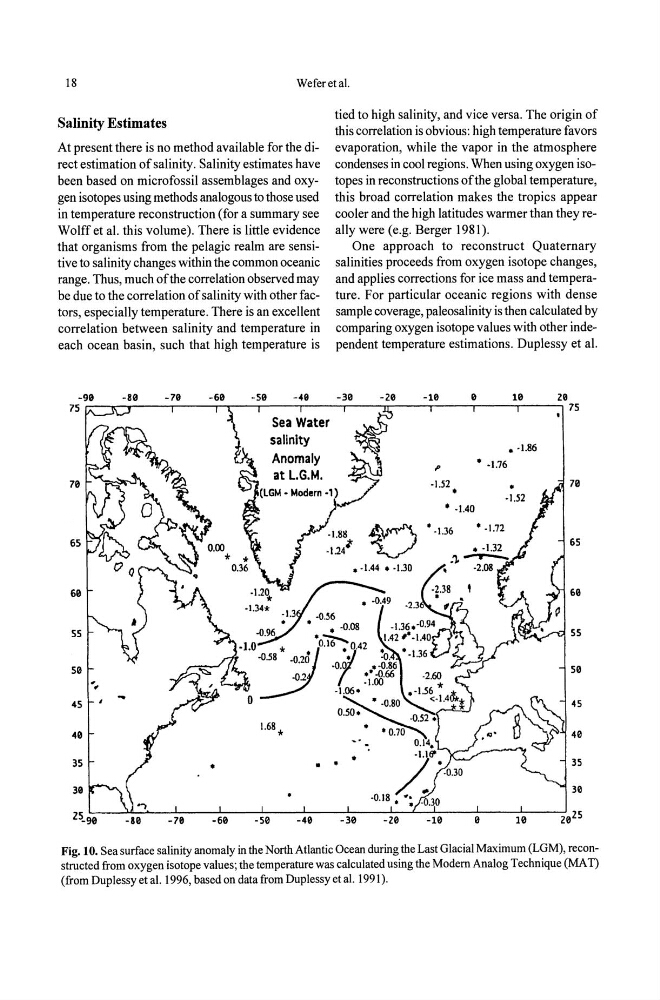
One approach to reconstruct Quaternary
salinities proceeds from oxygen isotope changes,
and applies corrections for ice mass and temperature. For particular oceanic regions with dense
sample coverage, paleosalinity is then calculated by
comparing oxygen isotope values with other independent temperature estimations. Duplessy et al.
-30
-20
-10
0
10
20
75
• ·1.86
• ·1.76
I'
70
65
60
55
50
45
40
.
35
30
-30
-l0
10
20 25
Fig. 10. Sea surface salinity anomaly in the North Atlantic Ocean during the Last Glacial Maximum (LGM), reconstructed from oxygen isotope values; the temperature was calculated using the Modern Analog Technique (MAT)
(from Dup1essyetal. 1996, based on data from Duplessy et al. 1991).
Weferetal.
Salinity Estimates
At present there is no method available for the direct estimation of salinity. Salinity estimates have
been based on microfossil assemblages and oxygen isotopes using methods analogous to those used
in temperature reconstruction (for a summary see
Wolff et al. this volume). There is little evidence
that organisms from the pelagic realm are sensitive to salinity changes within the common oceanic
range. Thus, much ofthe correlation observed may
be due to the correlation of salinity with other factors, especially temperature. There is an excellent
correlation between salinity and temperature in
each ocean basin, such that high temperature is
-90
-80
-70
-60
-50
-40
75
Sea Water
salinity
Anomaly
70
at L.G.M.
65
60
55
50
~
~
45
40
1.68*
35
.
30
-70
-60
-50
-40
tied to high salinity, and vice versa. The origin of
this correlation is obvious: high temperature favors
evaporation, while the vapor in the atmosphere
condenses in cool regions. When using oxygen isotopes in reconstructions ofthe global temperature,
this broad correlation makes the tropics appear
cooler and the high latitudes warmer than they really were (e.g. Berger 1981).
One approach to reconstruct Quaternary
salinities proceeds from oxygen isotope changes,
and applies corrections for ice mass and temperature. For particular oceanic regions with dense
sample coverage, paleosalinity is then calculated by
comparing oxygen isotope values with other independent temperature estimations. Duplessy et al.
-30
-20
-10
0
10
20
75
• ·1.86
• ·1.76
I'
70
65
60
55
50
45
40
.
35
30
-30
-l0
10
20 25
Fig. 10. Sea surface salinity anomaly in the North Atlantic Ocean during the Last Glacial Maximum (LGM), reconstructed from oxygen isotope values; the temperature was calculated using the Modern Analog Technique (MAT)
(from Dup1essyetal. 1996, based on data from Duplessy et al. 1991).