

258
Dittert et at.
transition zone between the onset of dissolution and
the CCD. The latter makes more sense to us linguistically (the word thermocline refers to the region oftemperature gradient, for example), and we
suggest to use the phrase transition zone when
the entire zone is meant.
The by far greatest fraction of the organic carbon arriving at the sea-floor is respired as CO 2 or
remineralized to other organic compounds by
benthic organisms (Reimers 1989). This metabolic
CO 2 generated by organisms which live within the
sediment may contribute to the dissolution of calcite even above the lysocline, known as
supralysoclinal dissolution (Emerson and Bender
1981; Jahnke et al. 1994; Freiwald 1995). Other
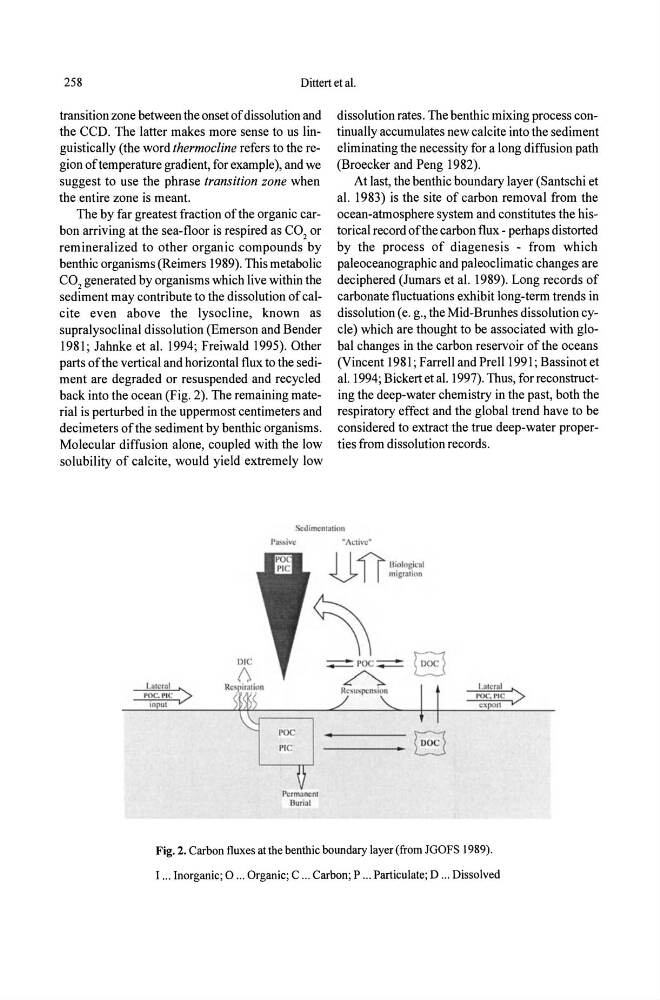
parts ofthe vertical and horizontal flux to the sediment are degraded or resuspended and recycled
back into the ocean (Fig. 2). The remaining material is perturbed in the uppermost centimeters and
decimeters of the sediment by benthic organisms.
Molecular diffusion alone, coupled with the low
solubility of calcite, would yield extremely low
dissolution rates. The benthic mixing process continually accumulates new calcite into the sediment
eliminating the necessity for a long diffusion path
(Broecker and Peng 1982).
At last, the benthic boundary layer (Santschi et
al. 1983) is the site of carbon removal from the
ocean-atmosphere system and constitutes the historical record of the carbon flux - perhaps distorted
by the process of diagenesis - from which
paleoceanographic and paleoclimatic changes are
deciphered (Jumars et al. 1989). Long records of
carbonate fluctuations exhibit long-term trends in
dissolution (e. g., the Mid-Brunhes dissolution cycle) which are thought to be associated with global changes in the carbon reservoir of the oceans
(Vincent 1981; Farrell and Prell 1991 ; Bassinot et
al. 1994; Bickert et al. 1997). Thus, for reconstructing the deep-water chemistry in the past, both the
respiratory effect and the global trend have to be
considered to extract the true deep-water properties from dissolution records.
Sctlimcnlation
Lal<:rnl >
P(')(;"PIC
tnru1
l 'a~iYc
- Acti\'e"
I' IC
Pennantnl
Durial
L.ucml
~ cxpon
~(
• c::::.:J
Fig. 2. Carbon fluxes at the benthic boundary layer (from JOOFS 1989).
I .. . Inorganic; 0 ... Organic; C ... Carbon; P .
.. Particulate; D ... Dissolved
Dittert et at.
transition zone between the onset of dissolution and
the CCD. The latter makes more sense to us linguistically (the word thermocline refers to the region oftemperature gradient, for example), and we
suggest to use the phrase transition zone when
the entire zone is meant.
The by far greatest fraction of the organic carbon arriving at the sea-floor is respired as CO 2 or
remineralized to other organic compounds by
benthic organisms (Reimers 1989). This metabolic
CO 2 generated by organisms which live within the
sediment may contribute to the dissolution of calcite even above the lysocline, known as
supralysoclinal dissolution (Emerson and Bender
1981; Jahnke et al. 1994; Freiwald 1995). Other
parts ofthe vertical and horizontal flux to the sediment are degraded or resuspended and recycled
back into the ocean (Fig. 2). The remaining material is perturbed in the uppermost centimeters and
decimeters of the sediment by benthic organisms.
Molecular diffusion alone, coupled with the low
solubility of calcite, would yield extremely low
dissolution rates. The benthic mixing process continually accumulates new calcite into the sediment
eliminating the necessity for a long diffusion path
(Broecker and Peng 1982).
At last, the benthic boundary layer (Santschi et
al. 1983) is the site of carbon removal from the
ocean-atmosphere system and constitutes the historical record of the carbon flux - perhaps distorted
by the process of diagenesis - from which
paleoceanographic and paleoclimatic changes are
deciphered (Jumars et al. 1989). Long records of
carbonate fluctuations exhibit long-term trends in
dissolution (e. g., the Mid-Brunhes dissolution cycle) which are thought to be associated with global changes in the carbon reservoir of the oceans
(Vincent 1981; Farrell and Prell 1991 ; Bassinot et
al. 1994; Bickert et al. 1997). Thus, for reconstructing the deep-water chemistry in the past, both the
respiratory effect and the global trend have to be
considered to extract the true deep-water properties from dissolution records.
Sctlimcnlation
Lal<:rnl >
P(')(;"PIC
tnru1
l 'a~iYc
- Acti\'e"
I' IC
Pennantnl
Durial
L.ucml
~ cxpon
~(
• c::::.:J
Fig. 2. Carbon fluxes at the benthic boundary layer (from JOOFS 1989).
I .. . Inorganic; 0 ... Organic; C ... Carbon; P .
.. Particulate; D ... Dissolved