

Stable Carbon Isotopes in Benthic Foraminifera
235
values are indicative of very cold and dense meteoric water melted from below the ice shelves and
then advected during bottom water formation processes to WSBW. The latter water, however, should
have been in less extensive contact with the atmosphere and therefore should carry a lower thermodynamic tag. To constrain this hypothesis, i.e. the
assumption that at present two different principal
processes are active to form Weddell Sea deep and
bottom waters, and that these processes result in
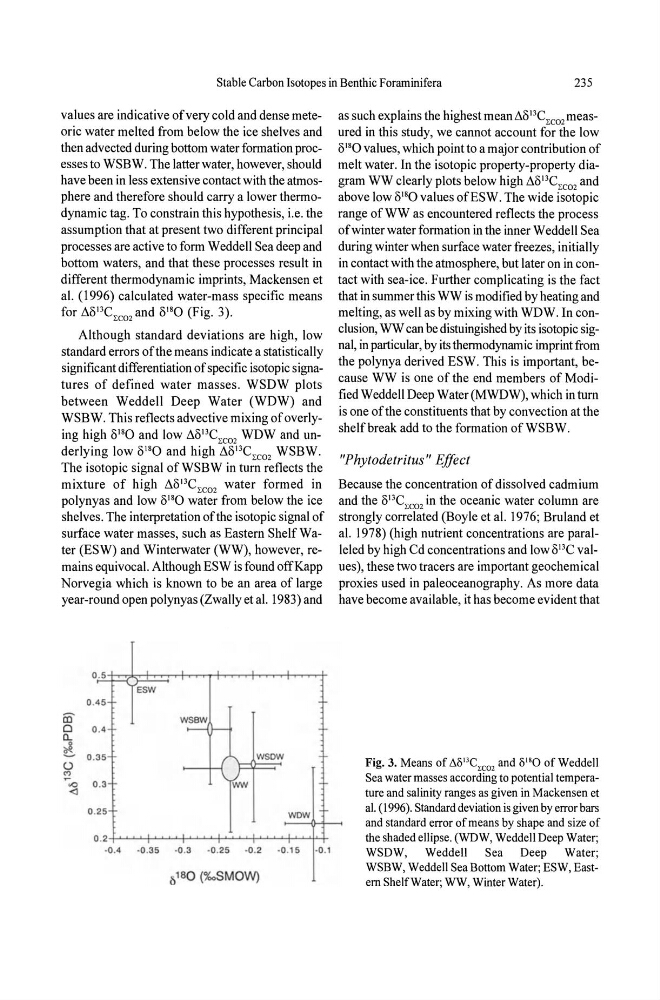
different thermodynamic imprints, Mackensen et
al. (1996) calculated water-mass specific means
for ~81 3 C l:C02 and 8 18 0 (Fig. 3).
Although standard deviations are high, low
standard errors of the means indicate a statistically
significant differentiation of specific isotopic signatures of defined water masses. WSDW plots
between Weddell Deep Water (WDW) and
WSBW. This reflects advective mixing of overlying high 8 18 0 and low ~81 3C l:C02 WDW and underlying low 8 18 0 and high ~81 3 C l:C02 WSBW.
The isotopic signal of WSBW in turn reflects the
mixture of high ~813Cl:C02 water formed in
polynyas and low 8 18 0 water from below the ice
shelves. The interpretation ofthe isotopic signal of
surface water masses, such as Eastern ShelfWater (ESW) and Winterwater (WW), however, remains equivocal. Although ESW is found offKapp
Norvegia which is known to be an area of large
year-round open polynyas (Zwally et al. 1983) and
0 .5
ESW
0 .45
iD
WSfN>I
0
0 .4
a..
t 0 .35
()
'" ~
WDW
0 .2
-0.4
-0 .35
-0.3
-0.25
-0.2
-0 .1 5
-0 . 1
0180 (%oS MOW)
as such explains the highest mean ~813Cl:C02 measured in this study, we cannot account for the low
8 18 0 values, which point to a major contribution of
melt water. In the isotopic property-property diagram WW clearly plots below high ~813Cl:C02 and
above low 8 18 0 values ofESW. The wide isotopic
range ofWW as encountered reflects the process
of winter water formation in the inner Weddell Sea
during winter when surface water freezes, initially
in contact with the atmosphere, but later on in contact with sea-ice. Further complicating is the fact
that in summer this WW is modified by heating and
melting, as well as by mixing with WDW. In conclusion, WW can be distuingished by its isotopic signal, in particular, by its thermodynamic imprint from
the polynya derived ESW. This is important, because WW is one of the end members of Modified Weddell Deep Water (MWDW), which in turn
is one of the constituents that by convection at the
shelfbreak add to the formation ofWSBW.
"Phytodetritus" Effect
Because the concentration of dissolved cadmium
and the 813Cl:C02 in the oceanic water column are
strongly correlated (Boyle et al. 1976; Bruland et
al. 1978) (high nutrient concentrations are paralleled by high Cd concentrations and low 8 13 C values), these two tracers are important geochemical
proxies used in paleoceanography. As more data
have become available, it has become evident that
Fig. 3. Means of t10 13 C 'C02 and 0 18 0 of Weddell
Sea water masses according to potential temperature and salinity ranges as given in Mackensen et
al. (J 996). Standard deviation is given by error bars
and standard error of means by shape and size of
the shaded ellipse. (WDW, Weddell Deep Water;
WSDW, Weddell Sea Deep Water;
WSBW, Weddell Sea Bottom Water; ESW, Eastern Shelf Water; WW, Winter Water).
235
values are indicative of very cold and dense meteoric water melted from below the ice shelves and
then advected during bottom water formation processes to WSBW. The latter water, however, should
have been in less extensive contact with the atmosphere and therefore should carry a lower thermodynamic tag. To constrain this hypothesis, i.e. the
assumption that at present two different principal
processes are active to form Weddell Sea deep and
bottom waters, and that these processes result in
different thermodynamic imprints, Mackensen et
al. (1996) calculated water-mass specific means
for ~81 3 C l:C02 and 8 18 0 (Fig. 3).
Although standard deviations are high, low
standard errors of the means indicate a statistically
significant differentiation of specific isotopic signatures of defined water masses. WSDW plots
between Weddell Deep Water (WDW) and
WSBW. This reflects advective mixing of overlying high 8 18 0 and low ~81 3C l:C02 WDW and underlying low 8 18 0 and high ~81 3 C l:C02 WSBW.
The isotopic signal of WSBW in turn reflects the
mixture of high ~813Cl:C02 water formed in
polynyas and low 8 18 0 water from below the ice
shelves. The interpretation ofthe isotopic signal of
surface water masses, such as Eastern ShelfWater (ESW) and Winterwater (WW), however, remains equivocal. Although ESW is found offKapp
Norvegia which is known to be an area of large
year-round open polynyas (Zwally et al. 1983) and
0 .5
ESW
0 .45
iD
WSfN>I
0
0 .4
a..
t 0 .35
()
'" ~
WDW
0 .2
-0.4
-0 .35
-0.3
-0.25
-0.2
-0 .1 5
-0 . 1
0180 (%oS MOW)
as such explains the highest mean ~813Cl:C02 measured in this study, we cannot account for the low
8 18 0 values, which point to a major contribution of
melt water. In the isotopic property-property diagram WW clearly plots below high ~813Cl:C02 and
above low 8 18 0 values ofESW. The wide isotopic
range ofWW as encountered reflects the process
of winter water formation in the inner Weddell Sea
during winter when surface water freezes, initially
in contact with the atmosphere, but later on in contact with sea-ice. Further complicating is the fact
that in summer this WW is modified by heating and
melting, as well as by mixing with WDW. In conclusion, WW can be distuingished by its isotopic signal, in particular, by its thermodynamic imprint from
the polynya derived ESW. This is important, because WW is one of the end members of Modified Weddell Deep Water (MWDW), which in turn
is one of the constituents that by convection at the
shelfbreak add to the formation ofWSBW.
"Phytodetritus" Effect
Because the concentration of dissolved cadmium
and the 813Cl:C02 in the oceanic water column are
strongly correlated (Boyle et al. 1976; Bruland et
al. 1978) (high nutrient concentrations are paralleled by high Cd concentrations and low 8 13 C values), these two tracers are important geochemical
proxies used in paleoceanography. As more data
have become available, it has become evident that
Fig. 3. Means of t10 13 C 'C02 and 0 18 0 of Weddell
Sea water masses according to potential temperature and salinity ranges as given in Mackensen et
al. (J 996). Standard deviation is given by error bars
and standard error of means by shape and size of
the shaded ellipse. (WDW, Weddell Deep Water;
WSDW, Weddell Sea Deep Water;
WSBW, Weddell Sea Bottom Water; ESW, Eastern Shelf Water; WW, Winter Water).