

Stable Isotopes of Pteropod Shells as Recorders of Sub-Surface Water Conditions
203
a 2
~ L. innata I Conclusions
CD
0
a.
0
~
U
'" ..-- ,
~
(])
"0
0
b 2
CD
0
a.
0
:,g 0
U
'"
.!!l
Q)
"0
0
o
<>+
•
0.0
.,~-jii
e. .i~ ••
••• • •
•
•• ·0
• •
o •
o.
•
0
0<>
•
·.1 ... ·0
• •
.... ~
o
•
0
1+
-2
••
•
0··
•
•
G. ruber (w) I
-1
0
delta-180 (%0 POB)
•
•
•
•
•
... . . •
•• •
..
•
L.innstal
13C=-O.OS-T+2.S
N =55
R' = 0.24
••
•
•
f
•
••• •
I + G. ruber(w) I
•
18
20
22
24
26
28
Temperature (DC), from O-isotopes
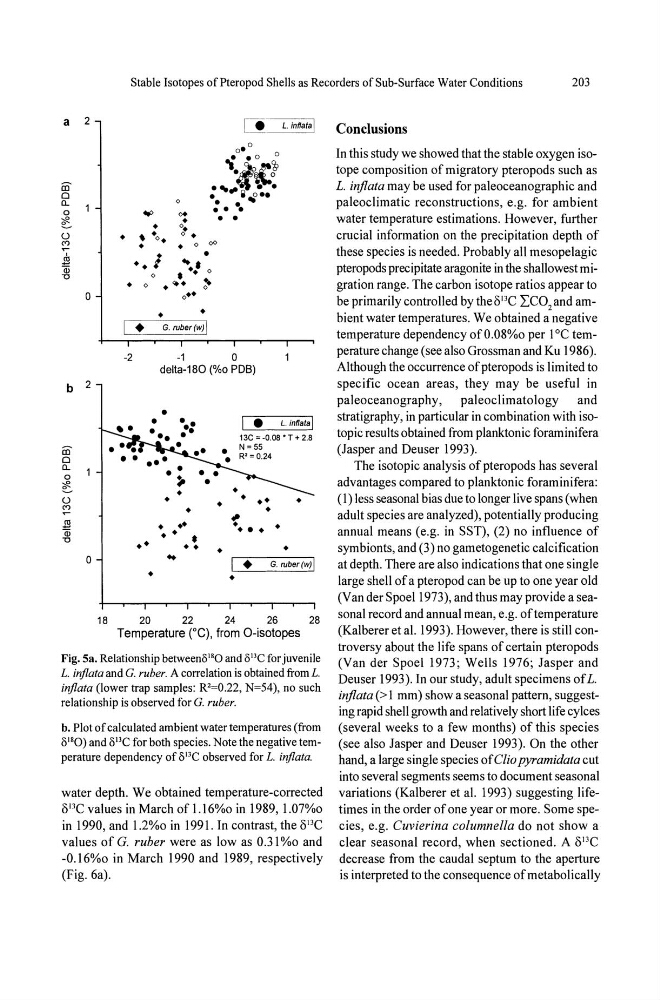
Fig_ Sa. Relationship betweeno"O and O"C for juvenile
L. iriflata and G. ruber. A correlation is obtained from L.
inflata (lower trap samples: R2=0.22, N=54), no such
relationship is observed for G. ruber.
b_ Plot of calculated ambient water temperatures (from
a 18 0) and a l3 c for both species. Note the negative temperature dependency of a l3 c observed for L. iriflata.
water depth. We obtained temperature-corrected
ODC values in March of 1.16%0 in 1989, 1.07%0
in 1990, and 1.2%0 in 1991. In contrast, the Ol3C
values of G. ruber were as low as 0.31 %0 and
-0.16%0 in March 1990 and 1989, respectively
(Fig.6a).
In this study we showed that the stable oxygen isotope composition of migratory pteropods such as
L. injlata may be used for paleoceanographic and
paleoclimatic reconstructions, e.g. for ambient
water temperature estimations. However, further
crucial information on the precipitation depth of
these species is needed. Probably all mesopelagic
pteropods precipitate aragonite in the shallowest migration range. The carbon isotope ratios appear to
be primarily controlled by theo l3 C LCO z and ambient water temperatures. We obtained a negative
temperature dependency of 0.08%0 per 1°C temperature change (see also Grossman and Ku 1986).
Although the occurrence of pteropods is limited to
specific ocean areas, they may be useful in
paleoceanography, paleoclimatology and
stratigraphy, in particular in combination with isotopic results obtained from planktonic foraminifera
(Jasper and Deuser 1993).
The isotopic analysis of pteropods has several
advantages compared to planktonic foraminifera:
(1) less seasonal bias due to longer live spans (when
adult species are analyzed), potentially producing
annual means (e.g. in SST), (2) no influence of
symbionts, and (3) no gametogenetic calcification
at depth. There are also indications that one single
large shell of a pteropod can be up to one year old
(Van der SpoeI1973), and thus may provide a seasonal record and annual mean, e.g. oftemperature
(Kalberer et al. 1993). However, there is still controversy about the life spans of certain pteropods
(Van der Spoel 1973; Wells 1976; Jasper and
Deuser 1993). In our study, adult specimens ofL.
injlata (> 1 mm) show a seasonal pattern, suggesting rapid shell growth and relatively short life cy1ces
(several weeks to a few months) of this species
(see also Jasper and Deuser 1993). On the other
hand, a large single species of Clio pyramidata cut
into several segments seems to document seasonal
variations (Kalberer et al. 1993) suggesting lifetimes in the order of one year or more. Some species, e.g. Cuvierina columnella do not show a
clear seasonal record, when sectioned. A Ol3C
decrease from the caudal septum to the aperture
is interpreted to the consequence of metabolically
203
a 2
~ L. innata I Conclusions
CD
0
a.
0
~
U
'" ..-- ,
~
(])
"0
0
b 2
CD
0
a.
0
:,g 0
U
'"
.!!l
Q)
"0
0
o
<>+
•
0.0
.,~-jii
e. .i~ ••
••• • •
•
•• ·0
• •
o •
o.
•
0
0<>
•
·.1 ... ·0
• •
.... ~
o
•
0
1+
-2
••
•
0··
•
•
G. ruber (w) I
-1
0
delta-180 (%0 POB)
•
•
•
•
•
... . . •
•• •
..
•
L.innstal
13C=-O.OS-T+2.S
N =55
R' = 0.24
••
•
•
f
•
••• •
I + G. ruber(w) I
•
18
20
22
24
26
28
Temperature (DC), from O-isotopes
Fig_ Sa. Relationship betweeno"O and O"C for juvenile
L. iriflata and G. ruber. A correlation is obtained from L.
inflata (lower trap samples: R2=0.22, N=54), no such
relationship is observed for G. ruber.
b_ Plot of calculated ambient water temperatures (from
a 18 0) and a l3 c for both species. Note the negative temperature dependency of a l3 c observed for L. iriflata.
water depth. We obtained temperature-corrected
ODC values in March of 1.16%0 in 1989, 1.07%0
in 1990, and 1.2%0 in 1991. In contrast, the Ol3C
values of G. ruber were as low as 0.31 %0 and
-0.16%0 in March 1990 and 1989, respectively
(Fig.6a).
In this study we showed that the stable oxygen isotope composition of migratory pteropods such as
L. injlata may be used for paleoceanographic and
paleoclimatic reconstructions, e.g. for ambient
water temperature estimations. However, further
crucial information on the precipitation depth of
these species is needed. Probably all mesopelagic
pteropods precipitate aragonite in the shallowest migration range. The carbon isotope ratios appear to
be primarily controlled by theo l3 C LCO z and ambient water temperatures. We obtained a negative
temperature dependency of 0.08%0 per 1°C temperature change (see also Grossman and Ku 1986).
Although the occurrence of pteropods is limited to
specific ocean areas, they may be useful in
paleoceanography, paleoclimatology and
stratigraphy, in particular in combination with isotopic results obtained from planktonic foraminifera
(Jasper and Deuser 1993).
The isotopic analysis of pteropods has several
advantages compared to planktonic foraminifera:
(1) less seasonal bias due to longer live spans (when
adult species are analyzed), potentially producing
annual means (e.g. in SST), (2) no influence of
symbionts, and (3) no gametogenetic calcification
at depth. There are also indications that one single
large shell of a pteropod can be up to one year old
(Van der SpoeI1973), and thus may provide a seasonal record and annual mean, e.g. oftemperature
(Kalberer et al. 1993). However, there is still controversy about the life spans of certain pteropods
(Van der Spoel 1973; Wells 1976; Jasper and
Deuser 1993). In our study, adult specimens ofL.
injlata (> 1 mm) show a seasonal pattern, suggesting rapid shell growth and relatively short life cy1ces
(several weeks to a few months) of this species
(see also Jasper and Deuser 1993). On the other
hand, a large single species of Clio pyramidata cut
into several segments seems to document seasonal
variations (Kalberer et al. 1993) suggesting lifetimes in the order of one year or more. Some species, e.g. Cuvierina columnella do not show a
clear seasonal record, when sectioned. A Ol3C
decrease from the caudal septum to the aperture
is interpreted to the consequence of metabolically