

172
Niebler et a!.
peratures (from 21 ° to 4 .5°C) and consequently the
number of species available for isotopic investigations decreases as well (Be 1977; Vincent and
Berger 1981; Niebler and Gersonde 1998).
have their maximum occurrence in winter, which
is due to the low temperatures and that the
foraminiferal flux mainly reflects a summer signal
(Wefer et al. 1988; Wefer 1989; Donner and Wefer
1994).
The mean isotope value of two single measurements performed on 5 to 25 individuals (depending
on their shell-size) each was plotted for all available size classes of each species at six stations
(Figs. 3-8). Tn these figures, the measured values
are shown and no corrections for the "oxygen isotope disequilibrium" were made. The simple assumption that all species live and calcifY at the same
time is probably unrealistic. However, investigations
on the population dynamics in the Southern Ocean
(Drake Passage and Weddell Sea) indicate, that it
can be safely assumed that the foraminifera did not
The 0 18 0"loite values of planktic foraminiferal
shells mainly store the 0 18 0 w ",,, values of the surrounding sea-water and the ambient temperature.
For most species, "oxygen isotope disequilibrium
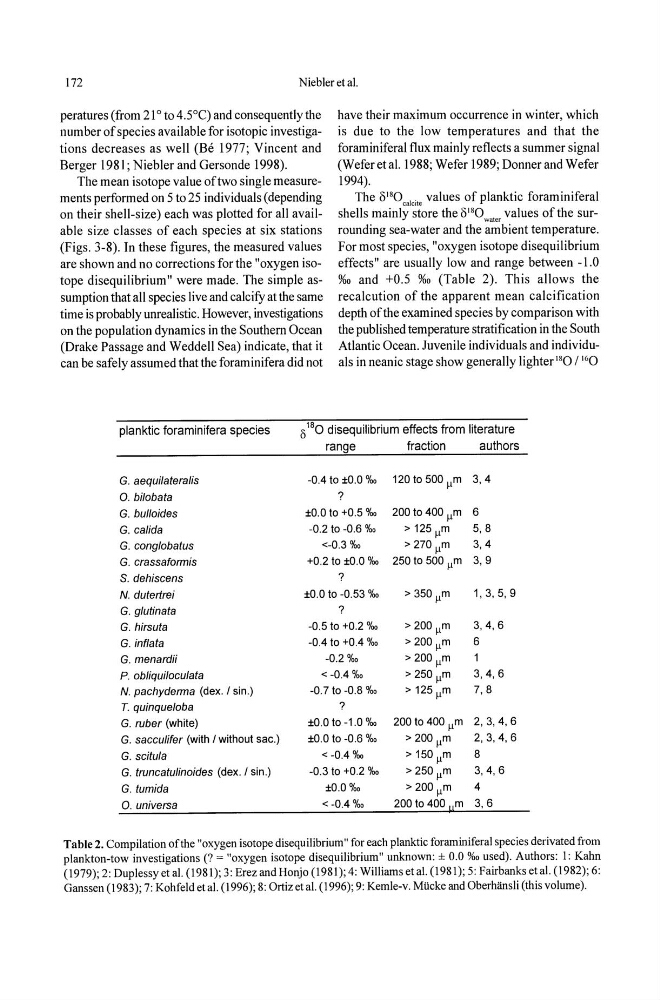
effects" are usually low and range between -\.O
%0 and +0.5 %0 (Table 2). This allows the
recalcution of the apparent mean calcification
depth ofthe examined species by comparison with
the published temperature stratification in the South
Atlantic Ocean. Juvenile individuals and individuals in neanic stage show generally lighter 18 0/ 16 0
planktiC foraminifera species
8180 disequilibrium effects from literature
range
fraction
authors
G. aequilateralis
-0.4 to ±O.O %0 120 to 500 ~m 3,4
O. bi/obala
?
G. bulloides
±O.O to +0.5 %0 200 to 400 ~m 6
G. calida
-0.2 to -0.6 %0
> 125 ~m
5,8
G. cong/obatus
<-0.3 %0
> 270 ~m
3,4
G. crassaformis
+0.2 to ±O.O %0 250 to 500 ~m 3,9
S. dehiscens
?
N. dulerlrei
±O.O to -0.53 %0
> 350 ~m
1,3,5,9
G. g/ulinala
?
G. hirsula
-0.5 to +0.2 %0
> 200 ~m
3,4,6
G. inflata
-0.4 to +0.4 %0
> 200 ~m
6
G. menardii
-0.2 %0
> 200 ~m
P. ob/iqui/ocu/ata
< -0.4 %0
> 250 ~m
3,4,6
N. pachyderma (dex. ! sin.)
-0.7 to -0.8 %0
> 125 ~m
7,8
T. quinque/oba
?
G. ruber (white)
±O.O to -1.0 %0 200 to 400 ~m 2,3,4,6
G. saccu/ifer (with! without sac.)
±O.O to -0.6 %0
> 200 ~m
2,3,4,6
G. scilu/a
< -0.4 %0
> 150 ~m
8
G. truncalulinoides (dex.! sin.)
-0.3 to +0.2 %0
> 250 ~m
3,4,6
G.lumida
±O.O %0
> 200 ~m
4
O. universa
< -0.4 %0
200 to 400 11m 3,6
Table 2. Compilation of the "oxygen isotope disequilibrium" for each planktic foraminiferal species derivated from
plankton-tow investigations (? = "oxygen isotope disequilibrium" unknown: ± 0.0 %0 used). Authors: I: Kahn
(1979); 2: Duplessy et a1. (1981); 3: Erez and Honjo (1981); 4: Williams et a1. (1981); 5: Fairbanks et a1. (1982); 6:
Ganssen (1983); 7: Kohfeld et a1. (1996); 8: Ortiz et a1. (1996); 9: Kemle-v. Miicke and Oberhansli (this volume).
Niebler et a!.
peratures (from 21 ° to 4 .5°C) and consequently the
number of species available for isotopic investigations decreases as well (Be 1977; Vincent and
Berger 1981; Niebler and Gersonde 1998).
have their maximum occurrence in winter, which
is due to the low temperatures and that the
foraminiferal flux mainly reflects a summer signal
(Wefer et al. 1988; Wefer 1989; Donner and Wefer
1994).
The mean isotope value of two single measurements performed on 5 to 25 individuals (depending
on their shell-size) each was plotted for all available size classes of each species at six stations
(Figs. 3-8). Tn these figures, the measured values
are shown and no corrections for the "oxygen isotope disequilibrium" were made. The simple assumption that all species live and calcifY at the same
time is probably unrealistic. However, investigations
on the population dynamics in the Southern Ocean
(Drake Passage and Weddell Sea) indicate, that it
can be safely assumed that the foraminifera did not
The 0 18 0"loite values of planktic foraminiferal
shells mainly store the 0 18 0 w ",,, values of the surrounding sea-water and the ambient temperature.
For most species, "oxygen isotope disequilibrium
effects" are usually low and range between -\.O
%0 and +0.5 %0 (Table 2). This allows the
recalcution of the apparent mean calcification
depth ofthe examined species by comparison with
the published temperature stratification in the South
Atlantic Ocean. Juvenile individuals and individuals in neanic stage show generally lighter 18 0/ 16 0
planktiC foraminifera species
8180 disequilibrium effects from literature
range
fraction
authors
G. aequilateralis
-0.4 to ±O.O %0 120 to 500 ~m 3,4
O. bi/obala
?
G. bulloides
±O.O to +0.5 %0 200 to 400 ~m 6
G. calida
-0.2 to -0.6 %0
> 125 ~m
5,8
G. cong/obatus
<-0.3 %0
> 270 ~m
3,4
G. crassaformis
+0.2 to ±O.O %0 250 to 500 ~m 3,9
S. dehiscens
?
N. dulerlrei
±O.O to -0.53 %0
> 350 ~m
1,3,5,9
G. g/ulinala
?
G. hirsula
-0.5 to +0.2 %0
> 200 ~m
3,4,6
G. inflata
-0.4 to +0.4 %0
> 200 ~m
6
G. menardii
-0.2 %0
> 200 ~m
P. ob/iqui/ocu/ata
< -0.4 %0
> 250 ~m
3,4,6
N. pachyderma (dex. ! sin.)
-0.7 to -0.8 %0
> 125 ~m
7,8
T. quinque/oba
?
G. ruber (white)
±O.O to -1.0 %0 200 to 400 ~m 2,3,4,6
G. saccu/ifer (with! without sac.)
±O.O to -0.6 %0
> 200 ~m
2,3,4,6
G. scilu/a
< -0.4 %0
> 150 ~m
8
G. truncalulinoides (dex.! sin.)
-0.3 to +0.2 %0
> 250 ~m
3,4,6
G.lumida
±O.O %0
> 200 ~m
4
O. universa
< -0.4 %0
200 to 400 11m 3,6
Table 2. Compilation of the "oxygen isotope disequilibrium" for each planktic foraminiferal species derivated from
plankton-tow investigations (? = "oxygen isotope disequilibrium" unknown: ± 0.0 %0 used). Authors: I: Kahn
(1979); 2: Duplessy et a1. (1981); 3: Erez and Honjo (1981); 4: Williams et a1. (1981); 5: Fairbanks et a1. (1982); 6:
Ganssen (1983); 7: Kohfeld et a1. (1996); 8: Ortiz et a1. (1996); 9: Kemle-v. Miicke and Oberhansli (this volume).