

166
Niebler et al.
1989; Charles and Fairbanks 1990; Labeyrie et al.
1996; Niebler et al. subm).
Since these pioneering investigations, a wide
range of studies on OI80 c • lci ,. compositions of
foraminiferal shells have made clear that this is a
rich source of paleoceanographic information. Generally, oxygen isotope values of planktic
foraminifera specify the temperature of the water
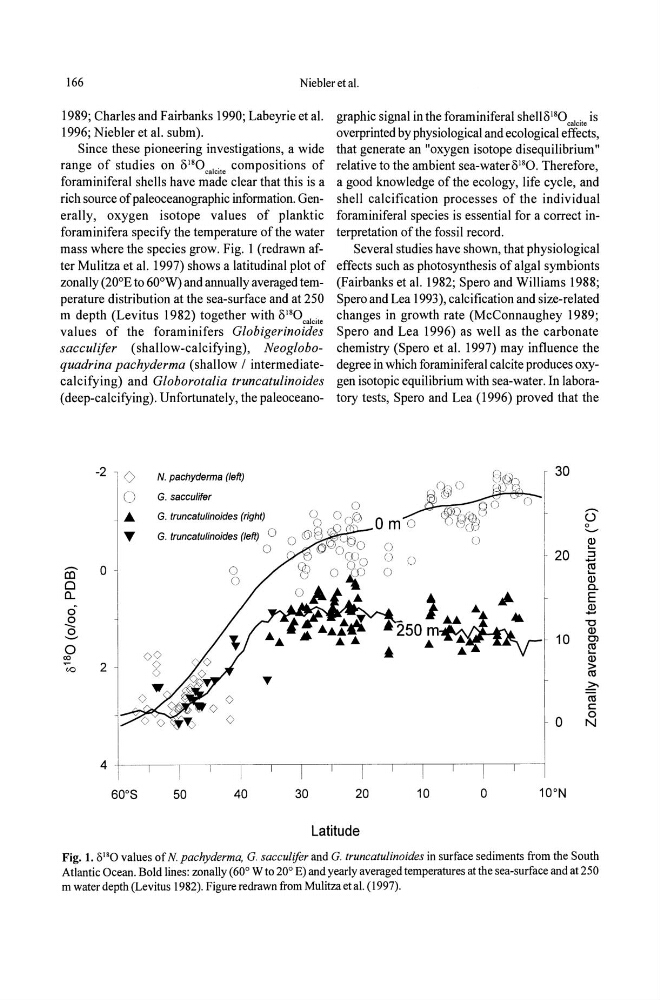
mass where the species grow. Fig. 1 (redrawn after Mulitza et al. 1997) shows a latitudinal plot of
zonally (20 0 E to 60°W) and annually averaged temperature distribution at the sea-surface and at 250
m depth (Levitus 1982) together with OI80 c ,lci,.
values of the foraminifers Globigerinoides
sacculifer (shallow-calcifying), Neogloboquadrina pachyderma (shallow / intermediatecalcifying) and Globorotalia truncatulinoides
(deep-calcifying). Unfortunately, the paleoceano-2 0
N. pachyderma (left)
0
G. sacculifer
.6G. truncatulinoides (right)
T
G. truncatulinoides (left) 0
0
- 0
m
0
a...
c5
0
-- ~
0
co
CoO
2
T
4
60 0 S
50
40
30
graphic signal in the foraminiferal shelloI80c.lci,. is
overprinted by physiological and ecological effects,
that generate an "oxygen isotope disequilibrium"
relative to the ambient sea-wateroI80. Therefore,
a good knowledge ofthe ecology, life cycle, and
shell calcification processes of the individual
foraminiferal species is essential for a correct interpretation of the fossil record.
Several studies have shown, that physiological
effects such as photosynthesis of algal symbionts
(Fairbanks et al. 1982; Spero and Williams 1988;
Spero and Lea 1993), calcification and size-related
changes in growth rate (McConnaughey 1989;
Spero and Lea 1996) as well as the carbonate
chemistry (Spero et al. 1997) may influence the
degree in which foraminiferal calcite produces oxygen isotopic equilibrium with sea-water. In laboratory tests, Spero and Lea (1996) proved that the
~
30
. 8 0 0
Omo
~~
[)
~
0
0
!!!
0
0
20 ::I
-
0
C\l
....
Q)
c.
i . . . Ji..
E Q)
-
~250m~
"0
Q)
10 Cl
, ... ...
~
Q)
> C\l
~
co c
0
0
N
20
10
0
100N
Latitude
Fig. 1. 8180 values of N. pachyderma. G. sacculifer and G. truncatulinoides in surface sediments from the South
Atlantic Ocean. Bold lines: zonally (60° W to 20° E) and yearly averaged temperatures at the sea-surface and at 250
m water depth (Levitus 1982). Figure redrawn from Mulitza et al. (1997).
Niebler et al.
1989; Charles and Fairbanks 1990; Labeyrie et al.
1996; Niebler et al. subm).
Since these pioneering investigations, a wide
range of studies on OI80 c • lci ,. compositions of
foraminiferal shells have made clear that this is a
rich source of paleoceanographic information. Generally, oxygen isotope values of planktic
foraminifera specify the temperature of the water
mass where the species grow. Fig. 1 (redrawn after Mulitza et al. 1997) shows a latitudinal plot of
zonally (20 0 E to 60°W) and annually averaged temperature distribution at the sea-surface and at 250
m depth (Levitus 1982) together with OI80 c ,lci,.
values of the foraminifers Globigerinoides
sacculifer (shallow-calcifying), Neogloboquadrina pachyderma (shallow / intermediatecalcifying) and Globorotalia truncatulinoides
(deep-calcifying). Unfortunately, the paleoceano-2 0
N. pachyderma (left)
0
G. sacculifer
.6G. truncatulinoides (right)
T
G. truncatulinoides (left) 0
0
- 0
m
0
a...
c5
0
-- ~
0
co
CoO
2
T
4
60 0 S
50
40
30
graphic signal in the foraminiferal shelloI80c.lci,. is
overprinted by physiological and ecological effects,
that generate an "oxygen isotope disequilibrium"
relative to the ambient sea-wateroI80. Therefore,
a good knowledge ofthe ecology, life cycle, and
shell calcification processes of the individual
foraminiferal species is essential for a correct interpretation of the fossil record.
Several studies have shown, that physiological
effects such as photosynthesis of algal symbionts
(Fairbanks et al. 1982; Spero and Williams 1988;
Spero and Lea 1993), calcification and size-related
changes in growth rate (McConnaughey 1989;
Spero and Lea 1996) as well as the carbonate
chemistry (Spero et al. 1997) may influence the
degree in which foraminiferal calcite produces oxygen isotopic equilibrium with sea-water. In laboratory tests, Spero and Lea (1996) proved that the
~
30
. 8 0 0
Omo
~~
[)
~
0
0
!!!
0
0
20 ::I
-
0
C\l
....
Q)
c.
i . . . Ji..
E Q)
-
~250m~
"0
Q)
10 Cl
, ... ...
~
Q)
> C\l
~
co c
0
0
N
20
10
0
100N
Latitude
Fig. 1. 8180 values of N. pachyderma. G. sacculifer and G. truncatulinoides in surface sediments from the South
Atlantic Ocean. Bold lines: zonally (60° W to 20° E) and yearly averaged temperatures at the sea-surface and at 250
m water depth (Levitus 1982). Figure redrawn from Mulitza et al. (1997).