

Clues to Ocean History: a Brief Overview of Proxies
5
the sediments at the top (or bottom) of each 9.5m
long core is lost during the coring procedure. Reasons include the expansion of sediments resulting
from warming and pressure release. For example,
in ODP Site 806 (Leg 130), expansion was 6%,
gaps were typically 30-60 cm (Berger eta!. 1993).
Easily measured sediment characteristics (magnetic susceptibility, density, color) are employed to
correlate the parallel cores on board the JOIDES
Resolution, preferably in "real time", to adjust for
optimum offset.
In addition to their usefulness for correlation, the
non-destructive measurements of sediment characteristics such as magnetic susceptibility, density,
radioactivity, and color provide a new dimension in
high-resolution reconstructions of ocean circulation
and paleoproductivity (Rack 1998). These measurements are also the foundation for the age models based on tuning to astronomical cycles, and for
discrete sampling of the sediments for detailed
micropaleontological, chemical, isotopic, and
sedimentologic investigations.
What is a Proxy?
Proxy, as used here and elsewhere, is short for
proxy variable. The word "proxy" is commonly used
to describe a stand-in, as in "proxy vote" or "fighting by proxy". By analogy, "proxy variables" in the
parlance of paleoenvironmental reconstruction are
measurable descriptors which stand in for desired
(but unobservable) variables such as temperature,
salinity, nutrient content, oxygen content, carbon
dioxide concentration, wind speed, and productivity. These are the target parameters. The concept
of a proxy, then, presumes the existence (in principie) of a target, that is, the proxied parameter of
the system being reconstructed. Consequently, each
proxy is associated with a rule or rules denoting how
the transform from proxy to target is to be accomplished. Usually, this means that a transforming
algorithm has to be established by calibration.
The calibration is performed by expressing the
target parameter as a function of its proxy:
T"g = f (Prox)
(1).
For example, a widely used mapping procedure
is linear regression. The quality of a proxy is given
by the confidence with which Eq.l predicts the
target.
The tramform equation is derived through statistical evaluation of a calibration set, commonly
consisting of two subsets of data, that of the proxy
variable and that of the target parameter. Proxy
data, as sediment properties, are usually derived
from properties of surface sediments on the sea
floor. The corresponding target data are collected
in the overlying water column. In this classical
approach (e.g. CLIMAP 1976) the quality of the
surface sediment data is of particular importance.
Box cores and multicorer samples are preferable
over tops from gravity or piston cores. In some
cases, data from net tows (e.g. planktic
foraminifers) or from sediment traps (various
microfossils) have been used to build the proxy
subset for comparison with the target water properties. The implication is that the abundance ratios
in net tows and traps are similar to those arriving
at the sea floor. This assumption has poorly known
error sources, especially in the case of net tows.
Invariably, the correlation between target parameter and proxy variable is imperfect, and several more or less independent parameters will determine the behavior of the proxy. In other words,
there is more than one equation of the type shown
with the same proxy variable, but with different
targets. The prime example for this situation concerns the master proxy of paleoceanography, that
is, oxygen isotopes of foraminifers. As pointed out
by Emiliani (1955), and many others since, this
proxy is influenced by both changes in seawater
chemistry and temperature, so that the temperature estimate has to be corrected for seawater
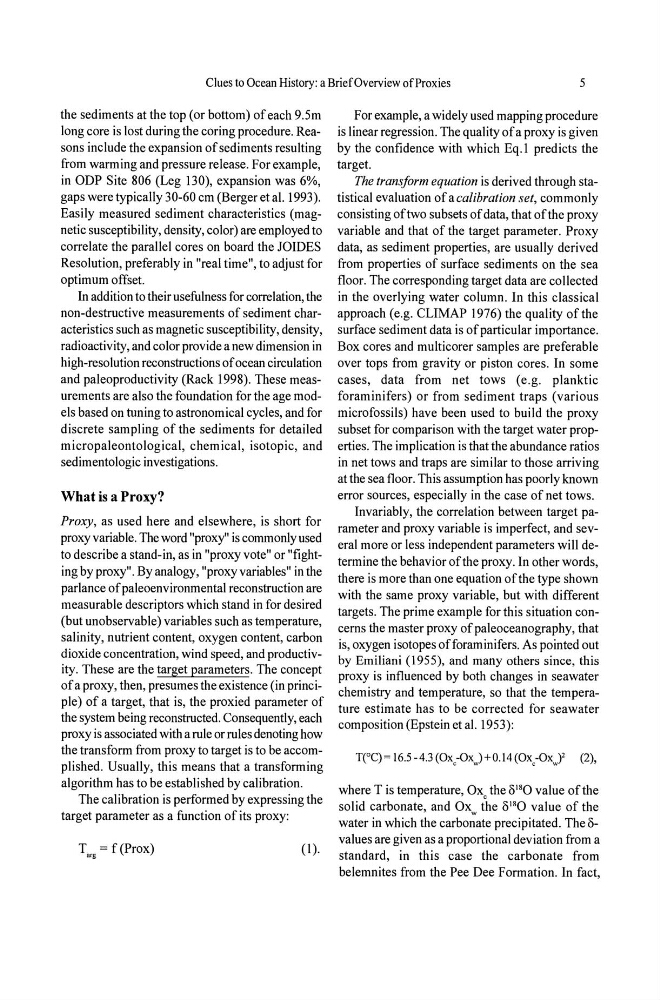
composition (Epstein et a!. 1953):
where T is temperature, Ox, the 8 18 0 value of the
solid carbonate, and OXw the 8 18 0 value of the
water in which the carbonate precipitated. The 8values are given as a proportional deviation from a
standard, in this case the carbonate from
belemnites from the Pee Dee Formation. In fact,
5
the sediments at the top (or bottom) of each 9.5m
long core is lost during the coring procedure. Reasons include the expansion of sediments resulting
from warming and pressure release. For example,
in ODP Site 806 (Leg 130), expansion was 6%,
gaps were typically 30-60 cm (Berger eta!. 1993).
Easily measured sediment characteristics (magnetic susceptibility, density, color) are employed to
correlate the parallel cores on board the JOIDES
Resolution, preferably in "real time", to adjust for
optimum offset.
In addition to their usefulness for correlation, the
non-destructive measurements of sediment characteristics such as magnetic susceptibility, density,
radioactivity, and color provide a new dimension in
high-resolution reconstructions of ocean circulation
and paleoproductivity (Rack 1998). These measurements are also the foundation for the age models based on tuning to astronomical cycles, and for
discrete sampling of the sediments for detailed
micropaleontological, chemical, isotopic, and
sedimentologic investigations.
What is a Proxy?
Proxy, as used here and elsewhere, is short for
proxy variable. The word "proxy" is commonly used
to describe a stand-in, as in "proxy vote" or "fighting by proxy". By analogy, "proxy variables" in the
parlance of paleoenvironmental reconstruction are
measurable descriptors which stand in for desired
(but unobservable) variables such as temperature,
salinity, nutrient content, oxygen content, carbon
dioxide concentration, wind speed, and productivity. These are the target parameters. The concept
of a proxy, then, presumes the existence (in principie) of a target, that is, the proxied parameter of
the system being reconstructed. Consequently, each
proxy is associated with a rule or rules denoting how
the transform from proxy to target is to be accomplished. Usually, this means that a transforming
algorithm has to be established by calibration.
The calibration is performed by expressing the
target parameter as a function of its proxy:
T"g = f (Prox)
(1).
For example, a widely used mapping procedure
is linear regression. The quality of a proxy is given
by the confidence with which Eq.l predicts the
target.
The tramform equation is derived through statistical evaluation of a calibration set, commonly
consisting of two subsets of data, that of the proxy
variable and that of the target parameter. Proxy
data, as sediment properties, are usually derived
from properties of surface sediments on the sea
floor. The corresponding target data are collected
in the overlying water column. In this classical
approach (e.g. CLIMAP 1976) the quality of the
surface sediment data is of particular importance.
Box cores and multicorer samples are preferable
over tops from gravity or piston cores. In some
cases, data from net tows (e.g. planktic
foraminifers) or from sediment traps (various
microfossils) have been used to build the proxy
subset for comparison with the target water properties. The implication is that the abundance ratios
in net tows and traps are similar to those arriving
at the sea floor. This assumption has poorly known
error sources, especially in the case of net tows.
Invariably, the correlation between target parameter and proxy variable is imperfect, and several more or less independent parameters will determine the behavior of the proxy. In other words,
there is more than one equation of the type shown
with the same proxy variable, but with different
targets. The prime example for this situation concerns the master proxy of paleoceanography, that
is, oxygen isotopes of foraminifers. As pointed out
by Emiliani (1955), and many others since, this
proxy is influenced by both changes in seawater
chemistry and temperature, so that the temperature estimate has to be corrected for seawater
composition (Epstein et a!. 1953):
where T is temperature, Ox, the 8 18 0 value of the
solid carbonate, and OXw the 8 18 0 value of the
water in which the carbonate precipitated. The 8values are given as a proportional deviation from a
standard, in this case the carbonate from
belemnites from the Pee Dee Formation. In fact,