

146
Zonneveld et al.
Motile based name
Ensiculifera carinata Matsuoka et al. 1990
Ensiculifera mexicana Ba1ech 1967
Pentapharsodinium tyrrhenicum
(Ba1ech) Montresor et al. 1993
Scrippsiella crystallina Lewis 1991
Scrippsiella lachrymosa Lewis 1991
Palaeontological based name
Bicarinellum tricarinelloides Versteegh 1993
Calciodinellum operosum Deflandre 1947
Calciperidinium asymmetricum Versteegh 1993
Pentadinellum oblatum Keupp 1991
F ollisdinellum splendidum Versteegh 1993
Orthopithonellla granifera (Ftitterer)
Keupp and Versteegh 1989
Calcicarpinum bivalvum Versteegh 1993
Praecalcigonellum schizosaeptum Versteegh 1993
Scrippsiella minima Gao and Dodge 1991
Scrippsiella precaria Montresor and Zingone 1988 -
Scrippsiella ramonii Montresor 1995
Scrippsiella rotunda Lewis 1991
Scrippsiella sweenyae (Balech) Loeblich III 1965 Wallidinellum dalei Keupp 1991
Scrippsiella trifida Lewis 1991
Scrippsiella trochoidea (Stein) Loeb1ich III 1965
Rhabdothorax ericaneus Kamptner 1937
Sphaerodinella albatrosiana (Kamptner)
Keupp and Versteegh 1989
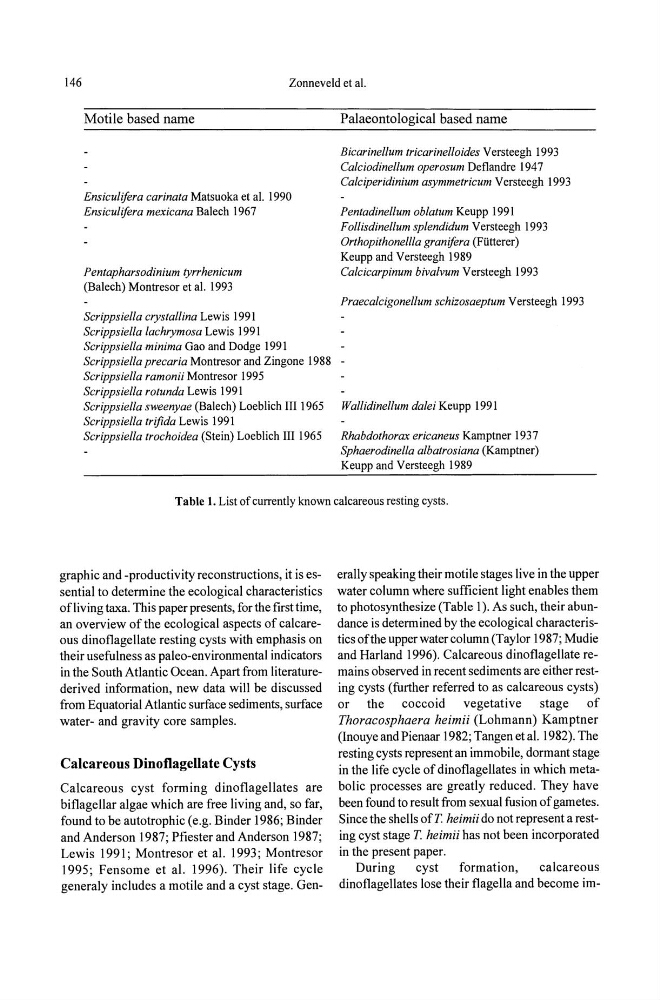
Table 1. List of currently known calcareous resting cysts.
graphic and -productivity reconstructions, it is essential to detennine the ecological characteristics
of living taxa. This paper presents, for the firsttime,
an overview of the ecological aspects of calcareous dinoflagellate resting cysts with emphasis on
their usefulness as paleo-environmental indicators
in the South Atlantic Ocean. Apart from literaturederived information, new data will be discussed
from Equatorial Atlantic surface sediments, surface
water- and gravity core samples.
Calcareous Dinoflagellate Cysts
Calcareous cyst forming dinoflagellates are
biflagellar algae which are free living and, so far,
found to be autotrophic (e.g. Binder 1986; Binder
and Anderson 1987; Pfiester and Anderson 1987;
Lewis 1991; Montresor et a1. 1993; Montresor
1995; Fensome et a1. 1996). Their life cycle
generaly includes a motile and a cyst stage. Generally speaking their motile stages live in the upper
water column where sufficient light enables them
to photosynthesize (Table 1). As such, their abundance is detennined by the ecological characteristics of the upper water column (Taylor 1987; Mudie
and Harland 1996). Calcareous dinoflagellate remains observed in recent sediments are either resting cysts (further referred to as calcareous cysts)
or the coccoid vegetative
stage
of
Thoracosphaera heimii (Lohmann) Kamptner
(Inouye and Pienaar 1982; Tangen et al. 1982). The
resting cysts represent an immobile, dormant stage
in the life cycle of dinoflagellates in which metabolic processes are greatly reduced. They have
been found to result from sexual fusion of gametes.
Since the shells of T. heimii do not represent a resting cyst stage T. heimii has not been incorporated
in the present paper.
During
cyst
formation,
calcareous
dinoflagellates lose their flagella and become im-
Zonneveld et al.
Motile based name
Ensiculifera carinata Matsuoka et al. 1990
Ensiculifera mexicana Ba1ech 1967
Pentapharsodinium tyrrhenicum
(Ba1ech) Montresor et al. 1993
Scrippsiella crystallina Lewis 1991
Scrippsiella lachrymosa Lewis 1991
Palaeontological based name
Bicarinellum tricarinelloides Versteegh 1993
Calciodinellum operosum Deflandre 1947
Calciperidinium asymmetricum Versteegh 1993
Pentadinellum oblatum Keupp 1991
F ollisdinellum splendidum Versteegh 1993
Orthopithonellla granifera (Ftitterer)
Keupp and Versteegh 1989
Calcicarpinum bivalvum Versteegh 1993
Praecalcigonellum schizosaeptum Versteegh 1993
Scrippsiella minima Gao and Dodge 1991
Scrippsiella precaria Montresor and Zingone 1988 -
Scrippsiella ramonii Montresor 1995
Scrippsiella rotunda Lewis 1991
Scrippsiella sweenyae (Balech) Loeblich III 1965 Wallidinellum dalei Keupp 1991
Scrippsiella trifida Lewis 1991
Scrippsiella trochoidea (Stein) Loeb1ich III 1965
Rhabdothorax ericaneus Kamptner 1937
Sphaerodinella albatrosiana (Kamptner)
Keupp and Versteegh 1989
Table 1. List of currently known calcareous resting cysts.
graphic and -productivity reconstructions, it is essential to detennine the ecological characteristics
of living taxa. This paper presents, for the firsttime,
an overview of the ecological aspects of calcareous dinoflagellate resting cysts with emphasis on
their usefulness as paleo-environmental indicators
in the South Atlantic Ocean. Apart from literaturederived information, new data will be discussed
from Equatorial Atlantic surface sediments, surface
water- and gravity core samples.
Calcareous Dinoflagellate Cysts
Calcareous cyst forming dinoflagellates are
biflagellar algae which are free living and, so far,
found to be autotrophic (e.g. Binder 1986; Binder
and Anderson 1987; Pfiester and Anderson 1987;
Lewis 1991; Montresor et a1. 1993; Montresor
1995; Fensome et a1. 1996). Their life cycle
generaly includes a motile and a cyst stage. Generally speaking their motile stages live in the upper
water column where sufficient light enables them
to photosynthesize (Table 1). As such, their abundance is detennined by the ecological characteristics of the upper water column (Taylor 1987; Mudie
and Harland 1996). Calcareous dinoflagellate remains observed in recent sediments are either resting cysts (further referred to as calcareous cysts)
or the coccoid vegetative
stage
of
Thoracosphaera heimii (Lohmann) Kamptner
(Inouye and Pienaar 1982; Tangen et al. 1982). The
resting cysts represent an immobile, dormant stage
in the life cycle of dinoflagellates in which metabolic processes are greatly reduced. They have
been found to result from sexual fusion of gametes.
Since the shells of T. heimii do not represent a resting cyst stage T. heimii has not been incorporated
in the present paper.
During
cyst
formation,
calcareous
dinoflagellates lose their flagella and become im-