

Coccolithophores as Indicators of Ocean Water Masses
131
more susceptible to dissolution or oxidation processes than calcareous ones.
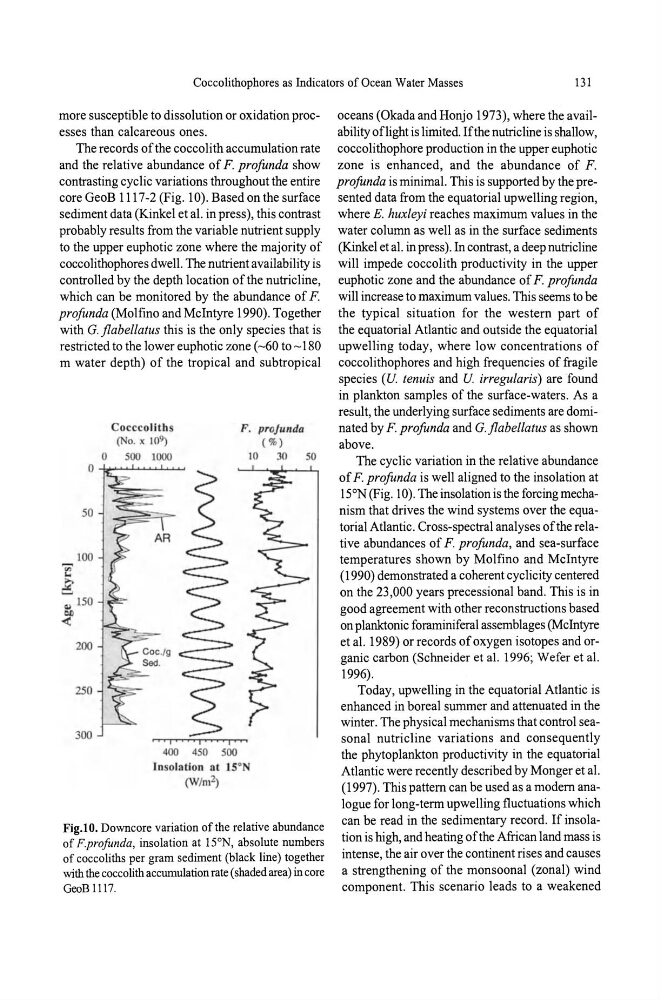
The records of the coccolith accumulation rate
and the relative abundance of F. profunda show
contrasting cyclic variations throughout the entire
core GeoB 1117-2 (Fig. 10). Based on the surface
sediment data (Kinkel et al. in press), this contrast
probably results from the variable nutrient supply
to the upper euphotic zone where the majority of
coccolithophores dwell. The nutrient availability is
controlled by the depth location of the nutricline,
which can be monitored by the abundance of F.
profunda (Mol fino and McIntyre 1990). Together
with G. jlabellatus this is the only species that is
restricted to the lower euphotic zone (-60 to -180
m water depth) of the tropical and subtropical
Cocccoliths
(No. x 1(9)
F. profunda
( % )
o 500 1000
400 450 500
Insolation at IS·
(W/m 2 )
JO
30
50
Fig.10. Downcore variation of the relative abundance
of F.profunda, insolation at lsoN, absolute numbers
of coccoliths per gram sediment (black line) together
with the coccolith accumulation rate (shaded area) in core
GeoBl1l7.
oceans (Okada and Honjo 1973), where the availability of light is limited. Ifthe nutricline is shallow,
coccolithophore production in the upper euphotic
zone is enhanced, and the abundance of F.
profunda is minimal. This is supported by the presented data from the equatorial upwelling region,
where E. huxleyi reaches maximum values in the
water column as well as in the surface sediments
(Kinkel et al. in press). In contrast, a deep nutricline
will impede coccolith productivity in the upper
euphotic zone and the abundance of F. profunda
will increase to maximum values. This seems to be
the typical situation for the western part of
the equatorial Atlantic and outside the equatorial
upwelling today, where low concentrations of
coccolithophores and high frequencies of fragile
species (u. tenuis and U. irregularis) are found
in plankton samples of the surface-waters. As a
result, the underlying surface sediments are dominated by F. profunda and G. jlabellatus as shown
above.
The cyclic variation in the relative abundance
of F. profunda is well aligned to the insolation at
IsoN (Fig. 10). The insolation is the forcing mechanism that drives the wind systems over the equatorial Atlantic. Cross-spectral analyses of the relative abundances of F. profunda, and sea-surface
temperatures shown by Molfino and McIntyre
(1990) demonstrated a coherent cyclicity centered
on the 23,000 years precessional band. This is in
good agreement with other reconstructions based
on planktonic foraminiferal assemblages (McIntyre
et al. 1989) or records of oxygen isotopes and organic carbon (Schneider et al. 1996; Wefer et al.
1996).
Today, upwelling in the equatorial Atlantic is
enhanced in boreal summer and attenuated in the
winter. The physical mechanisms that control seasonal nutricline variations and consequently
the phytoplankton productivity in the equatorial
Atlantic were recently described by Monger et al.
(1997) . This pattern can be used as a modem analogue for long-term upwelling fluctuations which
can be read in the sedimentary record. If insolation is high, and heating of the African land mass is
intense, the air over the continent rises and causes
a strengthening of the monsoonal (zonal) wind
component. This scenario leads to a weakened
131
more susceptible to dissolution or oxidation processes than calcareous ones.
The records of the coccolith accumulation rate
and the relative abundance of F. profunda show
contrasting cyclic variations throughout the entire
core GeoB 1117-2 (Fig. 10). Based on the surface
sediment data (Kinkel et al. in press), this contrast
probably results from the variable nutrient supply
to the upper euphotic zone where the majority of
coccolithophores dwell. The nutrient availability is
controlled by the depth location of the nutricline,
which can be monitored by the abundance of F.
profunda (Mol fino and McIntyre 1990). Together
with G. jlabellatus this is the only species that is
restricted to the lower euphotic zone (-60 to -180
m water depth) of the tropical and subtropical
Cocccoliths
(No. x 1(9)
F. profunda
( % )
o 500 1000
400 450 500
Insolation at IS·
(W/m 2 )
JO
30
50
Fig.10. Downcore variation of the relative abundance
of F.profunda, insolation at lsoN, absolute numbers
of coccoliths per gram sediment (black line) together
with the coccolith accumulation rate (shaded area) in core
GeoBl1l7.
oceans (Okada and Honjo 1973), where the availability of light is limited. Ifthe nutricline is shallow,
coccolithophore production in the upper euphotic
zone is enhanced, and the abundance of F.
profunda is minimal. This is supported by the presented data from the equatorial upwelling region,
where E. huxleyi reaches maximum values in the
water column as well as in the surface sediments
(Kinkel et al. in press). In contrast, a deep nutricline
will impede coccolith productivity in the upper
euphotic zone and the abundance of F. profunda
will increase to maximum values. This seems to be
the typical situation for the western part of
the equatorial Atlantic and outside the equatorial
upwelling today, where low concentrations of
coccolithophores and high frequencies of fragile
species (u. tenuis and U. irregularis) are found
in plankton samples of the surface-waters. As a
result, the underlying surface sediments are dominated by F. profunda and G. jlabellatus as shown
above.
The cyclic variation in the relative abundance
of F. profunda is well aligned to the insolation at
IsoN (Fig. 10). The insolation is the forcing mechanism that drives the wind systems over the equatorial Atlantic. Cross-spectral analyses of the relative abundances of F. profunda, and sea-surface
temperatures shown by Molfino and McIntyre
(1990) demonstrated a coherent cyclicity centered
on the 23,000 years precessional band. This is in
good agreement with other reconstructions based
on planktonic foraminiferal assemblages (McIntyre
et al. 1989) or records of oxygen isotopes and organic carbon (Schneider et al. 1996; Wefer et al.
1996).
Today, upwelling in the equatorial Atlantic is
enhanced in boreal summer and attenuated in the
winter. The physical mechanisms that control seasonal nutricline variations and consequently
the phytoplankton productivity in the equatorial
Atlantic were recently described by Monger et al.
(1997) . This pattern can be used as a modem analogue for long-term upwelling fluctuations which
can be read in the sedimentary record. If insolation is high, and heating of the African land mass is
intense, the air over the continent rises and causes
a strengthening of the monsoonal (zonal) wind
component. This scenario leads to a weakened