

92
Kemle-von Mucke and Oberhansli
Since Emiliani's early work (1954), the 8 18 0
values of planktic foraminifera shells have been used
for paleoceanographic reconstructions. Several
studies have illustrated thatthe stable isotopic values of fossil foraminifera are highly variable (e.g.
Emiliani 1971, Berger et al. 1978), because their
depth habitats may change due to local differences
in water chemistry, temperature, nutrient and light
(e.g. Williams et al. 1979; Kahn 1979; Duplessy et
al. 1981; Fairbanks etal. 1982; Kroon and Ganssen
1989; Spero and Lea 1993). Many studies have
confirmed vertical species stratification within the
photic and subphotic zones, indicating that the assemblages are adapted to particular hydrographic
conditions in the water column (e.g. Be et al. 1985;
Fairbanks et al. 1982; Arikawa 1983; Carstens
. 25 l
• 30 1
1988). Therefore, it is very importantto gather more
information about regional depth distribution patterns and calcification depths from plankton samples.
The primary objective of our tow studies was
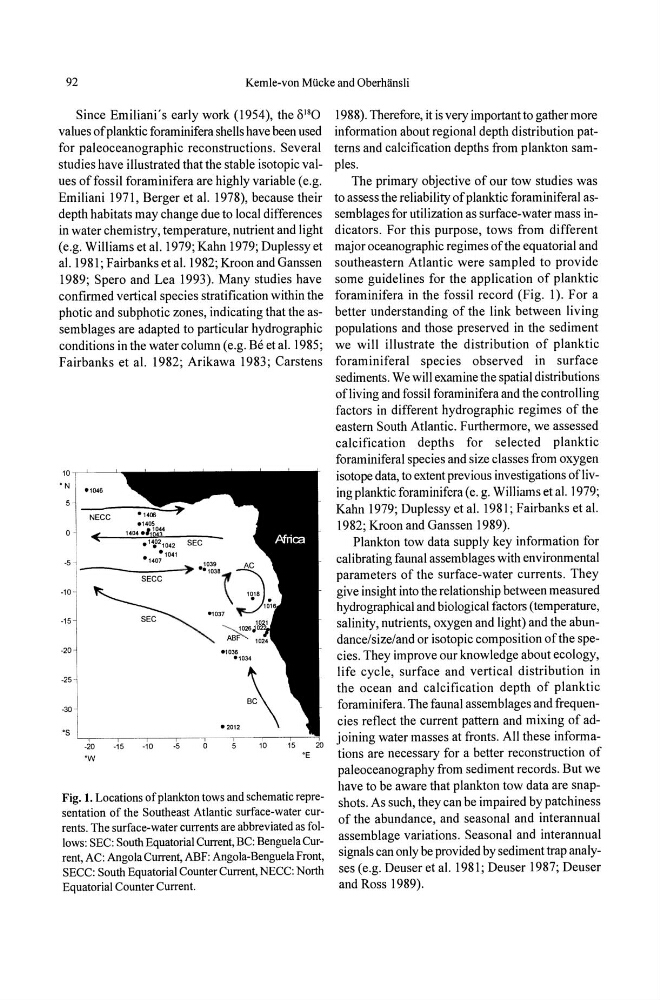
to assess the reliability of planktic foraminiferal assemblages for utilization as surface-water mass indicators. For this purpose, tows from different
major oceanographic regimes of the equatorial and
southeastern Atlantic were sampled to provide
some guidelines for the application of planktic
foraminifera in the fossil record (Fig. 1). For a
better understanding of the link between living
populations and those preserved in the sediment
we will illustrate the distribution of planktic
foraminiferal species observed in surface
sediments. We will examine the spatial distributions
of living and fossil foraminifera and the controlling
factors in different hydrographic regimes of the
eastern South Atlantic. Furthermore, we assessed
calcification depths for selected planktic
foraminiferal species and size classes from oxygen
isotope data, to extent previous investigations ofliving planktic foraminifera (e. g. Williams et al. 1979;
Kahn 1979; Duplessy et al. 1981; Fairbanks et al.
1982; Kroon and Ganssen 1989).
Plankton tow data supply key information for
calibrating faunal assemblages with environmental
parameters of the surface-water currents. They
give insight into the relationship between measured
hydrographical and biological factors (temperature,
salinity, nutrients, oxygen and light) and the abundance/size/and or isotopic composition ofthe species. They improve our knowledge about ecology,
life cycle, surface and vertical distribution in
the ocean and calcification depth of planktic
foraminifera. The faunal assemblages and frequencies reflect the current pattern and mixing of ad's L-,
·20
'w
-1-0--1"5----'="l20
joining water masses at fronts. All these informa. ,--- ,'--r-----,,----- -,--·15
·10·5
5
'E
Fig, 1. Locations of plankton tows and schematic representation of the Southeast Atlantic surface-water currents. The surface-water currents are abbreviated as follows: SEC: South Equatorial Current, BC: Benguela Current, AC: Angola Current, ABF: Angola-Benguela Front,
SECC: South Equatorial Counter Current, NECC: North
Equatorial Counter Current.
tions are necessary for a better reconstruction of
paleoceanography from sediment records. But we
have to be aware that plankton tow data are snapshots. As such, they can be impaired by patchiness
of the abundance, and seasonal and interannual
assemblage variations. Seasonal and interannual
signals can only be provided by sediment trap analyses (e.g. Deuser et al. 1981; Deuser 1987; Deuser
and Ross 1989).
Kemle-von Mucke and Oberhansli
Since Emiliani's early work (1954), the 8 18 0
values of planktic foraminifera shells have been used
for paleoceanographic reconstructions. Several
studies have illustrated thatthe stable isotopic values of fossil foraminifera are highly variable (e.g.
Emiliani 1971, Berger et al. 1978), because their
depth habitats may change due to local differences
in water chemistry, temperature, nutrient and light
(e.g. Williams et al. 1979; Kahn 1979; Duplessy et
al. 1981; Fairbanks etal. 1982; Kroon and Ganssen
1989; Spero and Lea 1993). Many studies have
confirmed vertical species stratification within the
photic and subphotic zones, indicating that the assemblages are adapted to particular hydrographic
conditions in the water column (e.g. Be et al. 1985;
Fairbanks et al. 1982; Arikawa 1983; Carstens
. 25 l
• 30 1
1988). Therefore, it is very importantto gather more
information about regional depth distribution patterns and calcification depths from plankton samples.
The primary objective of our tow studies was
to assess the reliability of planktic foraminiferal assemblages for utilization as surface-water mass indicators. For this purpose, tows from different
major oceanographic regimes of the equatorial and
southeastern Atlantic were sampled to provide
some guidelines for the application of planktic
foraminifera in the fossil record (Fig. 1). For a
better understanding of the link between living
populations and those preserved in the sediment
we will illustrate the distribution of planktic
foraminiferal species observed in surface
sediments. We will examine the spatial distributions
of living and fossil foraminifera and the controlling
factors in different hydrographic regimes of the
eastern South Atlantic. Furthermore, we assessed
calcification depths for selected planktic
foraminiferal species and size classes from oxygen
isotope data, to extent previous investigations ofliving planktic foraminifera (e. g. Williams et al. 1979;
Kahn 1979; Duplessy et al. 1981; Fairbanks et al.
1982; Kroon and Ganssen 1989).
Plankton tow data supply key information for
calibrating faunal assemblages with environmental
parameters of the surface-water currents. They
give insight into the relationship between measured
hydrographical and biological factors (temperature,
salinity, nutrients, oxygen and light) and the abundance/size/and or isotopic composition ofthe species. They improve our knowledge about ecology,
life cycle, surface and vertical distribution in
the ocean and calcification depth of planktic
foraminifera. The faunal assemblages and frequencies reflect the current pattern and mixing of ad's L-,
·20
'w
-1-0--1"5----'="l20
joining water masses at fronts. All these informa. ,--- ,'--r-----,,----- -,--·15
·10·5
5
'E
Fig, 1. Locations of plankton tows and schematic representation of the Southeast Atlantic surface-water currents. The surface-water currents are abbreviated as follows: SEC: South Equatorial Current, BC: Benguela Current, AC: Angola Current, ABF: Angola-Benguela Front,
SECC: South Equatorial Counter Current, NECC: North
Equatorial Counter Current.
tions are necessary for a better reconstruction of
paleoceanography from sediment records. But we
have to be aware that plankton tow data are snapshots. As such, they can be impaired by patchiness
of the abundance, and seasonal and interannual
assemblage variations. Seasonal and interannual
signals can only be provided by sediment trap analyses (e.g. Deuser et al. 1981; Deuser 1987; Deuser
and Ross 1989).