

Marine Outfalls 32.2 Governance 715
Part C | 32.2
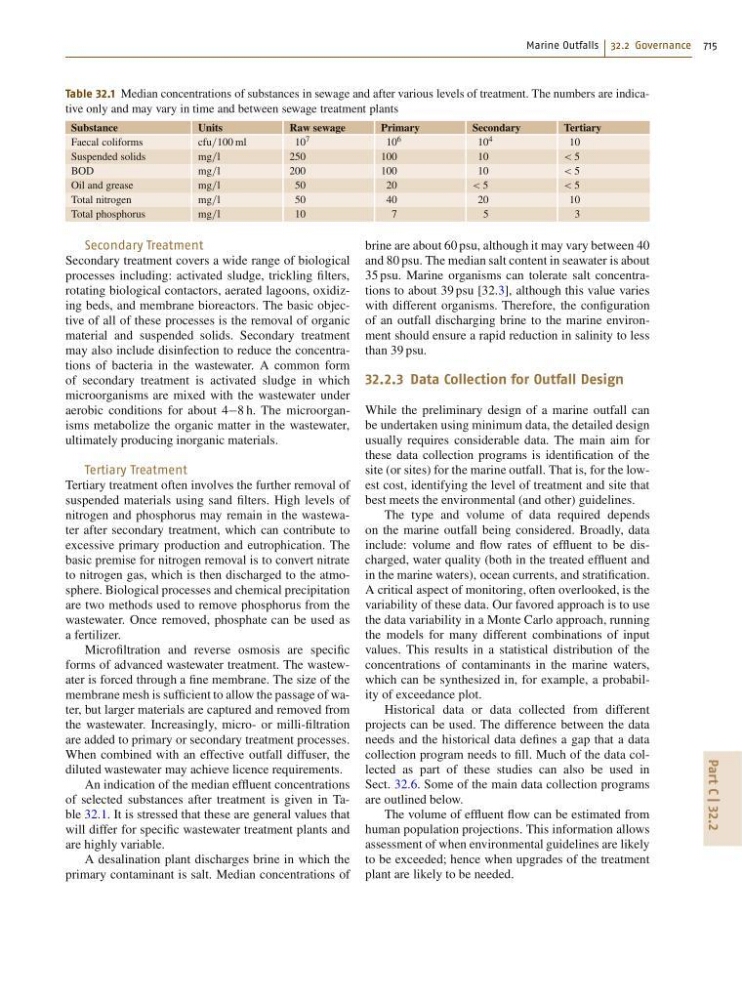
Table 32.1 Median concentrations of substances in sewage and after various levels of treatment. The numbers are indicative only and may vary in time and between sewage treatment plants
Substance
Units
Raw sewage
Primary
Secondary
Tertiary
Faecal coliforms
cfu=100 ml
10 7
10 6
10 4
10
Suspended solids
mg=l
250
100
10
< 5
BOD
mg=l
200
100
10
< 5
Oil and grease
mg=l
50
20
< 5
< 5
Total nitrogen
mg=l
50
40
20
10
Total phosphorus
mg=l
10
7
5
3
Secondary Treatment
Secondary treatment covers a wide range of biological
processes including: activated sludge, trickling filters,
rotating biological contactors, aerated lagoons, oxidizing beds, and membrane bioreactors. The basic objective of all of these processes is the removal of organic
material and suspended solids. Secondary treatment
may also include disinfection to reduce the concentrations of bacteria in the wastewater. A common form
of secondary treatment is activated sludge in which
microorganisms are mixed with the wastewater under
aerobic conditions for about 48 h. The microorganisms metabolize the organic matter in the wastewater,
ultimately producing inorganic materials.
Tertiary Treatment
Tertiary treatment often involves the further removal of
suspended materials using sand filters. High levels of
nitrogen and phosphorus may remain in the wastewater after secondary treatment, which can contribute to
excessive primary production and eutrophication. The
basic premise for nitrogen removal is to convert nitrate
to nitrogen gas, which is then discharged to the atmosphere. Biological processes and chemical precipitation
are two methods used to remove phosphorus from the
wastewater. Once removed, phosphate can be used as
a fertilizer.
Microfiltration and reverse osmosis are specific
forms of advanced wastewater treatment. The wastewater is forced through a fine membrane. The size of the
membrane mesh is sufficient to allow the passage of water, but larger materials are captured and removed from
the wastewater. Increasingly, micro- or milli-filtration
are added to primary or secondary treatment processes.
When combined with an effective outfall diffuser, the
diluted wastewater may achieve licence requirements.
An indication of the median effluent concentrations
of selected substances after treatment is given in Table 32.1. It is stressed that these are general values that
will differ for specific wastewater treatment plants and
are highly variable.
A desalination plant discharges brine in which the
primary contaminant is salt. Median concentrations of
brine are about 60 psu, although it may vary between 40
and 80 psu. The median salt content in seawater is about
35 psu. Marine organisms can tolerate salt concentrations to about 39 psu [32.3], although this value varies
with different organisms. Therefore, the configuration
of an outfall discharging brine to the marine environment should ensure a rapid reduction in salinity to less
than 39 psu.
32.2.3 Data Collection for Outfall Design
While the preliminary design of a marine outfall can
be undertaken using minimum data, the detailed design
usually requires considerable data. The main aim for
these data collection programs is identification of the
site (or sites) for the marine outfall. That is, for the lowest cost, identifying the level of treatment and site that
best meets the environmental (and other) guidelines.
The type and volume of data required depends
on the marine outfall being considered. Broadly, data
include: volume and flow rates of effluent to be discharged, water quality (both in the treated effluent and
in the marine waters), ocean currents, and stratification.
A critical aspect of monitoring, often overlooked, is the
variability of these data. Our favored approach is to use
the data variability in a Monte Carlo approach, running
the models for many different combinations of input
values. This results in a statistical distribution of the
concentrations of contaminants in the marine waters,
which can be synthesized in, for example, a probability of exceedance plot.
Historical data or data collected from different
projects can be used. The difference between the data
needs and the historical data defines a gap that a data
collection program needs to fill. Much of the data collected as part of these studies can also be used in
Sect. 32.6. Some of the main data collection programs
are outlined below.
The volume of effluent flow can be estimated from
human population projections. This information allows
assessment of when environmental guidelines are likely
to be exceeded; hence when upgrades of the treatment
plant are likely to be needed.