

Part A | 2.5
36 Part A Fundamentals
V
CF = pf |V|n
∂p
∂n
PGF = –
n
The Cartesian representation of the velocity, Coriolis
force, and pressure gradient force are
V D ui C v j ;
CF D f v i fuj ;
@p=@n D D@p=@xi C C@p=@yj :
Strictly speaking geostrophic flow is a steady-state,
rectilinear flow that is perpendicular to the Corio0
100 200 300 400 500 600 700 800 900 1000 1100
(km)
fv
1
ρ
δp
δx
3°
3.5°
4°
5°
6°
8°
12°
16°
18°
20°
Calculated slope of surface
Steep slope
Gentle slope
Broad, shallow,
weak currents
Sargasso
sea
Wa ter sur fac e
N
T o p o f m o u n d
Narrow, deep,
strong currents
Gulf stream
Canary current
a)
b)
V
(Velocity into page)
0
200
400
600
800
1000
1200
1400
1600
1800
2000
2500
3000
3500
4000
0
1m
Fig. 2.35 Generalized geostrophic flow force balance between the Coriolis force CF D f jVjn and negative pressure gradient force PGF D D.@p=@n/n, which are acting
on a water parcel with a velocity V in the orthogonal direction. The Cartesian components of different vectors are
given J
lis/pressure gradient force balance which is to the right
(left) in the Northern (Southern) Hemisphere as illustrated in Fig. 2.35. However, geostrophic flow is
a practical model because much of the open ocean flows
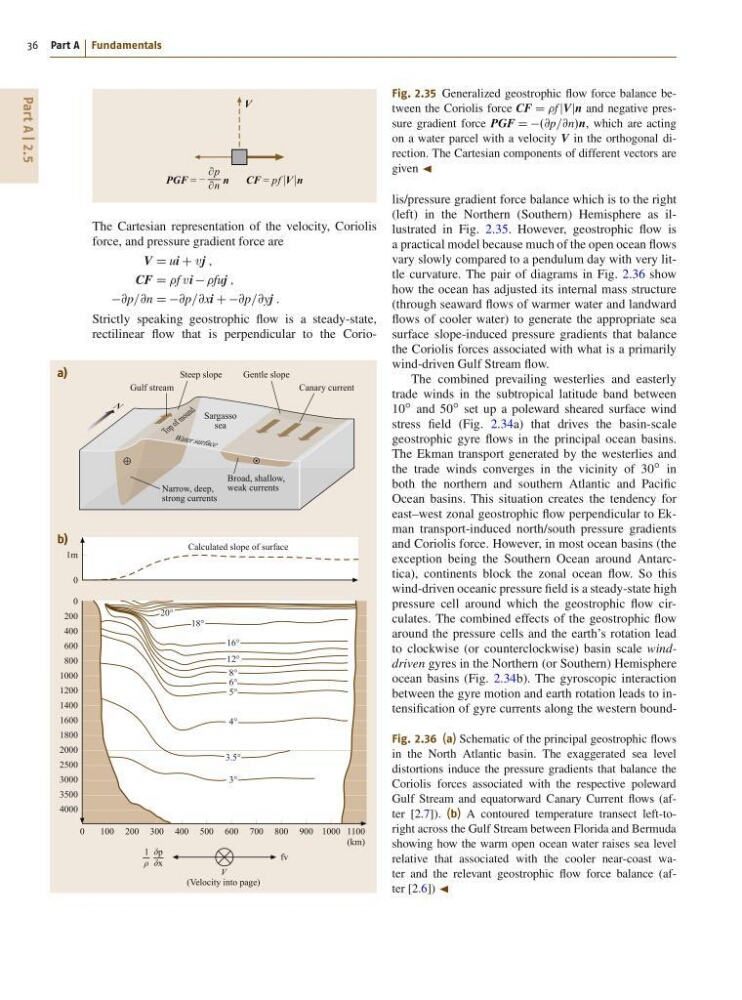
vary slowly compared to a pendulum day with very little curvature. The pair of diagrams in Fig. 2.36 show
how the ocean has adjusted its internal mass structure
(through seaward flows of warmer water and landward
flows of cooler water) to generate the appropriate sea
surface slope-induced pressure gradients that balance
the Coriolis forces associated with what is a primarily
wind-driven Gulf Stream flow.
The combined prevailing westerlies and easterly
trade winds in the subtropical latitude band between
10
ı and 50
ı set up a poleward sheared surface wind
stress field (Fig. 2.34a) that drives the basin-scale
geostrophic gyre flows in the principal ocean basins.
The Ekman transport generated by the westerlies and
the trade winds converges in the vicinity of 30
ı in
both the northern and southern Atlantic and Pacific
Ocean basins. This situation creates the tendency for
east–west zonal geostrophic flow perpendicular to Ekman transport-induced north/south pressure gradients
and Coriolis force. However, in most ocean basins (the
exception being the Southern Ocean around Antarctica), continents block the zonal ocean flow. So this
wind-driven oceanic pressure field is a steady-state high
pressure cell around which the geostrophic flow circulates. The combined effects of the geostrophic flow
around the pressure cells and the earth’s rotation lead
to clockwise (or counterclockwise) basin scale winddriven gyres in the Northern (or Southern) Hemisphere
ocean basins (Fig. 2.34b). The gyroscopic interaction
between the gyre motion and earth rotation leads to intensification of gyre currents along the western boundFig. 2.36 (a) Schematic of the principal geostrophic flows
in the North Atlantic basin. The exaggerated sea level
distortions induce the pressure gradients that balance the
Coriolis forces associated with the respective poleward
Gulf Stream and equatorward Canary Current flows (after [2.7]). (b) A contoured temperature transect left-toright across the Gulf Stream between Florida and Bermuda
showing how the warm open ocean water raises sea level
relative that associated with the cooler near-coast water and the relevant geostrophic flow force balance (after [2.6]) J
36 Part A Fundamentals
V
CF = pf |V|n
∂p
∂n
PGF = –
n
The Cartesian representation of the velocity, Coriolis
force, and pressure gradient force are
V D ui C v j ;
CF D f v i fuj ;
@p=@n D D@p=@xi C C@p=@yj :
Strictly speaking geostrophic flow is a steady-state,
rectilinear flow that is perpendicular to the Corio0
100 200 300 400 500 600 700 800 900 1000 1100
(km)
fv
1
ρ
δp
δx
3°
3.5°
4°
5°
6°
8°
12°
16°
18°
20°
Calculated slope of surface
Steep slope
Gentle slope
Broad, shallow,
weak currents
Sargasso
sea
Wa ter sur fac e
N
T o p o f m o u n d
Narrow, deep,
strong currents
Gulf stream
Canary current
a)
b)
V
(Velocity into page)
0
200
400
600
800
1000
1200
1400
1600
1800
2000
2500
3000
3500
4000
0
1m
Fig. 2.35 Generalized geostrophic flow force balance between the Coriolis force CF D f jVjn and negative pressure gradient force PGF D D.@p=@n/n, which are acting
on a water parcel with a velocity V in the orthogonal direction. The Cartesian components of different vectors are
given J
lis/pressure gradient force balance which is to the right
(left) in the Northern (Southern) Hemisphere as illustrated in Fig. 2.35. However, geostrophic flow is
a practical model because much of the open ocean flows
vary slowly compared to a pendulum day with very little curvature. The pair of diagrams in Fig. 2.36 show
how the ocean has adjusted its internal mass structure
(through seaward flows of warmer water and landward
flows of cooler water) to generate the appropriate sea
surface slope-induced pressure gradients that balance
the Coriolis forces associated with what is a primarily
wind-driven Gulf Stream flow.
The combined prevailing westerlies and easterly
trade winds in the subtropical latitude band between
10
ı and 50
ı set up a poleward sheared surface wind
stress field (Fig. 2.34a) that drives the basin-scale
geostrophic gyre flows in the principal ocean basins.
The Ekman transport generated by the westerlies and
the trade winds converges in the vicinity of 30
ı in
both the northern and southern Atlantic and Pacific
Ocean basins. This situation creates the tendency for
east–west zonal geostrophic flow perpendicular to Ekman transport-induced north/south pressure gradients
and Coriolis force. However, in most ocean basins (the
exception being the Southern Ocean around Antarctica), continents block the zonal ocean flow. So this
wind-driven oceanic pressure field is a steady-state high
pressure cell around which the geostrophic flow circulates. The combined effects of the geostrophic flow
around the pressure cells and the earth’s rotation lead
to clockwise (or counterclockwise) basin scale winddriven gyres in the Northern (or Southern) Hemisphere
ocean basins (Fig. 2.34b). The gyroscopic interaction
between the gyre motion and earth rotation leads to intensification of gyre currents along the western boundFig. 2.36 (a) Schematic of the principal geostrophic flows
in the North Atlantic basin. The exaggerated sea level
distortions induce the pressure gradients that balance the
Coriolis forces associated with the respective poleward
Gulf Stream and equatorward Canary Current flows (after [2.7]). (b) A contoured temperature transect left-toright across the Gulf Stream between Florida and Bermuda
showing how the warm open ocean water raises sea level
relative that associated with the cooler near-coast water and the relevant geostrophic flow force balance (after [2.6]) J