

Modeling of Coastal Waves and Hydrodynamics 27.1 Wind Wave Modeling 601
Part C | 27.1
0
1 0
2 0
3 0
4 0
5 0
6 0
a)
x (km)
y (km)
50
45
40
35
30
25
20
15
10
5
0
300
250
200
150
100
50
0
0
1 0
2 0
3 0
4 0
5 0
6 0
b)
x (km)
y (km)
50
40
30
20
10
0
3
2.5
2
1.5
1
0.5
0
0.05
0.06
0.07
0.08
0.09
c)
Frequency (Hz)
Direction (deg)
100
50
0
–50
–100
0.05
0.06
0.07
0.08
0.09
d)
Frequency (Hz)
Direction (deg)
100
50
0
–50
–100
0.25
0.2
0.15
0.1
0.05
0
0.05
0.04
0.03
0.02
0.01
0
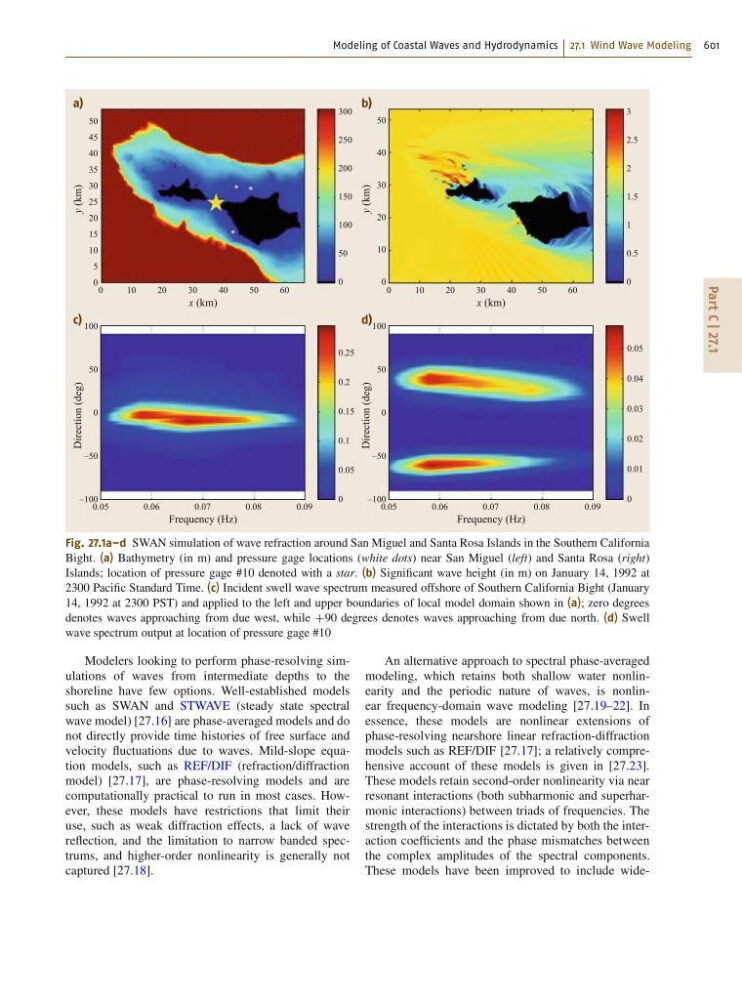
Fig. 27.1a–d SWAN simulation of wave refraction around San Miguel and Santa Rosa Islands in the Southern California
Bight. (a) Bathymetry (in m) and pressure gage locations (white dots) near San Miguel (left) and Santa Rosa (right)
Islands; location of pressure gage #10 denoted with a star. (b) Significant wave height (in m) on January 14, 1992 at
2300 Pacific Standard Time. (c) Incident swell wave spectrum measured offshore of Southern California Bight (January
14, 1992 at 2300 PST) and applied to the left and upper boundaries of local model domain shown in (a); zero degrees
denotes waves approaching from due west, while C90 degrees denotes waves approaching from due north. (d) Swell
wave spectrum output at location of pressure gage #10
Modelers looking to perform phase-resolving simulations of waves from intermediate depths to the
shoreline have few options. Well-established models
such as SWAN and STWAVE (steady state spectral
wave model) [27.16] are phase-averaged models and do
not directly provide time histories of free surface and
velocity fluctuations due to waves. Mild-slope equation models, such as REF/DIF (refraction/diffraction
model) [27.17], are phase-resolving models and are
computationally practical to run in most cases. However, these models have restrictions that limit their
use, such as weak diffraction effects, a lack of wave
reflection, and the limitation to narrow banded spectrums, and higher-order nonlinearity is generally not
captured [27.18].
An alternative approach to spectral phase-averaged
modeling, which retains both shallow water nonlinearity and the periodic nature of waves, is nonlinear frequency-domain wave modeling [27.19–22]. In
essence, these models are nonlinear extensions of
phase-resolving nearshore linear refraction-diffraction
models such as REF/DIF [27.17]; a relatively comprehensive account of these models is given in [27.23].
These models retain second-order nonlinearity via near
resonant interactions (both subharmonic and superharmonic interactions) between triads of frequencies. The
strength of the interactions is dictated by both the interaction coefficients and the phase mismatches between
the complex amplitudes of the spectral components.
These models have been improved to include wide-