

Statistical Characterization of Hazards and Risk in Coastal Areas 26.A Appendix: Glossary of Probability and Risk Terms 589
Part C | 26.A
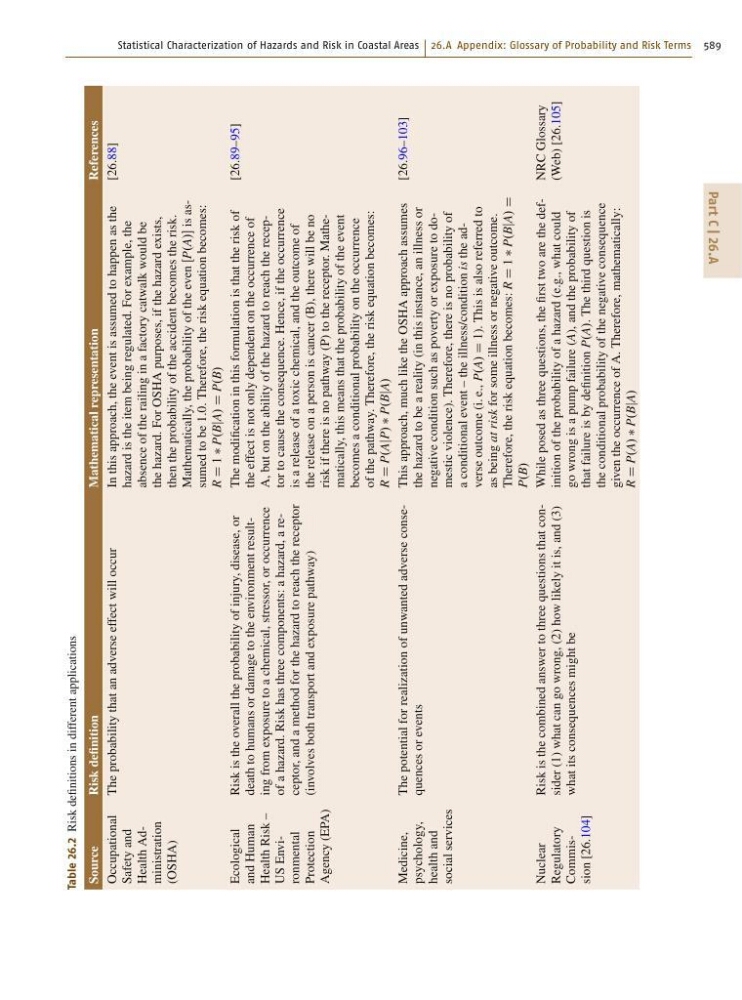
Table 26.2
Risk definitions in different applications
Source
Risk definition
Mathematical representation
References
Occupational
Safety and
Health Administration
(OSHA)
The probability that an adverse effect will occur
In this approach, the event is assumed to happen as the
hazard is the item being regulated. For example, the
absence of the railing in a factory catwalk would be
the hazard. For OSHA purposes, if the hazard exists,
then the probability of the accident becomes the risk.
Mathematically, the probability of the even
ŒP.A/ is assumed to be 1.0. Therefore, the risk equation becomes:
R
D
1 P.BjA/
D P.B/
[26.88]
Ecological
and Human
Health Risk –
US Environmental
Protection
Agency (EPA)
Risk is the overall the probability of injury, disease, or
death to humans or damage to the environment resulting from exposure to a chemical, stressor, or occurrence
of a hazard. Risk has three components: a hazard, a receptor, and a method for the hazard to reach the receptor
(involves both transport and exposure pathway)
The modification in this formulation is that the risk of
the effect is not only dependent on the occurrence of
A, but on the ability of the hazard to reach the receptor to cause the consequence. Hence, if the occurrence
is a release of a toxic chemical, and the outcome of
the release on a person is cancer (B), there will be no
risk if there is no pathway (P) to the receptor. Mathematically, this means that the probability of the event
becomes a conditional probability on the occurrence
of the pathway. Therefore, the risk equation becomes:
R
D P.AjP/
P.BjA/
[26.89–95]
Medicine,
psychology,
health and
social services
The potential for realization of unwanted adverse consequences or events
This approach, much like the OSHA approach assumes
the hazard to be a reality (in this instance, an illness or
negative condition such as poverty or exposure to domestic violence). Therefore, there is no probability of
a conditional event – the illness/condition is
the adverse outcome (i. e., P.A/
D
1). This is also referred to
as being at risk
for some illness or negative outcome.
Therefore, the risk equation becomes: R
D
1 P.BjA/
D
P.B/
[26.96–103]
Nuclear
Regulatory
Commission [26.104]
Risk is the combined answer to three questions that consider (1) what can go wrong, (2) how likely it is, and (3)
what its consequences might be
While posed as three questions, the first two are the definition of the probability of a hazard (e.g., what could
go wrong is a pump failure (A), and the probability of
that failure is by definition P.A/.
The third question is
the conditional probability of the negative consequence
given the occurrence of A. Therefore, mathematically:
R
D P.A/
P.BjA/
NRC Glossary
(Web) [26.105]