

Part B | 20.4
466 Part B Autonomous Ocean Vehicles, Subsystems and Control
Undefined
Driving
Transit
Station_Keep
BHV_StationKeep
BHV_Loiter
BHV_Lawnmower
BHV_FollowGradient
BHV_ConstantDepth
BHV_YoYo
Station Keep
IvP behavior
Loiter
Search
Classify
Track
Loiter
Return
Prosecute
Classify
Track
Search
Deploy
Surfacing
Allstop
Mission
Heading
Speed
Depth
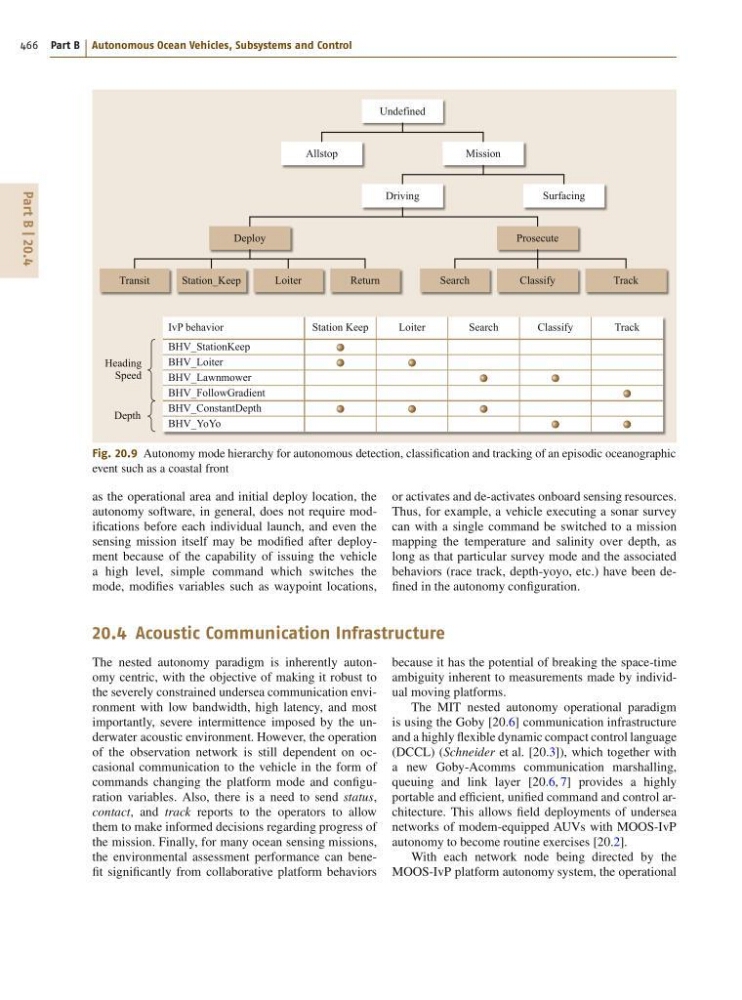
Fig. 20.9 Autonomy mode hierarchy for autonomous detection, classification and tracking of an episodic oceanographic
event such as a coastal front
as the operational area and initial deploy location, the
autonomy software, in general, does not require modifications before each individual launch, and even the
sensing mission itself may be modified after deployment because of the capability of issuing the vehicle
a high level, simple command which switches the
mode, modifies variables such as waypoint locations,
or activates and de-activates onboard sensing resources.
Thus, for example, a vehicle executing a sonar survey
can with a single command be switched to a mission
mapping the temperature and salinity over depth, as
long as that particular survey mode and the associated
behaviors (race track, depth-yoyo, etc.) have been defined in the autonomy configuration.
20.4 Acoustic Communication Infrastructure
The nested autonomy paradigm is inherently autonomy centric, with the objective of making it robust to
the severely constrained undersea communication environment with low bandwidth, high latency, and most
importantly, severe intermittence imposed by the underwater acoustic environment. However, the operation
of the observation network is still dependent on occasional communication to the vehicle in the form of
commands changing the platform mode and configuration variables. Also, there is a need to send status,
contact, and track reports to the operators to allow
them to make informed decisions regarding progress of
the mission. Finally, for many ocean sensing missions,
the environmental assessment performance can benefit significantly from collaborative platform behaviors
because it has the potential of breaking the space-time
ambiguity inherent to measurements made by individual moving platforms.
The MIT nested autonomy operational paradigm
is using the Goby [20.6] communication infrastructure
and a highly flexible dynamic compact control language
(DCCL) (Schneider et al. [20.3]), which together with
a new Goby-Acomms communication marshalling,
queuing and link layer [20.6, 7] provides a highly
portable and efficient, unified command and control architecture. This allows field deployments of undersea
networks of modem-equipped AUVs with MOOS-IvP
autonomy to become routine exercises [20.2].
With each network node being directed by the
MOOS-IvP platform autonomy system, the operational
466 Part B Autonomous Ocean Vehicles, Subsystems and Control
Undefined
Driving
Transit
Station_Keep
BHV_StationKeep
BHV_Loiter
BHV_Lawnmower
BHV_FollowGradient
BHV_ConstantDepth
BHV_YoYo
Station Keep
IvP behavior
Loiter
Search
Classify
Track
Loiter
Return
Prosecute
Classify
Track
Search
Deploy
Surfacing
Allstop
Mission
Heading
Speed
Depth
Fig. 20.9 Autonomy mode hierarchy for autonomous detection, classification and tracking of an episodic oceanographic
event such as a coastal front
as the operational area and initial deploy location, the
autonomy software, in general, does not require modifications before each individual launch, and even the
sensing mission itself may be modified after deployment because of the capability of issuing the vehicle
a high level, simple command which switches the
mode, modifies variables such as waypoint locations,
or activates and de-activates onboard sensing resources.
Thus, for example, a vehicle executing a sonar survey
can with a single command be switched to a mission
mapping the temperature and salinity over depth, as
long as that particular survey mode and the associated
behaviors (race track, depth-yoyo, etc.) have been defined in the autonomy configuration.
20.4 Acoustic Communication Infrastructure
The nested autonomy paradigm is inherently autonomy centric, with the objective of making it robust to
the severely constrained undersea communication environment with low bandwidth, high latency, and most
importantly, severe intermittence imposed by the underwater acoustic environment. However, the operation
of the observation network is still dependent on occasional communication to the vehicle in the form of
commands changing the platform mode and configuration variables. Also, there is a need to send status,
contact, and track reports to the operators to allow
them to make informed decisions regarding progress of
the mission. Finally, for many ocean sensing missions,
the environmental assessment performance can benefit significantly from collaborative platform behaviors
because it has the potential of breaking the space-time
ambiguity inherent to measurements made by individual moving platforms.
The MIT nested autonomy operational paradigm
is using the Goby [20.6] communication infrastructure
and a highly flexible dynamic compact control language
(DCCL) (Schneider et al. [20.3]), which together with
a new Goby-Acomms communication marshalling,
queuing and link layer [20.6, 7] provides a highly
portable and efficient, unified command and control architecture. This allows field deployments of undersea
networks of modem-equipped AUVs with MOOS-IvP
autonomy to become routine exercises [20.2].
With each network node being directed by the
MOOS-IvP platform autonomy system, the operational