

Non-Acoustic Sensors References 437
Part B | 18
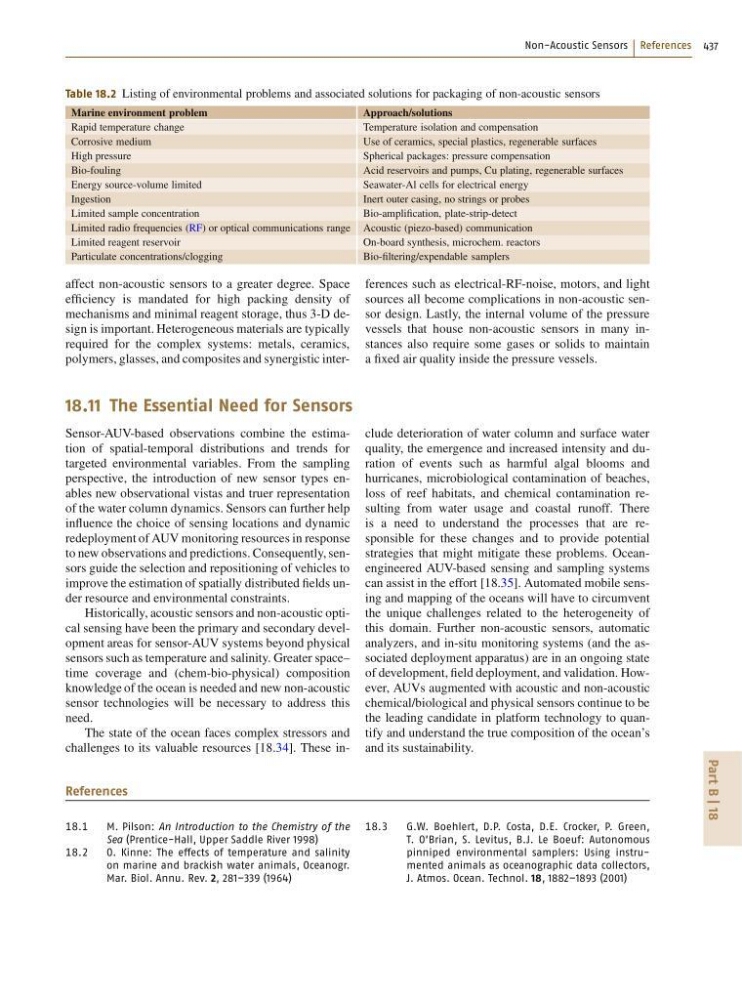
Table 18.2 Listing of environmental problems and associated solutions for packaging of non-acoustic sensors
Marine environment problem
Approach/solutions
Rapid temperature change
Temperature isolation and compensation
Corrosive medium
Use of ceramics, special plastics, regenerable surfaces
High pressure
Spherical packages: pressure compensation
Bio-fouling
Acid reservoirs and pumps, Cu plating, regenerable surfaces
Energy source-volume limited
Seawater-Al cells for electrical energy
Ingestion
Inert outer casing, no strings or probes
Limited sample concentration
Bio-amplification, plate-strip-detect
Limited radio frequencies (RF) or optical communications range Acoustic (piezo-based) communication
Limited reagent reservoir
On-board synthesis, microchem. reactors
Particulate concentrations/clogging
Bio-filtering/expendable samplers
affect non-acoustic sensors to a greater degree. Space
efficiency is mandated for high packing density of
mechanisms and minimal reagent storage, thus 3-D design is important. Heterogeneous materials are typically
required for the complex systems: metals, ceramics,
polymers, glasses, and composites and synergistic interferences such as electrical-RF-noise, motors, and light
sources all become complications in non-acoustic sensor design. Lastly, the internal volume of the pressure
vessels that house non-acoustic sensors in many instances also require some gases or solids to maintain
a fixed air quality inside the pressure vessels.
18.11 The Essential Need for Sensors
Sensor-AUV-based observations combine the estimation of spatial-temporal distributions and trends for
targeted environmental variables. From the sampling
perspective, the introduction of new sensor types enables new observational vistas and truer representation
of the water column dynamics. Sensors can further help
influence the choice of sensing locations and dynamic
redeployment of AUV monitoring resources in response
to new observations and predictions. Consequently, sensors guide the selection and repositioning of vehicles to
improve the estimation of spatially distributed fields under resource and environmental constraints.
Historically, acoustic sensors and non-acoustic optical sensing have been the primary and secondary development areas for sensor-AUV systems beyond physical
sensors such as temperature and salinity. Greater space–
time coverage and (chem-bio-physical) composition
knowledge of the ocean is needed and new non-acoustic
sensor technologies will be necessary to address this
need.
The state of the ocean faces complex stressors and
challenges to its valuable resources [18.34]. These include deterioration of water column and surface water
quality, the emergence and increased intensity and duration of events such as harmful algal blooms and
hurricanes, microbiological contamination of beaches,
loss of reef habitats, and chemical contamination resulting from water usage and coastal runoff. There
is a need to understand the processes that are responsible for these changes and to provide potential
strategies that might mitigate these problems. Oceanengineered AUV-based sensing and sampling systems
can assist in the effort [18.35]. Automated mobile sensing and mapping of the oceans will have to circumvent
the unique challenges related to the heterogeneity of
this domain. Further non-acoustic sensors, automatic
analyzers, and in-situ monitoring systems (and the associated deployment apparatus) are in an ongoing state
of development, field deployment, and validation. However, AUVs augmented with acoustic and non-acoustic
chemical/biological and physical sensors continue to be
the leading candidate in platform technology to quantify and understand the true composition of the ocean’s
and its sustainability.
References
18.1
M. Pilson: An Introduction to the Chemistry of the
Sea (Prentice-Hall, Upper Saddle River 1998)
18.2
O. Kinne: The effects of temperature and salinity
on marine and brackish water animals, Oceanogr.
Mar. Biol. Annu. Rev. 2, 281–339 (1964)
18.3
G.W. Boehlert, D.P. Costa, D.E. Crocker, P. Green,
T. O’Brian, S. Levitus, B.J. Le Boeuf: Autonomous
pinniped environmental samplers: Using instrumented animals as oceanographic data collectors,
J. Atmos. Ocean. Technol. 18, 1882–1893 (2001)
Part B | 18
Table 18.2 Listing of environmental problems and associated solutions for packaging of non-acoustic sensors
Marine environment problem
Approach/solutions
Rapid temperature change
Temperature isolation and compensation
Corrosive medium
Use of ceramics, special plastics, regenerable surfaces
High pressure
Spherical packages: pressure compensation
Bio-fouling
Acid reservoirs and pumps, Cu plating, regenerable surfaces
Energy source-volume limited
Seawater-Al cells for electrical energy
Ingestion
Inert outer casing, no strings or probes
Limited sample concentration
Bio-amplification, plate-strip-detect
Limited radio frequencies (RF) or optical communications range Acoustic (piezo-based) communication
Limited reagent reservoir
On-board synthesis, microchem. reactors
Particulate concentrations/clogging
Bio-filtering/expendable samplers
affect non-acoustic sensors to a greater degree. Space
efficiency is mandated for high packing density of
mechanisms and minimal reagent storage, thus 3-D design is important. Heterogeneous materials are typically
required for the complex systems: metals, ceramics,
polymers, glasses, and composites and synergistic interferences such as electrical-RF-noise, motors, and light
sources all become complications in non-acoustic sensor design. Lastly, the internal volume of the pressure
vessels that house non-acoustic sensors in many instances also require some gases or solids to maintain
a fixed air quality inside the pressure vessels.
18.11 The Essential Need for Sensors
Sensor-AUV-based observations combine the estimation of spatial-temporal distributions and trends for
targeted environmental variables. From the sampling
perspective, the introduction of new sensor types enables new observational vistas and truer representation
of the water column dynamics. Sensors can further help
influence the choice of sensing locations and dynamic
redeployment of AUV monitoring resources in response
to new observations and predictions. Consequently, sensors guide the selection and repositioning of vehicles to
improve the estimation of spatially distributed fields under resource and environmental constraints.
Historically, acoustic sensors and non-acoustic optical sensing have been the primary and secondary development areas for sensor-AUV systems beyond physical
sensors such as temperature and salinity. Greater space–
time coverage and (chem-bio-physical) composition
knowledge of the ocean is needed and new non-acoustic
sensor technologies will be necessary to address this
need.
The state of the ocean faces complex stressors and
challenges to its valuable resources [18.34]. These include deterioration of water column and surface water
quality, the emergence and increased intensity and duration of events such as harmful algal blooms and
hurricanes, microbiological contamination of beaches,
loss of reef habitats, and chemical contamination resulting from water usage and coastal runoff. There
is a need to understand the processes that are responsible for these changes and to provide potential
strategies that might mitigate these problems. Oceanengineered AUV-based sensing and sampling systems
can assist in the effort [18.35]. Automated mobile sensing and mapping of the oceans will have to circumvent
the unique challenges related to the heterogeneity of
this domain. Further non-acoustic sensors, automatic
analyzers, and in-situ monitoring systems (and the associated deployment apparatus) are in an ongoing state
of development, field deployment, and validation. However, AUVs augmented with acoustic and non-acoustic
chemical/biological and physical sensors continue to be
the leading candidate in platform technology to quantify and understand the true composition of the ocean’s
and its sustainability.
References
18.1
M. Pilson: An Introduction to the Chemistry of the
Sea (Prentice-Hall, Upper Saddle River 1998)
18.2
O. Kinne: The effects of temperature and salinity
on marine and brackish water animals, Oceanogr.
Mar. Biol. Annu. Rev. 2, 281–339 (1964)
18.3
G.W. Boehlert, D.P. Costa, D.E. Crocker, P. Green,
T. O’Brian, S. Levitus, B.J. Le Boeuf: Autonomous
pinniped environmental samplers: Using instrumented animals as oceanographic data collectors,
J. Atmos. Ocean. Technol. 18, 1882–1893 (2001)