

Part B | 18.5
434 Part B Autonomous Ocean Vehicles, Subsystems and Control
bioluminescence sensor specifically designed for deployment on multiple platforms, including shipboard
profilers, AUVs, and long-term deployment on moorings. The photomultiplier tube (PMT) and flow meter
that together comprise the core of the UBAT system
are calibrated to the appropriate National Institute of
Standards and Technology (NIST) specifications. The
current UBAT system operates to depths of 600 m at
present and uses mechanical stimulation, not unlike the
wake of a ship, necessary to obtain maximum bioluminescence potential from bioluminescent organisms
entrained in the flow. Stated sample rates of 60 Hz
are specified with a data output rate of 1 Hz. Laser
in-situ scattering and transmissometry (LISST) instrumentation include a series of submersible devices that
are configured for a number of applications, including
AUVs. All employ the small-angle forward scattering principle, also called low-angle laser scattering or
laser diffraction. Sequoia Scientific is a manufacturer
of several LISST laser sediment/particle/bubble/droplet
sensing instruments, which can be purchased currently.
Some of these instruments deliver the optical volume scattering function (VSF) of interest to optical
oceanographers. One variant of the LISST instrumentation is the LISST-hologram (LISST-HOLO). The optics
end of the LISST-HOLO consists of a 5 cm optical path using a red (658 nm) laser beam to traverse
the optical path, overfilling a charge-coupled device
(CCD) array, thereby creating a hologram. This instrument is particularly well suited to the measurement
of large, complex biological particles. The LISSTHOLO creates in-situ images of particles, using in-line
digital holography to overcome the depth of field issues other particle imaging systems are limited by.
The digitally recorded holograms yield images of particles from 25 m to 2:5 mm throughout the entire
sample volume ( 2 ml). The sampling frequency is
adjustable, with a maximum sampling frequency of
0:2 Hz or a hologram every 5 s. Others are considering
use of the LISST-HOLO to augment sensing capabilities in interdisciplinary research applications using
AUVs.
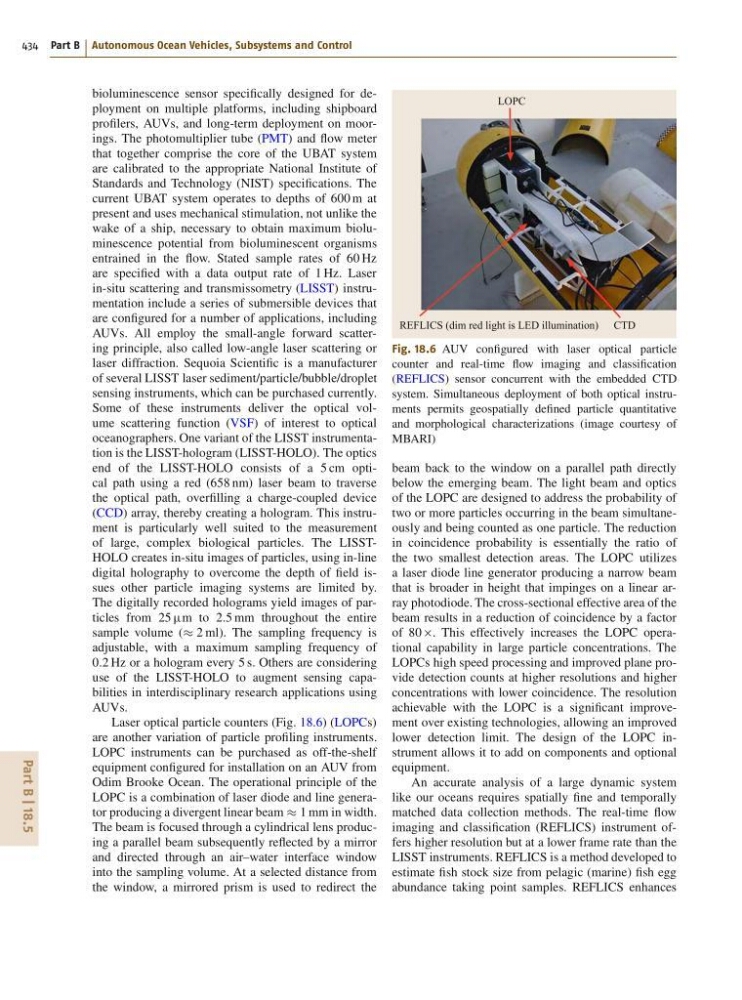
Laser optical particle counters (Fig. 18.6) (LOPCs)
are another variation of particle profiling instruments.
LOPC instruments can be purchased as off-the-shelf
equipment configured for installation on an AUV from
Odim Brooke Ocean. The operational principle of the
LOPC is a combination of laser diode and line generator producing a divergent linear beam 1 mm in width.
The beam is focused through a cylindrical lens producing a parallel beam subsequently reflected by a mirror
and directed through an air–water interface window
into the sampling volume. At a selected distance from
the window, a mirrored prism is used to redirect the
REFLICS (dim red light is LED illumination) CTD
LOPC
Fig. 18.6 AUV configured with laser optical particle
counter and real-time flow imaging and classification
(REFLICS) sensor concurrent with the embedded CTD
system. Simultaneous deployment of both optical instruments permits geospatially defined particle quantitative
and morphological characterizations (image courtesy of
MBARI)
beam back to the window on a parallel path directly
below the emerging beam. The light beam and optics
of the LOPC are designed to address the probability of
two or more particles occurring in the beam simultaneously and being counted as one particle. The reduction
in coincidence probability is essentially the ratio of
the two smallest detection areas. The LOPC utilizes
a laser diode line generator producing a narrow beam
that is broader in height that impinges on a linear array photodiode. The cross-sectional effective area of the
beam results in a reduction of coincidence by a factor
of 80 . This effectively increases the LOPC operational capability in large particle concentrations. The
LOPCs high speed processing and improved plane provide detection counts at higher resolutions and higher
concentrations with lower coincidence. The resolution
achievable with the LOPC is a significant improvement over existing technologies, allowing an improved
lower detection limit. The design of the LOPC instrument allows it to add on components and optional
equipment.
An accurate analysis of a large dynamic system
like our oceans requires spatially fine and temporally
matched data collection methods. The real-time flow
imaging and classification (REFLICS) instrument offers higher resolution but at a lower frame rate than the
LISST instruments. REFLICS is a method developed to
estimate fish stock size from pelagic (marine) fish egg
abundance taking point samples. REFLICS enhances
434 Part B Autonomous Ocean Vehicles, Subsystems and Control
bioluminescence sensor specifically designed for deployment on multiple platforms, including shipboard
profilers, AUVs, and long-term deployment on moorings. The photomultiplier tube (PMT) and flow meter
that together comprise the core of the UBAT system
are calibrated to the appropriate National Institute of
Standards and Technology (NIST) specifications. The
current UBAT system operates to depths of 600 m at
present and uses mechanical stimulation, not unlike the
wake of a ship, necessary to obtain maximum bioluminescence potential from bioluminescent organisms
entrained in the flow. Stated sample rates of 60 Hz
are specified with a data output rate of 1 Hz. Laser
in-situ scattering and transmissometry (LISST) instrumentation include a series of submersible devices that
are configured for a number of applications, including
AUVs. All employ the small-angle forward scattering principle, also called low-angle laser scattering or
laser diffraction. Sequoia Scientific is a manufacturer
of several LISST laser sediment/particle/bubble/droplet
sensing instruments, which can be purchased currently.
Some of these instruments deliver the optical volume scattering function (VSF) of interest to optical
oceanographers. One variant of the LISST instrumentation is the LISST-hologram (LISST-HOLO). The optics
end of the LISST-HOLO consists of a 5 cm optical path using a red (658 nm) laser beam to traverse
the optical path, overfilling a charge-coupled device
(CCD) array, thereby creating a hologram. This instrument is particularly well suited to the measurement
of large, complex biological particles. The LISSTHOLO creates in-situ images of particles, using in-line
digital holography to overcome the depth of field issues other particle imaging systems are limited by.
The digitally recorded holograms yield images of particles from 25 m to 2:5 mm throughout the entire
sample volume ( 2 ml). The sampling frequency is
adjustable, with a maximum sampling frequency of
0:2 Hz or a hologram every 5 s. Others are considering
use of the LISST-HOLO to augment sensing capabilities in interdisciplinary research applications using
AUVs.
Laser optical particle counters (Fig. 18.6) (LOPCs)
are another variation of particle profiling instruments.
LOPC instruments can be purchased as off-the-shelf
equipment configured for installation on an AUV from
Odim Brooke Ocean. The operational principle of the
LOPC is a combination of laser diode and line generator producing a divergent linear beam 1 mm in width.
The beam is focused through a cylindrical lens producing a parallel beam subsequently reflected by a mirror
and directed through an air–water interface window
into the sampling volume. At a selected distance from
the window, a mirrored prism is used to redirect the
REFLICS (dim red light is LED illumination) CTD
LOPC
Fig. 18.6 AUV configured with laser optical particle
counter and real-time flow imaging and classification
(REFLICS) sensor concurrent with the embedded CTD
system. Simultaneous deployment of both optical instruments permits geospatially defined particle quantitative
and morphological characterizations (image courtesy of
MBARI)
beam back to the window on a parallel path directly
below the emerging beam. The light beam and optics
of the LOPC are designed to address the probability of
two or more particles occurring in the beam simultaneously and being counted as one particle. The reduction
in coincidence probability is essentially the ratio of
the two smallest detection areas. The LOPC utilizes
a laser diode line generator producing a narrow beam
that is broader in height that impinges on a linear array photodiode. The cross-sectional effective area of the
beam results in a reduction of coincidence by a factor
of 80 . This effectively increases the LOPC operational capability in large particle concentrations. The
LOPCs high speed processing and improved plane provide detection counts at higher resolutions and higher
concentrations with lower coincidence. The resolution
achievable with the LOPC is a significant improvement over existing technologies, allowing an improved
lower detection limit. The design of the LOPC instrument allows it to add on components and optional
equipment.
An accurate analysis of a large dynamic system
like our oceans requires spatially fine and temporally
matched data collection methods. The real-time flow
imaging and classification (REFLICS) instrument offers higher resolution but at a lower frame rate than the
LISST instruments. REFLICS is a method developed to
estimate fish stock size from pelagic (marine) fish egg
abundance taking point samples. REFLICS enhances