

Part B | 16.6
402 Part B Autonomous Ocean Vehicles, Subsystems and Control
Execute
mission
En Route –
navigate to
dock
Approach
setup – transit to
outer marker
Approach –
home on dock from
outer marker
At
outer marker?
Missed dock?
Abort docking
attempt –
go to surface
Vehicle free
of dock?
Missed
approach – return to
outer marker
Capture and
engage – insert
inductive coil
Retract pin
Undock –
thrust in reverse
then drift up
Abort
undocking
Docked
Initiate docking?
Initiate undocking?
Inductive coil retracted?
Missed dock 3 times
No motion?
Detect dock with USBL?
At outer marker?
Detect RF network?
Detect
inductive
connection?
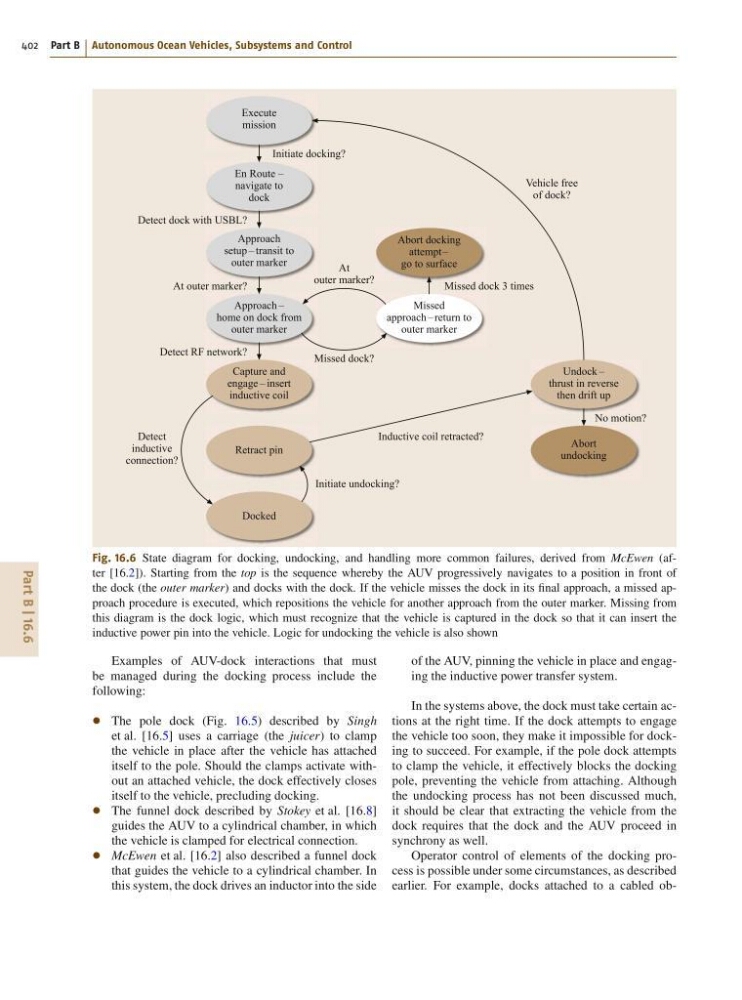
Fig. 16.6 State diagram for docking, undocking, and handling more common failures, derived from McEwen (after [16.2]). Starting from the top is the sequence whereby the AUV progressively navigates to a position in front of
the dock (the outer marker) and docks with the dock. If the vehicle misses the dock in its final approach, a missed approach procedure is executed, which repositions the vehicle for another approach from the outer marker. Missing from
this diagram is the dock logic, which must recognize that the vehicle is captured in the dock so that it can insert the
inductive power pin into the vehicle. Logic for undocking the vehicle is also shown
Examples of AUV-dock interactions that must
be managed during the docking process include the
following:
The pole dock (Fig. 16.5) described by Singh
et al. [16.5] uses a carriage (the juicer) to clamp
the vehicle in place after the vehicle has attached
itself to the pole. Should the clamps activate without an attached vehicle, the dock effectively closes
itself to the vehicle, precluding docking.
The funnel dock described by Stokey et al. [16.8]
guides the AUV to a cylindrical chamber, in which
the vehicle is clamped for electrical connection.
McEwen et al. [16.2] also described a funnel dock
that guides the vehicle to a cylindrical chamber. In
this system, the dock drives an inductor into the side
of the AUV, pinning the vehicle in place and engaging the inductive power transfer system.
In the systems above, the dock must take certain actions at the right time. If the dock attempts to engage
the vehicle too soon, they make it impossible for docking to succeed. For example, if the pole dock attempts
to clamp the vehicle, it effectively blocks the docking
pole, preventing the vehicle from attaching. Although
the undocking process has not been discussed much,
it should be clear that extracting the vehicle from the
dock requires that the dock and the AUV proceed in
synchrony as well.
Operator control of elements of the docking process is possible under some circumstances, as described
earlier. For example, docks attached to a cabled ob-
402 Part B Autonomous Ocean Vehicles, Subsystems and Control
Execute
mission
En Route –
navigate to
dock
Approach
setup – transit to
outer marker
Approach –
home on dock from
outer marker
At
outer marker?
Missed dock?
Abort docking
attempt –
go to surface
Vehicle free
of dock?
Missed
approach – return to
outer marker
Capture and
engage – insert
inductive coil
Retract pin
Undock –
thrust in reverse
then drift up
Abort
undocking
Docked
Initiate docking?
Initiate undocking?
Inductive coil retracted?
Missed dock 3 times
No motion?
Detect dock with USBL?
At outer marker?
Detect RF network?
Detect
inductive
connection?
Fig. 16.6 State diagram for docking, undocking, and handling more common failures, derived from McEwen (after [16.2]). Starting from the top is the sequence whereby the AUV progressively navigates to a position in front of
the dock (the outer marker) and docks with the dock. If the vehicle misses the dock in its final approach, a missed approach procedure is executed, which repositions the vehicle for another approach from the outer marker. Missing from
this diagram is the dock logic, which must recognize that the vehicle is captured in the dock so that it can insert the
inductive power pin into the vehicle. Logic for undocking the vehicle is also shown
Examples of AUV-dock interactions that must
be managed during the docking process include the
following:
The pole dock (Fig. 16.5) described by Singh
et al. [16.5] uses a carriage (the juicer) to clamp
the vehicle in place after the vehicle has attached
itself to the pole. Should the clamps activate without an attached vehicle, the dock effectively closes
itself to the vehicle, precluding docking.
The funnel dock described by Stokey et al. [16.8]
guides the AUV to a cylindrical chamber, in which
the vehicle is clamped for electrical connection.
McEwen et al. [16.2] also described a funnel dock
that guides the vehicle to a cylindrical chamber. In
this system, the dock drives an inductor into the side
of the AUV, pinning the vehicle in place and engaging the inductive power transfer system.
In the systems above, the dock must take certain actions at the right time. If the dock attempts to engage
the vehicle too soon, they make it impossible for docking to succeed. For example, if the pole dock attempts
to clamp the vehicle, it effectively blocks the docking
pole, preventing the vehicle from attaching. Although
the undocking process has not been discussed much,
it should be clear that extracting the vehicle from the
dock requires that the dock and the AUV proceed in
synchrony as well.
Operator control of elements of the docking process is possible under some circumstances, as described
earlier. For example, docks attached to a cabled ob-