

Part B | 15.5
376 Part B Autonomous Ocean Vehicles, Subsystems and Control
v 1 (t)
v 2 (t)
x 1 (n)
x p (n)
Equalizer 1
Phase
corrections
Equalizer P
Channel estimation and
post-cursor ISI computation
Decision
v K (t)
Data
decisions
Training
sequence
To parameter
update
e (n)
d ˆ (n)
d ˜ (n)
Pre-combiner
.
.
.
Fig. 15.15 Multichannel decision feedback equalizer
where the input vector x p .n/ to the p-th equalizer branch
consists of the sampled precombiner output
x p .t/ D
K
X
kD1
c
p;k v
.k/
.t/ :
The samples are taken at the Nyquist rate, e.g., two per
symbol interval for signals band-limited to ˙1=T. The
precombiner coefficients c p;k , the feedforward equalizer vectors a p , the feedback equalizer coefficients b i ,
and the phase estimates O
 p are adjusted adaptively
so as to minimize the mean squared error (MSE) in
data detection. Each of these parameters is thus driven
by the input signal and the error e.n/ D d.n/ O
d.n/.
Adaptive operation begins with a training sequence of
known data symbols d.n/ until convergence has been
established, after which the symbols d.n/ in (15.26)
are replaced by the decisions Q
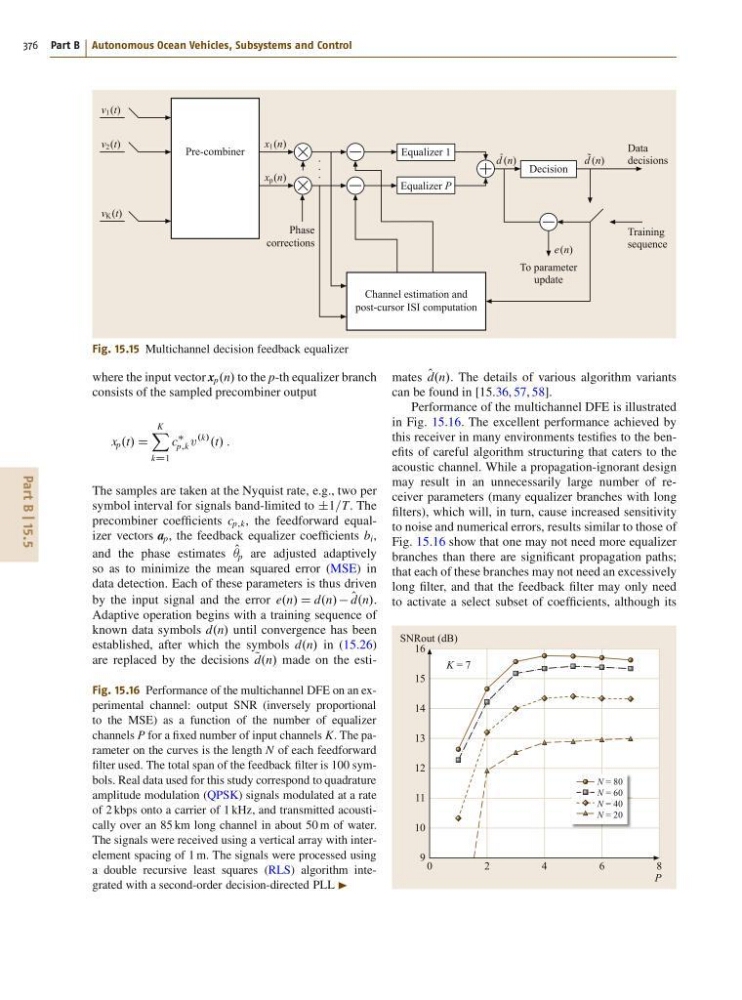
d.n/ made on the estiFig. 15.16 Performance of the multichannel DFE on an experimental channel: output SNR (inversely proportional
to the MSE) as a function of the number of equalizer
channels P for a fixed number of input channels K. The parameter on the curves is the length N of each feedforward
filter used. The total span of the feedback filter is 100 symbols. Real data used for this study correspond to quadrature
amplitude modulation (QPSK) signals modulated at a rate
of 2 kbps onto a carrier of 1 kHz, and transmitted acoustically over an 85 km long channel in about 50 m of water.
The signals were received using a vertical array with interelement spacing of 1 m. The signals were processed using
a double recursive least squares (RLS) algorithm integrated with a second-order decision-directed PLL I
mates O
d.n/. The details of various algorithm variants
can be found in [15.36, 57, 58].
Performance of the multichannel DFE is illustrated
in Fig. 15.16. The excellent performance achieved by
this receiver in many environments testifies to the benefits of careful algorithm structuring that caters to the
acoustic channel. While a propagation-ignorant design
may result in an unnecessarily large number of receiver parameters (many equalizer branches with long
filters), which will, in turn, cause increased sensitivity
to noise and numerical errors, results similar to those of
Fig. 15.16 show that one may not need more equalizer
branches than there are significant propagation paths;
that each of these branches may not need an excessively
long filter, and that the feedback filter may only need
to activate a select subset of coefficients, although its
N = 80
N = 60
N = 40
N = 20
0
2
K = 7
4
6
8
SNRout (dB)
P
16
15
14
13
12
11
10
9
376 Part B Autonomous Ocean Vehicles, Subsystems and Control
v 1 (t)
v 2 (t)
x 1 (n)
x p (n)
Equalizer 1
Phase
corrections
Equalizer P
Channel estimation and
post-cursor ISI computation
Decision
v K (t)
Data
decisions
Training
sequence
To parameter
update
e (n)
d ˆ (n)
d ˜ (n)
Pre-combiner
.
.
.
Fig. 15.15 Multichannel decision feedback equalizer
where the input vector x p .n/ to the p-th equalizer branch
consists of the sampled precombiner output
x p .t/ D
K
X
kD1
c
p;k v
.k/
.t/ :
The samples are taken at the Nyquist rate, e.g., two per
symbol interval for signals band-limited to ˙1=T. The
precombiner coefficients c p;k , the feedforward equalizer vectors a p , the feedback equalizer coefficients b i ,
and the phase estimates O
 p are adjusted adaptively
so as to minimize the mean squared error (MSE) in
data detection. Each of these parameters is thus driven
by the input signal and the error e.n/ D d.n/ O
d.n/.
Adaptive operation begins with a training sequence of
known data symbols d.n/ until convergence has been
established, after which the symbols d.n/ in (15.26)
are replaced by the decisions Q
d.n/ made on the estiFig. 15.16 Performance of the multichannel DFE on an experimental channel: output SNR (inversely proportional
to the MSE) as a function of the number of equalizer
channels P for a fixed number of input channels K. The parameter on the curves is the length N of each feedforward
filter used. The total span of the feedback filter is 100 symbols. Real data used for this study correspond to quadrature
amplitude modulation (QPSK) signals modulated at a rate
of 2 kbps onto a carrier of 1 kHz, and transmitted acoustically over an 85 km long channel in about 50 m of water.
The signals were received using a vertical array with interelement spacing of 1 m. The signals were processed using
a double recursive least squares (RLS) algorithm integrated with a second-order decision-directed PLL I
mates O
d.n/. The details of various algorithm variants
can be found in [15.36, 57, 58].
Performance of the multichannel DFE is illustrated
in Fig. 15.16. The excellent performance achieved by
this receiver in many environments testifies to the benefits of careful algorithm structuring that caters to the
acoustic channel. While a propagation-ignorant design
may result in an unnecessarily large number of receiver parameters (many equalizer branches with long
filters), which will, in turn, cause increased sensitivity
to noise and numerical errors, results similar to those of
Fig. 15.16 show that one may not need more equalizer
branches than there are significant propagation paths;
that each of these branches may not need an excessively
long filter, and that the feedback filter may only need
to activate a select subset of coefficients, although its
N = 80
N = 60
N = 40
N = 20
0
2
K = 7
4
6
8
SNRout (dB)
P
16
15
14
13
12
11
10
9