

Part B | 11.1
282 Part B Autonomous Ocean Vehicles, Subsystems and Control
Electric
Diesel
Nuclear
Tuna RM
Tuna WM
Shark RM
Bonito/Makarel RM
Bonito/Makerel WM
Empirical
NUWC BAUV
NUWC SPLINEII
Power (All)
0.0001
0.001
0.01
AUV
Mackerel
Bonito
Maneuvering
Shark red muscle
(cold blooded)
RM and submarines
Cruising
Electric submarines
Nuclear submarines
Diesel submarines
Tuna red muscle
(warm blooded)
Tuna white muscle
0.1
1
10
100
1000
10 000
100 000
Cilium &
flagellum
Unsteady hydro
(flapping fin)
Lower AR
more flexible
Higher AR
more rigid
Steady hydro (fixed blade rotating)
Displacement volume (m
3
)
Power (kW)
Reynolds number
Low
High
Very high
Very low
100 000 000
10 000 000
1000 000
100 000
10 000
1000
0.1
0.01
0.001
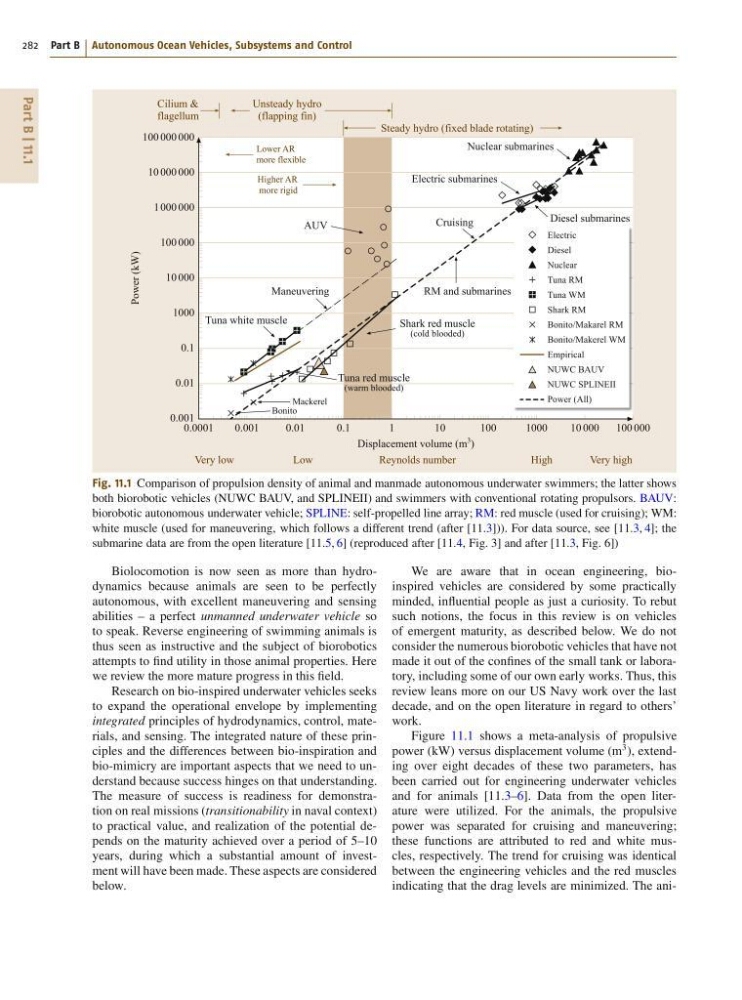
Fig. 11.1 Comparison of propulsion density of animal and manmade autonomous underwater swimmers; the latter shows
both biorobotic vehicles (NUWC BAUV, and SPLINEII) and swimmers with conventional rotating propulsors. BAUV:
biorobotic autonomous underwater vehicle; SPLINE: self-propelled line array; RM: red muscle (used for cruising); WM:
white muscle (used for maneuvering, which follows a different trend (after [11.3])). For data source, see [11.3, 4]; the
submarine data are from the open literature [11.5, 6] (reproduced after [11.4, Fig. 3] and after [11.3, Fig. 6])
Biolocomotion is now seen as more than hydrodynamics because animals are seen to be perfectly
autonomous, with excellent maneuvering and sensing
abilities – a perfect unmanned underwater vehicle so
to speak. Reverse engineering of swimming animals is
thus seen as instructive and the subject of biorobotics
attempts to find utility in those animal properties. Here
we review the more mature progress in this field.
Research on bio-inspired underwater vehicles seeks
to expand the operational envelope by implementing
integrated principles of hydrodynamics, control, materials, and sensing. The integrated nature of these principles and the differences between bio-inspiration and
bio-mimicry are important aspects that we need to understand because success hinges on that understanding.
The measure of success is readiness for demonstration on real missions (transitionability in naval context)
to practical value, and realization of the potential depends on the maturity achieved over a period of 5–10
years, during which a substantial amount of investment will have been made. These aspects are considered
below.
We are aware that in ocean engineering, bioinspired vehicles are considered by some practically
minded, influential people as just a curiosity. To rebut
such notions, the focus in this review is on vehicles
of emergent maturity, as described below. We do not
consider the numerous biorobotic vehicles that have not
made it out of the confines of the small tank or laboratory, including some of our own early works. Thus, this
review leans more on our US Navy work over the last
decade, and on the open literature in regard to others’
work.
Figure 11.1 shows a meta-analysis of propulsive
power (kW) versus displacement volume (m
3 ), extending over eight decades of these two parameters, has
been carried out for engineering underwater vehicles
and for animals [11.3–6]. Data from the open literature were utilized. For the animals, the propulsive
power was separated for cruising and maneuvering;
these functions are attributed to red and white muscles, respectively. The trend for cruising was identical
between the engineering vehicles and the red muscles
indicating that the drag levels are minimized. The ani-
282 Part B Autonomous Ocean Vehicles, Subsystems and Control
Electric
Diesel
Nuclear
Tuna RM
Tuna WM
Shark RM
Bonito/Makarel RM
Bonito/Makerel WM
Empirical
NUWC BAUV
NUWC SPLINEII
Power (All)
0.0001
0.001
0.01
AUV
Mackerel
Bonito
Maneuvering
Shark red muscle
(cold blooded)
RM and submarines
Cruising
Electric submarines
Nuclear submarines
Diesel submarines
Tuna red muscle
(warm blooded)
Tuna white muscle
0.1
1
10
100
1000
10 000
100 000
Cilium &
flagellum
Unsteady hydro
(flapping fin)
Lower AR
more flexible
Higher AR
more rigid
Steady hydro (fixed blade rotating)
Displacement volume (m
3
)
Power (kW)
Reynolds number
Low
High
Very high
Very low
100 000 000
10 000 000
1000 000
100 000
10 000
1000
0.1
0.01
0.001
Fig. 11.1 Comparison of propulsion density of animal and manmade autonomous underwater swimmers; the latter shows
both biorobotic vehicles (NUWC BAUV, and SPLINEII) and swimmers with conventional rotating propulsors. BAUV:
biorobotic autonomous underwater vehicle; SPLINE: self-propelled line array; RM: red muscle (used for cruising); WM:
white muscle (used for maneuvering, which follows a different trend (after [11.3])). For data source, see [11.3, 4]; the
submarine data are from the open literature [11.5, 6] (reproduced after [11.4, Fig. 3] and after [11.3, Fig. 6])
Biolocomotion is now seen as more than hydrodynamics because animals are seen to be perfectly
autonomous, with excellent maneuvering and sensing
abilities – a perfect unmanned underwater vehicle so
to speak. Reverse engineering of swimming animals is
thus seen as instructive and the subject of biorobotics
attempts to find utility in those animal properties. Here
we review the more mature progress in this field.
Research on bio-inspired underwater vehicles seeks
to expand the operational envelope by implementing
integrated principles of hydrodynamics, control, materials, and sensing. The integrated nature of these principles and the differences between bio-inspiration and
bio-mimicry are important aspects that we need to understand because success hinges on that understanding.
The measure of success is readiness for demonstration on real missions (transitionability in naval context)
to practical value, and realization of the potential depends on the maturity achieved over a period of 5–10
years, during which a substantial amount of investment will have been made. These aspects are considered
below.
We are aware that in ocean engineering, bioinspired vehicles are considered by some practically
minded, influential people as just a curiosity. To rebut
such notions, the focus in this review is on vehicles
of emergent maturity, as described below. We do not
consider the numerous biorobotic vehicles that have not
made it out of the confines of the small tank or laboratory, including some of our own early works. Thus, this
review leans more on our US Navy work over the last
decade, and on the open literature in regard to others’
work.
Figure 11.1 shows a meta-analysis of propulsive
power (kW) versus displacement volume (m
3 ), extending over eight decades of these two parameters, has
been carried out for engineering underwater vehicles
and for animals [11.3–6]. Data from the open literature were utilized. For the animals, the propulsive
power was separated for cruising and maneuvering;
these functions are attributed to red and white muscles, respectively. The trend for cruising was identical
between the engineering vehicles and the red muscles
indicating that the drag levels are minimized. The ani-