

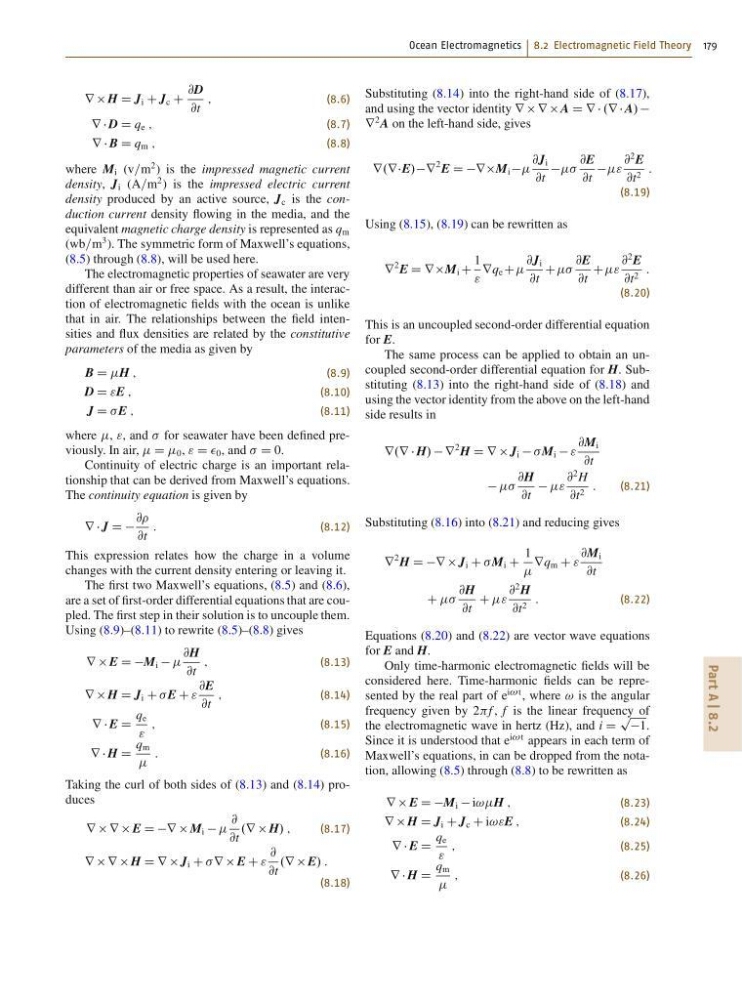
Ocean Electromagnetics 8.2 Electromagnetic Field Theory 179
Part A | 8.2
r r H D J i C J c C
@D
@t
;
(8.6)
r r D D q e ;
(8.7)
r r B D q m ;
(8.8)
where M i (v=m
2 ) is the impressed magnetic current
density, J i (A=m
2 ) is the impressed electric current
density produced by an active source, J c is the conduction current density flowing in the media, and the
equivalent magnetic charge density is represented as q m
(wb=m
3 ). The symmetric form of Maxwell’s equations,
(8.5) through (8.8), will be used here.
The electromagnetic properties of seawater are very
different than air or free space. As a result, the interaction of electromagnetic fields with the ocean is unlike
that in air. The relationships between the field intensities and flux densities are related by the constitutive
parameters of the media as given by
B D H ;
(8.9)
D D "E ;
(8.10)
J D E ;
(8.11)
where , ", and for seawater have been defined previously. In air, D 0 , " D 0 , and D 0.
Continuity of electric charge is an important relationship that can be derived from Maxwell’s equations.
The continuity equation is given by
r r J D D
@@
@t
:
(8.12)
This expression relates how the charge in a volume
changes with the current density entering or leaving it.
The first two Maxwell’s equations, (8.5) and (8.6),
are a set of first-order differential equations that are coupled. The first step in their solution is to uncouple them.
Using (8.9)–(8.11) to rewrite (8.5)–(8.8) gives
r r E D DM i
@H
@t
;
(8.13)
r r H D J i C E C "
@E
@t
;
(8.14)
r r E D
q e
"
;
(8.15)
r r H D
q m
:
(8.16)
Taking the curl of both sides of (8.13) and (8.14) produces
r r r r E D Dr r M i
@
@t
.r r H/ ;
(8.17)
r r r r H D r r J i C r r E C "
@
@t
.r r E/ :
(8.18)
Substituting (8.14) into the right-hand side of (8.17),
and using the vector identity r r r r A D r r .r r A/
r
2 A on the left-hand side, gives
r.r rE/r
2 E D DrrM i
@J i
@t
@E
@t
"
@
2 E
@t 2 :
(8.19)
Using (8.15), (8.19) can be rewritten as
r
2 E D r rM i C
1
"
rq e C
@J i
@t
C
@E
@t
C"
@
2 E
@t 2 :
(8.20)
This is an uncoupled second-order differential equation
for E.
The same process can be applied to obtain an uncoupled second-order differential equation for H. Substituting (8.13) into the right-hand side of (8.18) and
using the vector identity from the above on the left-hand
side results in
r.r r H/ r
2 H D r r J i M i "
@M i
@t
@H
@t
"
@
2 H
@t 2 :
(8.21)
Substituting (8.16) into (8.21) and reducing gives
r
2 H D Dr r J i C M i C
1
rq m C "
@M i
@t
C
@H
@t
C "
@
2 H
@t 2 :
(8.22)
Equations (8.20) and (8.22) are vector wave equations
for E and H.
Only time-harmonic electromagnetic fields will be
considered here. Time-harmonic fields can be represented by the real part of e
i!t , where ! is the angular
frequency given by 2f , f is the linear frequency of
the electromagnetic wave in hertz (Hz), and i D
p
1.
Since it is understood that e
i!t appears in each term of
Maxwell’s equations, in can be dropped from the notation, allowing (8.5) through (8.8) to be rewritten as
r r E D DM i i!!H ;
(8.23)
r r H D J i C J c C i!"E ;
(8.24)
r r E D
q e
"
;
(8.25)
r r H D
q m
;
(8.26)
Part A | 8.2
r r H D J i C J c C
@D
@t
;
(8.6)
r r D D q e ;
(8.7)
r r B D q m ;
(8.8)
where M i (v=m
2 ) is the impressed magnetic current
density, J i (A=m
2 ) is the impressed electric current
density produced by an active source, J c is the conduction current density flowing in the media, and the
equivalent magnetic charge density is represented as q m
(wb=m
3 ). The symmetric form of Maxwell’s equations,
(8.5) through (8.8), will be used here.
The electromagnetic properties of seawater are very
different than air or free space. As a result, the interaction of electromagnetic fields with the ocean is unlike
that in air. The relationships between the field intensities and flux densities are related by the constitutive
parameters of the media as given by
B D H ;
(8.9)
D D "E ;
(8.10)
J D E ;
(8.11)
where , ", and for seawater have been defined previously. In air, D 0 , " D 0 , and D 0.
Continuity of electric charge is an important relationship that can be derived from Maxwell’s equations.
The continuity equation is given by
r r J D D
@@
@t
:
(8.12)
This expression relates how the charge in a volume
changes with the current density entering or leaving it.
The first two Maxwell’s equations, (8.5) and (8.6),
are a set of first-order differential equations that are coupled. The first step in their solution is to uncouple them.
Using (8.9)–(8.11) to rewrite (8.5)–(8.8) gives
r r E D DM i
@H
@t
;
(8.13)
r r H D J i C E C "
@E
@t
;
(8.14)
r r E D
q e
"
;
(8.15)
r r H D
q m
:
(8.16)
Taking the curl of both sides of (8.13) and (8.14) produces
r r r r E D Dr r M i
@
@t
.r r H/ ;
(8.17)
r r r r H D r r J i C r r E C "
@
@t
.r r E/ :
(8.18)
Substituting (8.14) into the right-hand side of (8.17),
and using the vector identity r r r r A D r r .r r A/
r
2 A on the left-hand side, gives
r.r rE/r
2 E D DrrM i
@J i
@t
@E
@t
"
@
2 E
@t 2 :
(8.19)
Using (8.15), (8.19) can be rewritten as
r
2 E D r rM i C
1
"
rq e C
@J i
@t
C
@E
@t
C"
@
2 E
@t 2 :
(8.20)
This is an uncoupled second-order differential equation
for E.
The same process can be applied to obtain an uncoupled second-order differential equation for H. Substituting (8.13) into the right-hand side of (8.18) and
using the vector identity from the above on the left-hand
side results in
r.r r H/ r
2 H D r r J i M i "
@M i
@t
@H
@t
"
@
2 H
@t 2 :
(8.21)
Substituting (8.16) into (8.21) and reducing gives
r
2 H D Dr r J i C M i C
1
rq m C "
@M i
@t
C
@H
@t
C "
@
2 H
@t 2 :
(8.22)
Equations (8.20) and (8.22) are vector wave equations
for E and H.
Only time-harmonic electromagnetic fields will be
considered here. Time-harmonic fields can be represented by the real part of e
i!t , where ! is the angular
frequency given by 2f , f is the linear frequency of
the electromagnetic wave in hertz (Hz), and i D
p
1.
Since it is understood that e
i!t appears in each term of
Maxwell’s equations, in can be dropped from the notation, allowing (8.5) through (8.8) to be rewritten as
r r E D DM i i!!H ;
(8.23)
r r H D J i C J c C i!"E ;
(8.24)
r r E D
q e
"
;
(8.25)
r r H D
q m
;
(8.26)