

Part A | 7.1
134 Part A Fundamentals
Stern
Bow
2p
A p
2
A p
2
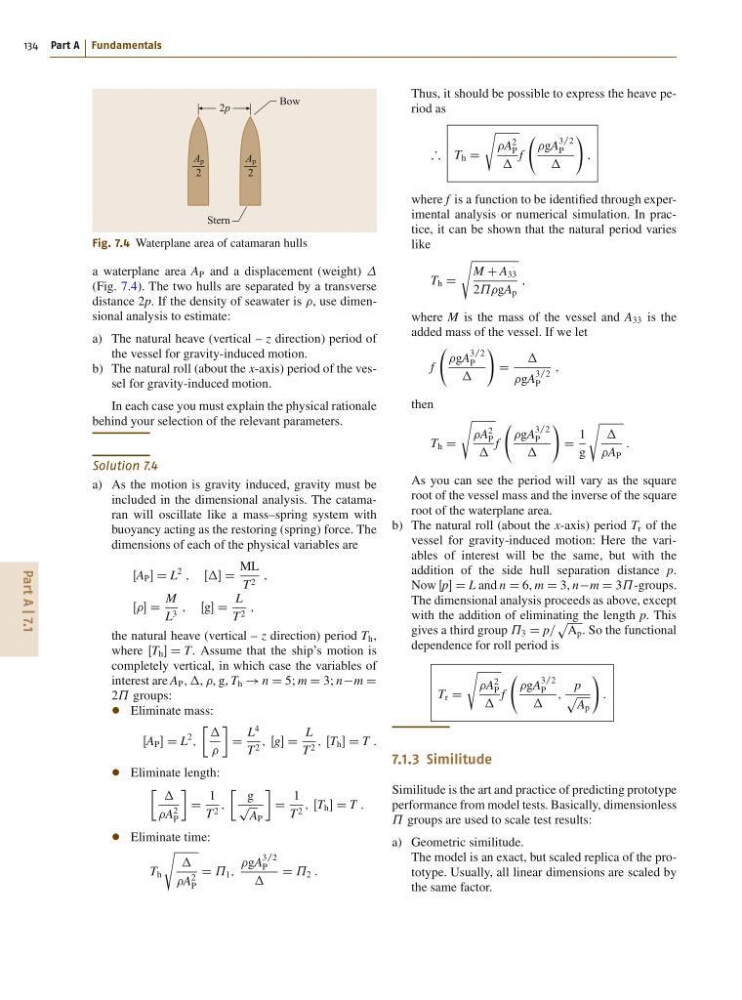
Fig. 7.4 Waterplane area of catamaran hulls
a waterplane area A P and a displacement (weight)
(Fig. 7.4). The two hulls are separated by a transverse
distance 2p. If the density of seawater is , use dimensional analysis to estimate:
a) The natural heave (vertical – z direction) period of
the vessel for gravity-induced motion.
b) The natural roll (about the x-axis) period of the vessel for gravity-induced motion.
In each case you must explain the physical rationale
behind your selection of the relevant parameters.
Solution 7.4
a) As the motion is gravity induced, gravity must be
included in the dimensional analysis. The catamaran will oscillate like a mass–spring system with
buoyancy acting as the restoring (spring) force. The
dimensions of each of the physical variables are
ŒA P D L
2
; ΠD
ML
T 2 ;
ŒŒ D
M
L 3 ; Œg D
L
T 2 ;
the natural heave (vertical – z direction) period T h ,
where ŒT h D T. Assume that the ship’s motion is
completely vertical, in which case the variables of
interest are A P ; , , g, T h ! n D 5; m D 3; nm D
2˘ groups:
Eliminate mass:
ŒA P D L
2
;
Ä
D
L
4
T 2 ; Œg D
L
T 2 ; ŒT h D T :
Eliminate length:
Ä
A
2
P
D
1
T 2 ;
Ä g
p
A P
D
1
T 2 ; ŒT h D T :
Eliminate time:
T h
s
A
2
P
D ˘ 1 ;
gA
3=2
P
D ˘ 2 :
Thus, it should be possible to express the heave period as
) T h D
s
A
2
P
f
gA
3=2
P
!
;
where f is a function to be identified through experimental analysis or numerical simulation. In practice, it can be shown that the natural period varies
like
T h D
s
M C A 33
2˘˘gA p
;
where M is the mass of the vessel and A 33 is the
added mass of the vessel. If we let
f
gA
3=2
P
!
D
gA
3=2
P
;
then
T h D
s
A
2
P
f
gA
3=2
P
!
D
1
g
s
A P
:
As you can see the period will vary as the square
root of the vessel mass and the inverse of the square
root of the waterplane area.
b) The natural roll (about the x-axis) period T r of the
vessel for gravity-induced motion: Here the variables of interest will be the same, but with the
addition of the side hull separation distance p.
Now Œp D L and n D 6, m D 3, nm D 3˘ -groups.
The dimensional analysis proceeds as above, except
with the addition of eliminating the length p. This
gives a third group ˘ 3 D p=
p
A p . So the functional
dependence for roll period is
T r D
s
A
2
P
f
gA
3=2
P
;
p
p
A p
!
:
7.1.3 Similitude
Similitude is the art and practice of predicting prototype
performance from model tests. Basically, dimensionless
˘ groups are used to scale test results:
a) Geometric similitude.
The model is an exact, but scaled replica of the prototype. Usually, all linear dimensions are scaled by
the same factor.
134 Part A Fundamentals
Stern
Bow
2p
A p
2
A p
2
Fig. 7.4 Waterplane area of catamaran hulls
a waterplane area A P and a displacement (weight)
(Fig. 7.4). The two hulls are separated by a transverse
distance 2p. If the density of seawater is , use dimensional analysis to estimate:
a) The natural heave (vertical – z direction) period of
the vessel for gravity-induced motion.
b) The natural roll (about the x-axis) period of the vessel for gravity-induced motion.
In each case you must explain the physical rationale
behind your selection of the relevant parameters.
Solution 7.4
a) As the motion is gravity induced, gravity must be
included in the dimensional analysis. The catamaran will oscillate like a mass–spring system with
buoyancy acting as the restoring (spring) force. The
dimensions of each of the physical variables are
ŒA P D L
2
; ΠD
ML
T 2 ;
ŒŒ D
M
L 3 ; Œg D
L
T 2 ;
the natural heave (vertical – z direction) period T h ,
where ŒT h D T. Assume that the ship’s motion is
completely vertical, in which case the variables of
interest are A P ; , , g, T h ! n D 5; m D 3; nm D
2˘ groups:
Eliminate mass:
ŒA P D L
2
;
Ä
D
L
4
T 2 ; Œg D
L
T 2 ; ŒT h D T :
Eliminate length:
Ä
A
2
P
D
1
T 2 ;
Ä g
p
A P
D
1
T 2 ; ŒT h D T :
Eliminate time:
T h
s
A
2
P
D ˘ 1 ;
gA
3=2
P
D ˘ 2 :
Thus, it should be possible to express the heave period as
) T h D
s
A
2
P
f
gA
3=2
P
!
;
where f is a function to be identified through experimental analysis or numerical simulation. In practice, it can be shown that the natural period varies
like
T h D
s
M C A 33
2˘˘gA p
;
where M is the mass of the vessel and A 33 is the
added mass of the vessel. If we let
f
gA
3=2
P
!
D
gA
3=2
P
;
then
T h D
s
A
2
P
f
gA
3=2
P
!
D
1
g
s
A P
:
As you can see the period will vary as the square
root of the vessel mass and the inverse of the square
root of the waterplane area.
b) The natural roll (about the x-axis) period T r of the
vessel for gravity-induced motion: Here the variables of interest will be the same, but with the
addition of the side hull separation distance p.
Now Œp D L and n D 6, m D 3, nm D 3˘ -groups.
The dimensional analysis proceeds as above, except
with the addition of eliminating the length p. This
gives a third group ˘ 3 D p=
p
A p . So the functional
dependence for roll period is
T r D
s
A
2
P
f
gA
3=2
P
;
p
p
A p
!
:
7.1.3 Similitude
Similitude is the art and practice of predicting prototype
performance from model tests. Basically, dimensionless
˘ groups are used to scale test results:
a) Geometric similitude.
The model is an exact, but scaled replica of the prototype. Usually, all linear dimensions are scaled by
the same factor.