

Part A | 7.1
130 Part A Fundamentals
Smooth
Rough
10
2
10
3
10
4
10
5
10
6
10
7
C D
Re
1.5
1
0.5
0.1
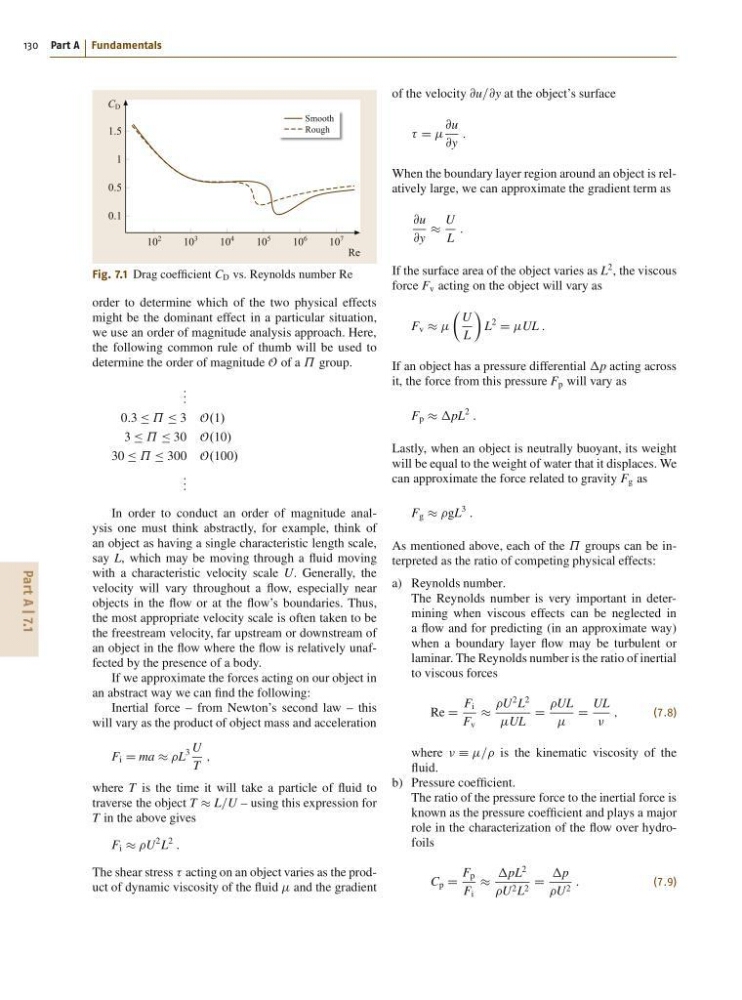
Fig. 7.1 Drag coefficient C D vs. Reynolds number Re
order to determine which of the two physical effects
might be the dominant effect in a particular situation,
we use an order of magnitude analysis approach. Here,
the following common rule of thumb will be used to
determine the order of magnitude O of a ˘ group.
: : :
0:3 Ä ˘ Ä 3 O.1/
3 Ä ˘ Ä 30 O.10/
30 Ä ˘ Ä 300 O.100/
: : :
In order to conduct an order of magnitude analysis one must think abstractly, for example, think of
an object as having a single characteristic length scale,
say L, which may be moving through a fluid moving
with a characteristic velocity scale U. Generally, the
velocity will vary throughout a flow, especially near
objects in the flow or at the flow’s boundaries. Thus,
the most appropriate velocity scale is often taken to be
the freestream velocity, far upstream or downstream of
an object in the flow where the flow is relatively unaffected by the presence of a body.
If we approximate the forces acting on our object in
an abstract way we can find the following:
Inertial force – from Newton’s second law – this
will vary as the product of object mass and acceleration
F i D ma L
3 U
T
;
where T is the time it will take a particle of fluid to
traverse the object T L=U – using this expression for
T in the above gives
F i U
2 L
2
:
The shear stress acting on an object varies as the product of dynamic viscosity of the fluid and the gradient
of the velocity @u=@y at the object’s surface
D
@u
@y
:
When the boundary layer region around an object is relatively large, we can approximate the gradient term as
@u
@y
U
L
:
If the surface area of the object varies as L
2 , the viscous
force F v acting on the object will vary as
F v
Â
U
L
Ã
L
2
D UL :
If an object has a pressure differential p acting across
it, the force from this pressure F p will vary as
F p pL
2
:
Lastly, when an object is neutrally buoyant, its weight
will be equal to the weight of water that it displaces. We
can approximate the force related to gravity F g as
F g gL
3
:
As mentioned above, each of the ˘ groups can be interpreted as the ratio of competing physical effects:
a) Reynolds number.
The Reynolds number is very important in determining when viscous effects can be neglected in
a flow and for predicting (in an approximate way)
when a boundary layer flow may be turbulent or
laminar. The Reynolds number is the ratio of inertial
to viscous forces
Re D
F i
F v
U
2 L
2
UL
D
UL
D
UL
;
(7.8)
where Á == is the kinematic viscosity of the
fluid.
b) Pressure coefficient.
The ratio of the pressure force to the inertial force is
known as the pressure coefficient and plays a major
role in the characterization of the flow over hydrofoils
C p D
F p
F i
pL
2
U 2 L 2 D
p
U 2 :
(7.9)
130 Part A Fundamentals
Smooth
Rough
10
2
10
3
10
4
10
5
10
6
10
7
C D
Re
1.5
1
0.5
0.1
Fig. 7.1 Drag coefficient C D vs. Reynolds number Re
order to determine which of the two physical effects
might be the dominant effect in a particular situation,
we use an order of magnitude analysis approach. Here,
the following common rule of thumb will be used to
determine the order of magnitude O of a ˘ group.
: : :
0:3 Ä ˘ Ä 3 O.1/
3 Ä ˘ Ä 30 O.10/
30 Ä ˘ Ä 300 O.100/
: : :
In order to conduct an order of magnitude analysis one must think abstractly, for example, think of
an object as having a single characteristic length scale,
say L, which may be moving through a fluid moving
with a characteristic velocity scale U. Generally, the
velocity will vary throughout a flow, especially near
objects in the flow or at the flow’s boundaries. Thus,
the most appropriate velocity scale is often taken to be
the freestream velocity, far upstream or downstream of
an object in the flow where the flow is relatively unaffected by the presence of a body.
If we approximate the forces acting on our object in
an abstract way we can find the following:
Inertial force – from Newton’s second law – this
will vary as the product of object mass and acceleration
F i D ma L
3 U
T
;
where T is the time it will take a particle of fluid to
traverse the object T L=U – using this expression for
T in the above gives
F i U
2 L
2
:
The shear stress acting on an object varies as the product of dynamic viscosity of the fluid and the gradient
of the velocity @u=@y at the object’s surface
D
@u
@y
:
When the boundary layer region around an object is relatively large, we can approximate the gradient term as
@u
@y
U
L
:
If the surface area of the object varies as L
2 , the viscous
force F v acting on the object will vary as
F v
Â
U
L
Ã
L
2
D UL :
If an object has a pressure differential p acting across
it, the force from this pressure F p will vary as
F p pL
2
:
Lastly, when an object is neutrally buoyant, its weight
will be equal to the weight of water that it displaces. We
can approximate the force related to gravity F g as
F g gL
3
:
As mentioned above, each of the ˘ groups can be interpreted as the ratio of competing physical effects:
a) Reynolds number.
The Reynolds number is very important in determining when viscous effects can be neglected in
a flow and for predicting (in an approximate way)
when a boundary layer flow may be turbulent or
laminar. The Reynolds number is the ratio of inertial
to viscous forces
Re D
F i
F v
U
2 L
2
UL
D
UL
D
UL
;
(7.8)
where Á == is the kinematic viscosity of the
fluid.
b) Pressure coefficient.
The ratio of the pressure force to the inertial force is
known as the pressure coefficient and plays a major
role in the characterization of the flow over hydrofoils
C p D
F p
F i
pL
2
U 2 L 2 D
p
U 2 :
(7.9)