

Part A | 6.1
112 Part A Fundamentals
Table 6.1 Typical major components and physical properties of seawater in selected oceans
Salinity (predominantly Na C
and Cl ) [ppt]
34.4 (range mainly 3138%)
Density [mg=l]
1:025 (average, at surface)
1:05 or more at depth
pH
8:1 typical (range 7:58:4 /
Ions
Weight [ppt]
Chlorine (Cl )
18:98
Sulfate (SO
4 )
2:65
Magnesium (Mg C )
1:272
Bicarbonate (HCO
3 )
0:14
Calcium (Ca 2C )
0:40
Potassium (K C )
0:38
Bromine
0:067
Carbon
0:028
Dissolved gasses
Weight [ppm]
Oxygen (O 2 )
At surface
7:5 (approx.)
500 m
1:5
2000 m
3:0
Carbon dioxide (CO 2 )
At surface
1:5
500 m
4:0
2000 m
6:0
Many of these are functions of water temperature and/or pressure (after [6.2])
involving marine growth and death [6.3]. However, in
some locations, there may be a substantial discharge of
nutrients or fertilizers or sewage effluents. Examples include highly populated areas or cities, where adjacent
coastal water quality may be lower than that in open
sea conditions. In particular, water quality can show
elevated concentrations of nutrients. For example, the
quality of seawater in the North Atlantic and that of the
adjacent North Sea is considerably different from the
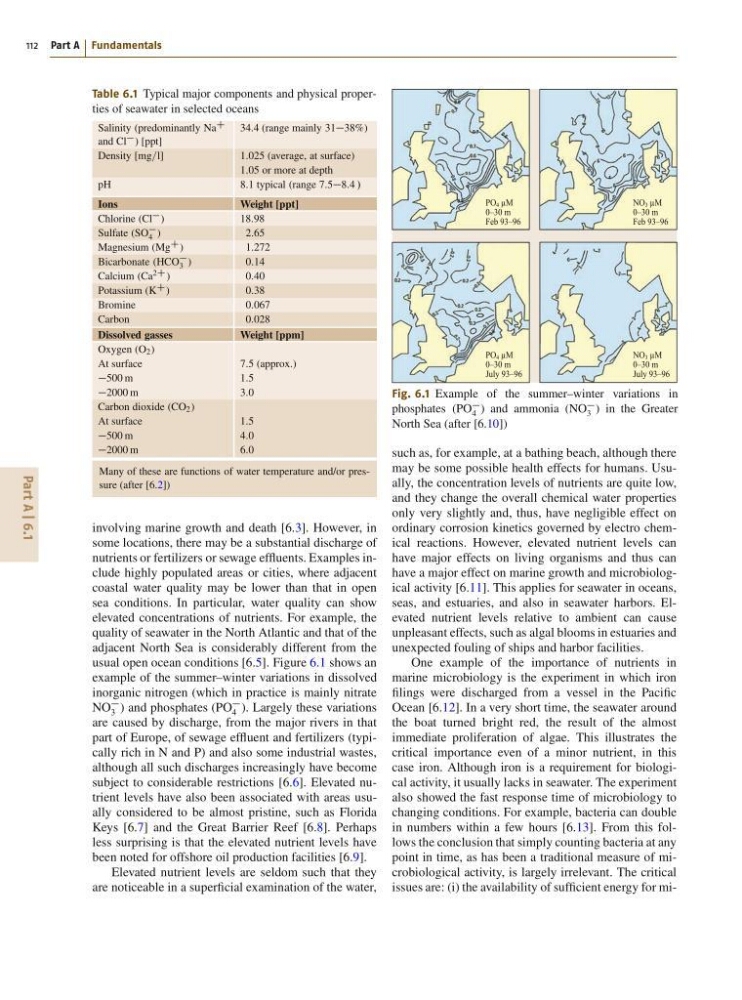
usual open ocean conditions [6.5]. Figure 6.1 shows an
example of the summer–winter variations in dissolved
inorganic nitrogen (which in practice is mainly nitrate
NO
3 ) and phosphates (PO
4 ). Largely these variations
are caused by discharge, from the major rivers in that
part of Europe, of sewage effluent and fertilizers (typically rich in N and P) and also some industrial wastes,
although all such discharges increasingly have become
subject to considerable restrictions [6.6]. Elevated nutrient levels have also been associated with areas usually considered to be almost pristine, such as Florida
Keys [6.7] and the Great Barrier Reef [6.8]. Perhaps
less surprising is that the elevated nutrient levels have
been noted for offshore oil production facilities [6.9].
Elevated nutrient levels are seldom such that they
are noticeable in a superficial examination of the water,
PO 4 μM
0–30 m
Feb 93–96
NO 3 μM
0–30 m
Feb 93–96
PO 4 μM
0–30 m
July 93–96
NO 3 μM
0–30 m
July 93–96
Fig. 6.1 Example of the summer–winter variations in
phosphates (PO
4 ) and ammonia (NO
3 ) in the Greater
North Sea (after [6.10])
such as, for example, at a bathing beach, although there
may be some possible health effects for humans. Usually, the concentration levels of nutrients are quite low,
and they change the overall chemical water properties
only very slightly and, thus, have negligible effect on
ordinary corrosion kinetics governed by electro chemical reactions. However, elevated nutrient levels can
have major effects on living organisms and thus can
have a major effect on marine growth and microbiological activity [6.11]. This applies for seawater in oceans,
seas, and estuaries, and also in seawater harbors. Elevated nutrient levels relative to ambient can cause
unpleasant effects, such as algal blooms in estuaries and
unexpected fouling of ships and harbor facilities.
One example of the importance of nutrients in
marine microbiology is the experiment in which iron
filings were discharged from a vessel in the Pacific
Ocean [6.12]. In a very short time, the seawater around
the boat turned bright red, the result of the almost
immediate proliferation of algae. This illustrates the
critical importance even of a minor nutrient, in this
case iron. Although iron is a requirement for biological activity, it usually lacks in seawater. The experiment
also showed the fast response time of microbiology to
changing conditions. For example, bacteria can double
in numbers within a few hours [6.13]. From this follows the conclusion that simply counting bacteria at any
point in time, as has been a traditional measure of microbiological activity, is largely irrelevant. The critical
issues are: (i) the availability of sufficient energy for mi-
112 Part A Fundamentals
Table 6.1 Typical major components and physical properties of seawater in selected oceans
Salinity (predominantly Na C
and Cl ) [ppt]
34.4 (range mainly 3138%)
Density [mg=l]
1:025 (average, at surface)
1:05 or more at depth
pH
8:1 typical (range 7:58:4 /
Ions
Weight [ppt]
Chlorine (Cl )
18:98
Sulfate (SO
4 )
2:65
Magnesium (Mg C )
1:272
Bicarbonate (HCO
3 )
0:14
Calcium (Ca 2C )
0:40
Potassium (K C )
0:38
Bromine
0:067
Carbon
0:028
Dissolved gasses
Weight [ppm]
Oxygen (O 2 )
At surface
7:5 (approx.)
500 m
1:5
2000 m
3:0
Carbon dioxide (CO 2 )
At surface
1:5
500 m
4:0
2000 m
6:0
Many of these are functions of water temperature and/or pressure (after [6.2])
involving marine growth and death [6.3]. However, in
some locations, there may be a substantial discharge of
nutrients or fertilizers or sewage effluents. Examples include highly populated areas or cities, where adjacent
coastal water quality may be lower than that in open
sea conditions. In particular, water quality can show
elevated concentrations of nutrients. For example, the
quality of seawater in the North Atlantic and that of the
adjacent North Sea is considerably different from the
usual open ocean conditions [6.5]. Figure 6.1 shows an
example of the summer–winter variations in dissolved
inorganic nitrogen (which in practice is mainly nitrate
NO
3 ) and phosphates (PO
4 ). Largely these variations
are caused by discharge, from the major rivers in that
part of Europe, of sewage effluent and fertilizers (typically rich in N and P) and also some industrial wastes,
although all such discharges increasingly have become
subject to considerable restrictions [6.6]. Elevated nutrient levels have also been associated with areas usually considered to be almost pristine, such as Florida
Keys [6.7] and the Great Barrier Reef [6.8]. Perhaps
less surprising is that the elevated nutrient levels have
been noted for offshore oil production facilities [6.9].
Elevated nutrient levels are seldom such that they
are noticeable in a superficial examination of the water,
PO 4 μM
0–30 m
Feb 93–96
NO 3 μM
0–30 m
Feb 93–96
PO 4 μM
0–30 m
July 93–96
NO 3 μM
0–30 m
July 93–96
Fig. 6.1 Example of the summer–winter variations in
phosphates (PO
4 ) and ammonia (NO
3 ) in the Greater
North Sea (after [6.10])
such as, for example, at a bathing beach, although there
may be some possible health effects for humans. Usually, the concentration levels of nutrients are quite low,
and they change the overall chemical water properties
only very slightly and, thus, have negligible effect on
ordinary corrosion kinetics governed by electro chemical reactions. However, elevated nutrient levels can
have major effects on living organisms and thus can
have a major effect on marine growth and microbiological activity [6.11]. This applies for seawater in oceans,
seas, and estuaries, and also in seawater harbors. Elevated nutrient levels relative to ambient can cause
unpleasant effects, such as algal blooms in estuaries and
unexpected fouling of ships and harbor facilities.
One example of the importance of nutrients in
marine microbiology is the experiment in which iron
filings were discharged from a vessel in the Pacific
Ocean [6.12]. In a very short time, the seawater around
the boat turned bright red, the result of the almost
immediate proliferation of algae. This illustrates the
critical importance even of a minor nutrient, in this
case iron. Although iron is a requirement for biological activity, it usually lacks in seawater. The experiment
also showed the fast response time of microbiology to
changing conditions. For example, bacteria can double
in numbers within a few hours [6.13]. From this follows the conclusion that simply counting bacteria at any
point in time, as has been a traditional measure of microbiological activity, is largely irrelevant. The critical
issues are: (i) the availability of sufficient energy for mi-