

Mechanics of Ocean Waves 4.8 Wave Forces on Fixed and Floating Structures 95
Part A | 4.8
and
F
i
z D Dgk
H
i
2
1
cosh kh
Z
8o
sinh k.z C h/ cos .kx !t/d8 o :
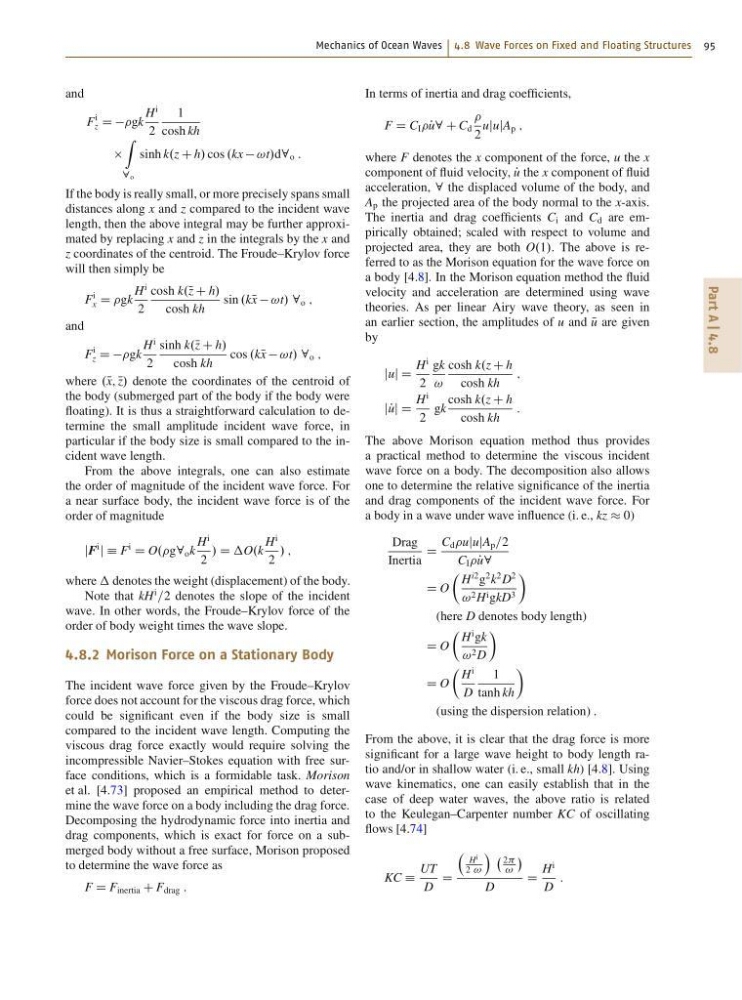
If the body is really small, or more precisely spans small
distances along x and z compared to the incident wave
length, then the above integral may be further approximated by replacing x and z in the integrals by the x and
z coordinates of the centroid. The Froude–Krylov force
will then simply be
F
i
x D gk
H
i
2
cosh k.N z C h/
cosh kh
sin .kN x !t/ 8 o ;
and
F
i
z D Dgk
H
i
2
sinh k.N z C h/
cosh kh
cos .kN x !t/ 8 o ;
where .N x; N
z/ denote the coordinates of the centroid of
the body (submerged part of the body if the body were
floating). It is thus a straightforward calculation to determine the small amplitude incident wave force, in
particular if the body size is small compared to the incident wave length.
From the above integrals, one can also estimate
the order of magnitude of the incident wave force. For
a near surface body, the incident wave force is of the
order of magnitude
jF
i
j Á F
i
D O..g8 o k
H
i
2
/ D O.k
H
i
2
/ ;
where denotes the weight (displacement) of the body.
Note that kH
i
=2 denotes the slope of the incident
wave. In other words, the Froude–Krylov force of the
order of body weight times the wave slope.
4.8.2 Morison Force on a Stationary Body
The incident wave force given by the Froude–Krylov
force does not account for the viscous drag force, which
could be significant even if the body size is small
compared to the incident wave length. Computing the
viscous drag force exactly would require solving the
incompressible Navier–Stokes equation with free surface conditions, which is a formidable task. Morison
et al. [4.73] proposed an empirical method to determine the wave force on a body including the drag force.
Decomposing the hydrodynamic force into inertia and
drag components, which is exact for force on a submerged body without a free surface, Morison proposed
to determine the wave force as
F D F inertia C F drag :
In terms of inertia and drag coefficients,
F D C I P u8 C C d
2
ujujA p ;
where F denotes the x component of the force, u the x
component of fluid velocity, P
u the x component of fluid
acceleration, 8 the displaced volume of the body, and
A p the projected area of the body normal to the x-axis.
The inertia and drag coefficients C i and C d are empirically obtained; scaled with respect to volume and
projected area, they are both O.1/. The above is referred to as the Morison equation for the wave force on
a body [4.8]. In the Morison equation method the fluid
velocity and acceleration are determined using wave
theories. As per linear Airy wave theory, as seen in
an earlier section, the amplitudes of u and N
u are given
by
juj D
H
i
2
gk
!
cosh k.z C h
cosh kh
;
jP uj D
H
i
2
gk
cosh k.z C h
cosh kh
:
The above Morison equation method thus provides
a practical method to determine the viscous incident
wave force on a body. The decomposition also allows
one to determine the relative significance of the inertia
and drag components of the incident wave force. For
a body in a wave under wave influence (i. e., kz 0)
Drag
Inertia
D
C d ujujA p =2
C I P u8
D O
 H
i2 g
2 k
2 D
2
! 2 H i gkD 3
Ã
(here D denotes body length)
D O
 H
i gk
! 2 D
Ã
D O
 H
i
D
1
tanh kh
Ã
(using the dispersion relation) :
From the above, it is clear that the drag force is more
significant for a large wave height to body length ratio and/or in shallow water (i. e., small kh) [4.8]. Using
wave kinematics, one can easily establish that in the
case of deep water waves, the above ratio is related
to the Keulegan–Carpenter number KC of oscillating
flows [4.74]
KC Á
UT
D
D
H i
2 !
Á 2
!
D
D
H
i
D
:
Part A | 4.8
and
F
i
z D Dgk
H
i
2
1
cosh kh
Z
8o
sinh k.z C h/ cos .kx !t/d8 o :
If the body is really small, or more precisely spans small
distances along x and z compared to the incident wave
length, then the above integral may be further approximated by replacing x and z in the integrals by the x and
z coordinates of the centroid. The Froude–Krylov force
will then simply be
F
i
x D gk
H
i
2
cosh k.N z C h/
cosh kh
sin .kN x !t/ 8 o ;
and
F
i
z D Dgk
H
i
2
sinh k.N z C h/
cosh kh
cos .kN x !t/ 8 o ;
where .N x; N
z/ denote the coordinates of the centroid of
the body (submerged part of the body if the body were
floating). It is thus a straightforward calculation to determine the small amplitude incident wave force, in
particular if the body size is small compared to the incident wave length.
From the above integrals, one can also estimate
the order of magnitude of the incident wave force. For
a near surface body, the incident wave force is of the
order of magnitude
jF
i
j Á F
i
D O..g8 o k
H
i
2
/ D O.k
H
i
2
/ ;
where denotes the weight (displacement) of the body.
Note that kH
i
=2 denotes the slope of the incident
wave. In other words, the Froude–Krylov force of the
order of body weight times the wave slope.
4.8.2 Morison Force on a Stationary Body
The incident wave force given by the Froude–Krylov
force does not account for the viscous drag force, which
could be significant even if the body size is small
compared to the incident wave length. Computing the
viscous drag force exactly would require solving the
incompressible Navier–Stokes equation with free surface conditions, which is a formidable task. Morison
et al. [4.73] proposed an empirical method to determine the wave force on a body including the drag force.
Decomposing the hydrodynamic force into inertia and
drag components, which is exact for force on a submerged body without a free surface, Morison proposed
to determine the wave force as
F D F inertia C F drag :
In terms of inertia and drag coefficients,
F D C I P u8 C C d
2
ujujA p ;
where F denotes the x component of the force, u the x
component of fluid velocity, P
u the x component of fluid
acceleration, 8 the displaced volume of the body, and
A p the projected area of the body normal to the x-axis.
The inertia and drag coefficients C i and C d are empirically obtained; scaled with respect to volume and
projected area, they are both O.1/. The above is referred to as the Morison equation for the wave force on
a body [4.8]. In the Morison equation method the fluid
velocity and acceleration are determined using wave
theories. As per linear Airy wave theory, as seen in
an earlier section, the amplitudes of u and N
u are given
by
juj D
H
i
2
gk
!
cosh k.z C h
cosh kh
;
jP uj D
H
i
2
gk
cosh k.z C h
cosh kh
:
The above Morison equation method thus provides
a practical method to determine the viscous incident
wave force on a body. The decomposition also allows
one to determine the relative significance of the inertia
and drag components of the incident wave force. For
a body in a wave under wave influence (i. e., kz 0)
Drag
Inertia
D
C d ujujA p =2
C I P u8
D O
 H
i2 g
2 k
2 D
2
! 2 H i gkD 3
Ã
(here D denotes body length)
D O
 H
i gk
! 2 D
Ã
D O
 H
i
D
1
tanh kh
Ã
(using the dispersion relation) :
From the above, it is clear that the drag force is more
significant for a large wave height to body length ratio and/or in shallow water (i. e., small kh) [4.8]. Using
wave kinematics, one can easily establish that in the
case of deep water waves, the above ratio is related
to the Keulegan–Carpenter number KC of oscillating
flows [4.74]
KC Á
UT
D
D
H i
2 !
Á 2
!
D
D
H
i
D
: