

Mechanics of Ocean Waves 4.3 Properties of Small Amplitude Gravity Waves 81
Part A | 4.3
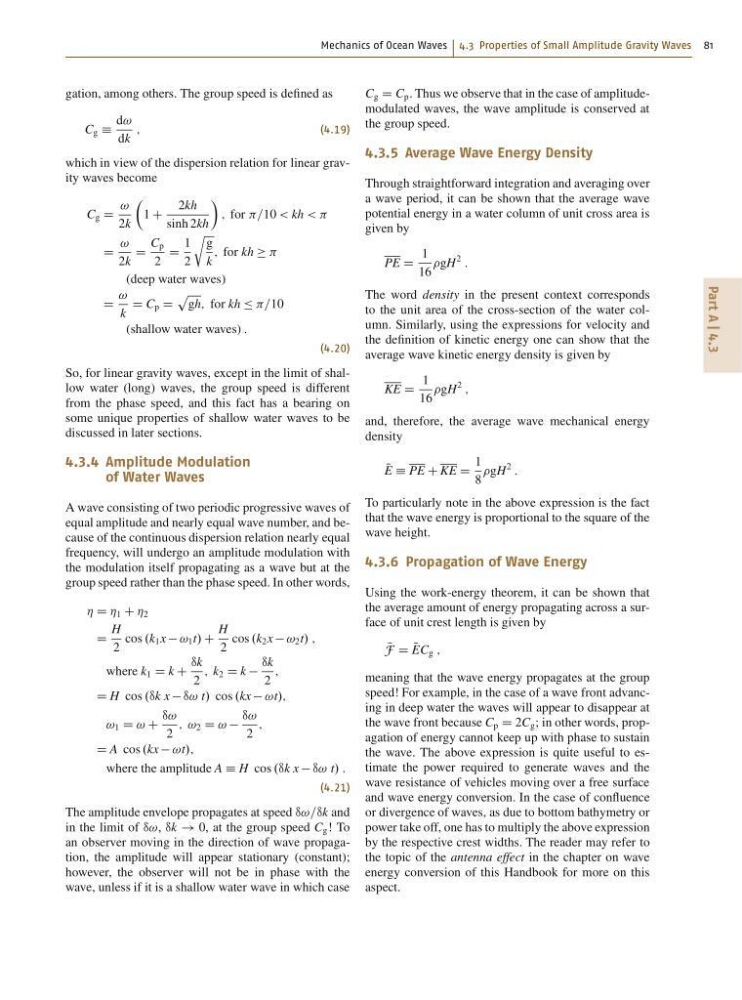
gation, among others. The group speed is defined as
C g Á
d!
dk
;
(4.19)
which in view of the dispersion relation for linear gravity waves become
C g D
!
2k
Â
1 C
2kh
sinh 2kh
Ã
; for =10 < kh < <
D
!
2k
D
C p
2
D
1
2
r
g
k
; for kh
(deep water waves)
D
!
k
D C p D
p
gh; for kh Ä =10
(shallow water waves) :
(4.20)
So, for linear gravity waves, except in the limit of shallow water (long) waves, the group speed is different
from the phase speed, and this fact has a bearing on
some unique properties of shallow water waves to be
discussed in later sections.
4.3.4 Amplitude Modulation
of Water Waves
A wave consisting of two periodic progressive waves of
equal amplitude and nearly equal wave number, and because of the continuous dispersion relation nearly equal
frequency, will undergo an amplitude modulation with
the modulation itself propagating as a wave but at the
group speed rather than the phase speed. In other words,
Á D Á 1 C Á 2
D
H
2
cos .k 1 x ! 1 t/ C
H
2
cos .k 2 x ! 2 t/ ;
where k 1 D k C
•k
2
; k 2 D k
•k
2
;
D H cos .•k x •! t/ cos .kx !t/;
! 1 D ! C
•!
2
; ! 2 D !
•!
2
;
D A cos .kx !t/;
where the amplitude A Á H cos .•k x •! t/ :
(4.21)
The amplitude envelope propagates at speed •!=•k and
in the limit of •!, •k ! 0, at the group speed C g ! To
an observer moving in the direction of wave propagation, the amplitude will appear stationary (constant);
however, the observer will not be in phase with the
wave, unless if it is a shallow water wave in which case
C g D C p . Thus we observe that in the case of amplitudemodulated waves, the wave amplitude is conserved at
the group speed.
4.3.5 Average Wave Energy Density
Through straightforward integration and averaging over
a wave period, it can be shown that the average wave
potential energy in a water column of unit cross area is
given by
PE D
1
16
gH
2
:
The word density in the present context corresponds
to the unit area of the cross-section of the water column. Similarly, using the expressions for velocity and
the definition of kinetic energy one can show that the
average wave kinetic energy density is given by
KE D
1
16
gH
2
;
and, therefore, the average wave mechanical energy
density
N
E Á PE C KE D
1
8
gH
2
:
To particularly note in the above expression is the fact
that the wave energy is proportional to the square of the
wave height.
4.3.6 Propagation of Wave Energy
Using the work-energy theorem, it can be shown that
the average amount of energy propagating across a surface of unit crest length is given by
N
F D N
EC g ;
meaning that the wave energy propagates at the group
speed! For example, in the case of a wave front advancing in deep water the waves will appear to disappear at
the wave front because C p D 2C g ; in other words, propagation of energy cannot keep up with phase to sustain
the wave. The above expression is quite useful to estimate the power required to generate waves and the
wave resistance of vehicles moving over a free surface
and wave energy conversion. In the case of confluence
or divergence of waves, as due to bottom bathymetry or
power take off, one has to multiply the above expression
by the respective crest widths. The reader may refer to
the topic of the antenna effect in the chapter on wave
energy conversion of this Handbook for more on this
aspect.
Part A | 4.3
gation, among others. The group speed is defined as
C g Á
d!
dk
;
(4.19)
which in view of the dispersion relation for linear gravity waves become
C g D
!
2k
Â
1 C
2kh
sinh 2kh
Ã
; for =10 < kh < <
D
!
2k
D
C p
2
D
1
2
r
g
k
; for kh
(deep water waves)
D
!
k
D C p D
p
gh; for kh Ä =10
(shallow water waves) :
(4.20)
So, for linear gravity waves, except in the limit of shallow water (long) waves, the group speed is different
from the phase speed, and this fact has a bearing on
some unique properties of shallow water waves to be
discussed in later sections.
4.3.4 Amplitude Modulation
of Water Waves
A wave consisting of two periodic progressive waves of
equal amplitude and nearly equal wave number, and because of the continuous dispersion relation nearly equal
frequency, will undergo an amplitude modulation with
the modulation itself propagating as a wave but at the
group speed rather than the phase speed. In other words,
Á D Á 1 C Á 2
D
H
2
cos .k 1 x ! 1 t/ C
H
2
cos .k 2 x ! 2 t/ ;
where k 1 D k C
•k
2
; k 2 D k
•k
2
;
D H cos .•k x •! t/ cos .kx !t/;
! 1 D ! C
•!
2
; ! 2 D !
•!
2
;
D A cos .kx !t/;
where the amplitude A Á H cos .•k x •! t/ :
(4.21)
The amplitude envelope propagates at speed •!=•k and
in the limit of •!, •k ! 0, at the group speed C g ! To
an observer moving in the direction of wave propagation, the amplitude will appear stationary (constant);
however, the observer will not be in phase with the
wave, unless if it is a shallow water wave in which case
C g D C p . Thus we observe that in the case of amplitudemodulated waves, the wave amplitude is conserved at
the group speed.
4.3.5 Average Wave Energy Density
Through straightforward integration and averaging over
a wave period, it can be shown that the average wave
potential energy in a water column of unit cross area is
given by
PE D
1
16
gH
2
:
The word density in the present context corresponds
to the unit area of the cross-section of the water column. Similarly, using the expressions for velocity and
the definition of kinetic energy one can show that the
average wave kinetic energy density is given by
KE D
1
16
gH
2
;
and, therefore, the average wave mechanical energy
density
N
E Á PE C KE D
1
8
gH
2
:
To particularly note in the above expression is the fact
that the wave energy is proportional to the square of the
wave height.
4.3.6 Propagation of Wave Energy
Using the work-energy theorem, it can be shown that
the average amount of energy propagating across a surface of unit crest length is given by
N
F D N
EC g ;
meaning that the wave energy propagates at the group
speed! For example, in the case of a wave front advancing in deep water the waves will appear to disappear at
the wave front because C p D 2C g ; in other words, propagation of energy cannot keep up with phase to sustain
the wave. The above expression is quite useful to estimate the power required to generate waves and the
wave resistance of vehicles moving over a free surface
and wave energy conversion. In the case of confluence
or divergence of waves, as due to bottom bathymetry or
power take off, one has to multiply the above expression
by the respective crest widths. The reader may refer to
the topic of the antenna effect in the chapter on wave
energy conversion of this Handbook for more on this
aspect.