

Mechanics of Ocean Waves 4.2 Wave Theories 79
Part A | 4.2
η = η (x, y, t)
F
B
S B
h (x,y)
g
z
y
x
Ω
r
Ω
Ω
n ˆ
n ˆ
n ˆ
η
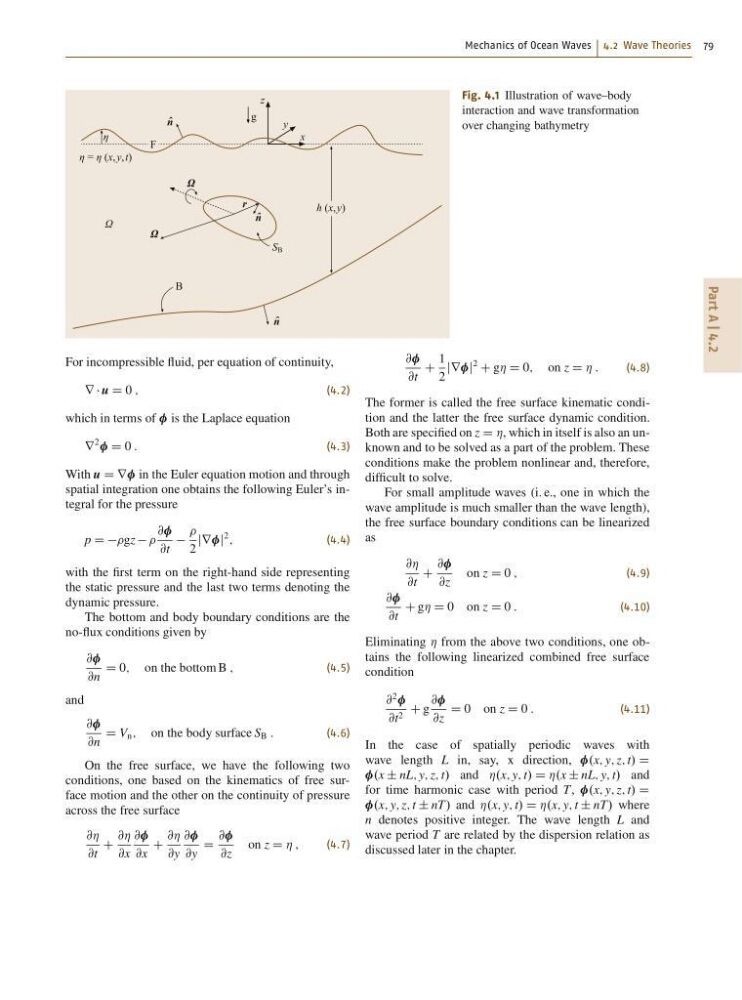
Fig. 4.1 Illustration of wave–body
interaction and wave transformation
over changing bathymetry
For incompressible fluid, per equation of continuity,
r r u D 0 ;
(4.2)
which in terms of is the Laplace equation
r
2
D 0 :
(4.3)
With u D r in the Euler equation motion and through
spatial integration one obtains the following Euler’s integral for the pressure
p D Dgz
@
@t
2
jrj
2
;
(4.4)
with the first term on the right-hand side representing
the static pressure and the last two terms denoting the
dynamic pressure.
The bottom and body boundary conditions are the
no-flux conditions given by
@
@n
D 0; on the bottom B ;
(4.5)
and
@
@n
D V n ; on the body surface S B :
(4.6)
On the free surface, we have the following two
conditions, one based on the kinematics of free surface motion and the other on the continuity of pressure
across the free surface
@Á
@t
C
@Á
@x
@
@x
C
@Á
@y
@
@y
D
@
@z
on z D Á ;
(4.7)
@
@t
C
1
2
jrj
2
C gÁ D 0; on z D Á :
(4.8)
The former is called the free surface kinematic condition and the latter the free surface dynamic condition.
Both are specified on z D Á, which in itself is also an unknown and to be solved as a part of the problem. These
conditions make the problem nonlinear and, therefore,
difficult to solve.
For small amplitude waves (i. e., one in which the
wave amplitude is much smaller than the wave length),
the free surface boundary conditions can be linearized
as
@Á
@t
C
@
@z
on z D 0 ;
(4.9)
@
@t
C gÁ D 0 on z D 0 :
(4.10)
Eliminating Á from the above two conditions, one obtains the following linearized combined free surface
condition
@
2
@t 2 C g
@
@z
D 0 on z D 0 :
(4.11)
In the case of spatially periodic waves with
wave length L in, say, x direction, .x; y; z; t/ D
.x ˙ nL; y; z; t/ and Á.x; y; t/ D Á.x ˙ nL; y; t/ and
for time harmonic case with period T, .x; y; z; t/ D
.x; y; z; t ˙ nT/ and Á.x; y; t/ D Á.x; y; t ˙ nT/ where
n denotes positive integer. The wave length L and
wave period T are related by the dispersion relation as
discussed later in the chapter.
Part A | 4.2
η = η (x, y, t)
F
B
S B
h (x,y)
g
z
y
x
Ω
r
Ω
Ω
n ˆ
n ˆ
n ˆ
η
Fig. 4.1 Illustration of wave–body
interaction and wave transformation
over changing bathymetry
For incompressible fluid, per equation of continuity,
r r u D 0 ;
(4.2)
which in terms of is the Laplace equation
r
2
D 0 :
(4.3)
With u D r in the Euler equation motion and through
spatial integration one obtains the following Euler’s integral for the pressure
p D Dgz
@
@t
2
jrj
2
;
(4.4)
with the first term on the right-hand side representing
the static pressure and the last two terms denoting the
dynamic pressure.
The bottom and body boundary conditions are the
no-flux conditions given by
@
@n
D 0; on the bottom B ;
(4.5)
and
@
@n
D V n ; on the body surface S B :
(4.6)
On the free surface, we have the following two
conditions, one based on the kinematics of free surface motion and the other on the continuity of pressure
across the free surface
@Á
@t
C
@Á
@x
@
@x
C
@Á
@y
@
@y
D
@
@z
on z D Á ;
(4.7)
@
@t
C
1
2
jrj
2
C gÁ D 0; on z D Á :
(4.8)
The former is called the free surface kinematic condition and the latter the free surface dynamic condition.
Both are specified on z D Á, which in itself is also an unknown and to be solved as a part of the problem. These
conditions make the problem nonlinear and, therefore,
difficult to solve.
For small amplitude waves (i. e., one in which the
wave amplitude is much smaller than the wave length),
the free surface boundary conditions can be linearized
as
@Á
@t
C
@
@z
on z D 0 ;
(4.9)
@
@t
C gÁ D 0 on z D 0 :
(4.10)
Eliminating Á from the above two conditions, one obtains the following linearized combined free surface
condition
@
2
@t 2 C g
@
@z
D 0 on z D 0 :
(4.11)
In the case of spatially periodic waves with
wave length L in, say, x direction, .x; y; z; t/ D
.x ˙ nL; y; z; t/ and Á.x; y; t/ D Á.x ˙ nL; y; t/ and
for time harmonic case with period T, .x; y; z; t/ D
.x; y; z; t ˙ nT/ and Á.x; y; t/ D Á.x; y; t ˙ nT/ where
n denotes positive integer. The wave length L and
wave period T are related by the dispersion relation as
discussed later in the chapter.