

81
accommodate a wide variety of physical, chemical, optical, and acoustic sensors,
many custom designed for gliders (Rudnick and Perry 2003). Gliders are relatively
slow, achieving forward speed of 0.2–0.4 m.s
−1
(about 0.4–0.7 km.h
−1
) in the
absence of contrary currents. Oceanographic cross sections thus obtained are consequently not truly synoptic and transient features may be blurred by Doppler smearing (Rudnick and Cole 2011).
Similar to the ARGO floats discussed above, buoyancy control on gliders is
achieved by pumping a buoyant fluid between an internal reservoir and an external
bladder. Electrical pumps driven by onboard disposable alkaline or reusable lithium
batteries are most common. The latter typically provide up to 17.5 mega joules (MJ)
of available power and allow missions extending to as long as 10 months with
ranges to 10,000 km. An alternative energy source for offshore applications is found
in the thermal glider approach using a phase-changing wax that contracts and
expands as it transitions from liquid to solid as the vehicle dives from the warm
surface water into colder deeper water. Applying and releasing the pressure thus
generated to compress a gaseous nitrogen reservoir provides the power to pump the
working fluid and reestablish buoyancy once the target depth is reached. Such a
scheme is limited only by mechanical failure, but again, is more suited for deep diving large area surveys than to nearshore coastal operations.
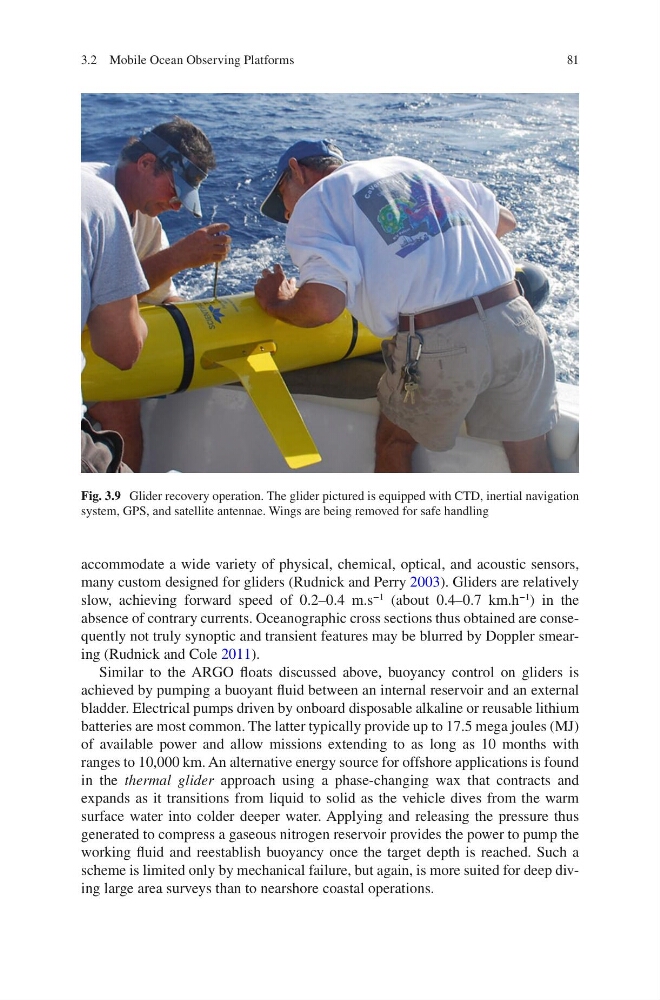
Fig. 3.9 Glider recovery operation. The glider pictured is equipped with CTD, inertial navigation
system, GPS, and satellite antennae. Wings are being removed for safe handling
3.2 Mobile Ocean Observing Platforms
accommodate a wide variety of physical, chemical, optical, and acoustic sensors,
many custom designed for gliders (Rudnick and Perry 2003). Gliders are relatively
slow, achieving forward speed of 0.2–0.4 m.s
−1
(about 0.4–0.7 km.h
−1
) in the
absence of contrary currents. Oceanographic cross sections thus obtained are consequently not truly synoptic and transient features may be blurred by Doppler smearing (Rudnick and Cole 2011).
Similar to the ARGO floats discussed above, buoyancy control on gliders is
achieved by pumping a buoyant fluid between an internal reservoir and an external
bladder. Electrical pumps driven by onboard disposable alkaline or reusable lithium
batteries are most common. The latter typically provide up to 17.5 mega joules (MJ)
of available power and allow missions extending to as long as 10 months with
ranges to 10,000 km. An alternative energy source for offshore applications is found
in the thermal glider approach using a phase-changing wax that contracts and
expands as it transitions from liquid to solid as the vehicle dives from the warm
surface water into colder deeper water. Applying and releasing the pressure thus
generated to compress a gaseous nitrogen reservoir provides the power to pump the
working fluid and reestablish buoyancy once the target depth is reached. Such a
scheme is limited only by mechanical failure, but again, is more suited for deep diving large area surveys than to nearshore coastal operations.
Fig. 3.9 Glider recovery operation. The glider pictured is equipped with CTD, inertial navigation
system, GPS, and satellite antennae. Wings are being removed for safe handling
3.2 Mobile Ocean Observing Platforms