

79
frame. Vehicle and propulsion system are connected by a 6–8 m tether. The difference between heightened orbital wave-induced motion at the surface and minimal
movement at depth coupled to the movable winglets provide propulsion power for
speeds up to 3 knots. Payload power is provided by a solar panel array supplying a
lithium-ion battery bank. A directional thruster mounted aft like a conventional
ship’s propeller but capable of swiveling on the horizontal plane allows surface
navigation.
These USVs are capable of year-long deployments and can carry a large number
and variety of instruments, onboard, subsurface, or towed. Patrolling in single units
or swarms or holding station alone or in arrays, these USVs achieve significant cost
reduction for surface and subsurface observations. Recurrent operational coastal
IOOS applications are still lacking, but the US Pacific Islands Ocean Observing
System (PacIOOS) has carried out experimental missions in the vicinity of the
Hawaiian Islands recording wave height, direction, and period and, notably, traversing and surviving 7 m hurricane wavefields. Custom towed bodies have found applications in geophysics, acoustic fisheries surveys, and ocean optics. Successful fish
stock assessment missions using towed sonar arrays have been reported off South
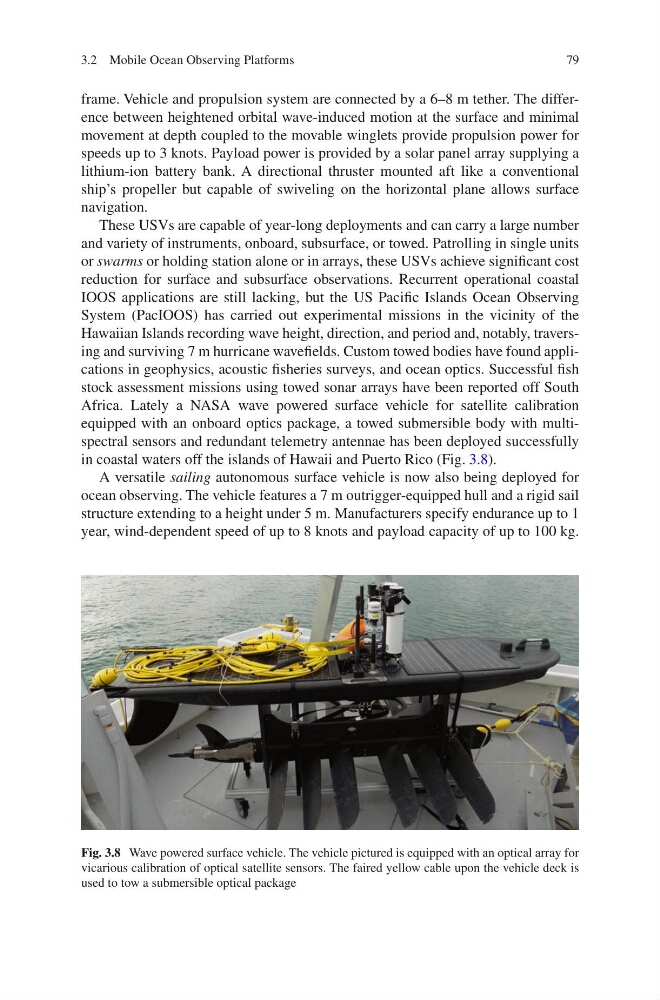
Africa. Lately a NASA wave powered surface vehicle for satellite calibration
equipped with an onboard optics package, a towed submersible body with multispectral sensors and redundant telemetry antennae has been deployed successfully
in coastal waters off the islands of Hawaii and Puerto Rico (Fig. 3.8).
A versatile sailing autonomous surface vehicle is now also being deployed for
ocean observing. The vehicle features a 7 m outrigger-equipped hull and a rigid sail
structure extending to a height under 5 m. Manufacturers specify endurance up to 1
year, wind-dependent speed of up to 8 knots and payload capacity of up to 100 kg.
Fig. 3.8 Wave powered surface vehicle. The vehicle pictured is equipped with an optical array for
vicarious calibration of optical satellite sensors. The faired yellow cable upon the vehicle deck is
used to tow a submersible optical package
3.2 Mobile Ocean Observing Platforms
frame. Vehicle and propulsion system are connected by a 6–8 m tether. The difference between heightened orbital wave-induced motion at the surface and minimal
movement at depth coupled to the movable winglets provide propulsion power for
speeds up to 3 knots. Payload power is provided by a solar panel array supplying a
lithium-ion battery bank. A directional thruster mounted aft like a conventional
ship’s propeller but capable of swiveling on the horizontal plane allows surface
navigation.
These USVs are capable of year-long deployments and can carry a large number
and variety of instruments, onboard, subsurface, or towed. Patrolling in single units
or swarms or holding station alone or in arrays, these USVs achieve significant cost
reduction for surface and subsurface observations. Recurrent operational coastal
IOOS applications are still lacking, but the US Pacific Islands Ocean Observing
System (PacIOOS) has carried out experimental missions in the vicinity of the
Hawaiian Islands recording wave height, direction, and period and, notably, traversing and surviving 7 m hurricane wavefields. Custom towed bodies have found applications in geophysics, acoustic fisheries surveys, and ocean optics. Successful fish
stock assessment missions using towed sonar arrays have been reported off South
Africa. Lately a NASA wave powered surface vehicle for satellite calibration
equipped with an onboard optics package, a towed submersible body with multispectral sensors and redundant telemetry antennae has been deployed successfully
in coastal waters off the islands of Hawaii and Puerto Rico (Fig. 3.8).
A versatile sailing autonomous surface vehicle is now also being deployed for
ocean observing. The vehicle features a 7 m outrigger-equipped hull and a rigid sail
structure extending to a height under 5 m. Manufacturers specify endurance up to 1
year, wind-dependent speed of up to 8 knots and payload capacity of up to 100 kg.
Fig. 3.8 Wave powered surface vehicle. The vehicle pictured is equipped with an optical array for
vicarious calibration of optical satellite sensors. The faired yellow cable upon the vehicle deck is
used to tow a submersible optical package
3.2 Mobile Ocean Observing Platforms