

50
and decreasing to zero at the equator, dictates differential lateral displacement of
river plumes such that they disperse directly out into the ocean at very low latitudes
but deviate strongly along the coast as latitude increases toward the right in the
northern hemisphere and left in the southern. At higher latitudes, consequently,
greater extensions of coastline come under the influence of river plumes. Terrestrial
runoff in Arctic regions is now a significant source of CDOM to the ocean due to the
anomalous melting of high peat-content permafrost.
CDOM is of practical concern since it limits the penetration of light into ocean
waters affecting the availability of photosynthetically active radiation (400–700 nm).
Thus, CDOM concentration limits the depth range of coastal vegetation such as
seagrass and kelp beds and coral reefs. Conversely, CDOM may provide a UV
screen to marine organisms residing close to the ocean surface reducing the harmful
effects of UV light. Communications using optical means can be similarly hampered
as will diver visibility. Since CDOM absorbs mostly in the blue to violet range
where light penetration in seawater is greatest, the effect is particularly pertinent to
these concerns.
Optical Characterization of CDOM
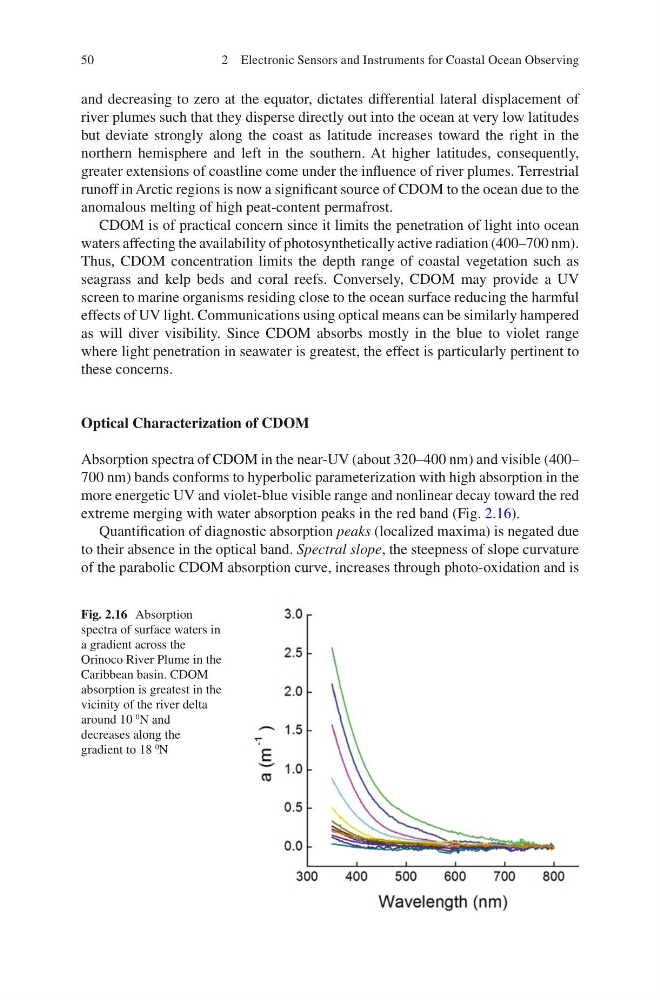
Absorption spectra of CDOM in the near-UV (about 320–400 nm) and visible (400–
700 nm) bands conforms to hyperbolic parameterization with high absorption in the
more energetic UV and violet-blue visible range and nonlinear decay toward the red
extreme merging with water absorption peaks in the red band (Fig. 2.16).
Quantification of diagnostic absorption peaks (localized maxima) is negated due
to their absence in the optical band. Spectral slope, the steepness of slope curvature
of the parabolic CDOM absorption curve, increases through photo-oxidation and is
Fig. 2.16 Absorption
spectra of surface waters in
a gradient across the
Orinoco River Plume in the
Caribbean basin. CDOM
absorption is greatest in the
vicinity of the river delta
around 10
0 N and
decreases along the
gradient to 18
0
N
2 Electronic Sensors and Instruments for Coastal Ocean Observing
and decreasing to zero at the equator, dictates differential lateral displacement of
river plumes such that they disperse directly out into the ocean at very low latitudes
but deviate strongly along the coast as latitude increases toward the right in the
northern hemisphere and left in the southern. At higher latitudes, consequently,
greater extensions of coastline come under the influence of river plumes. Terrestrial
runoff in Arctic regions is now a significant source of CDOM to the ocean due to the
anomalous melting of high peat-content permafrost.
CDOM is of practical concern since it limits the penetration of light into ocean
waters affecting the availability of photosynthetically active radiation (400–700 nm).
Thus, CDOM concentration limits the depth range of coastal vegetation such as
seagrass and kelp beds and coral reefs. Conversely, CDOM may provide a UV
screen to marine organisms residing close to the ocean surface reducing the harmful
effects of UV light. Communications using optical means can be similarly hampered
as will diver visibility. Since CDOM absorbs mostly in the blue to violet range
where light penetration in seawater is greatest, the effect is particularly pertinent to
these concerns.
Optical Characterization of CDOM
Absorption spectra of CDOM in the near-UV (about 320–400 nm) and visible (400–
700 nm) bands conforms to hyperbolic parameterization with high absorption in the
more energetic UV and violet-blue visible range and nonlinear decay toward the red
extreme merging with water absorption peaks in the red band (Fig. 2.16).
Quantification of diagnostic absorption peaks (localized maxima) is negated due
to their absence in the optical band. Spectral slope, the steepness of slope curvature
of the parabolic CDOM absorption curve, increases through photo-oxidation and is
Fig. 2.16 Absorption
spectra of surface waters in
a gradient across the
Orinoco River Plume in the
Caribbean basin. CDOM
absorption is greatest in the
vicinity of the river delta
around 10
0 N and
decreases along the
gradient to 18
0
N
2 Electronic Sensors and Instruments for Coastal Ocean Observing