

43
cosmetic industries. This proprietary technology has now been adapted for
autonomous seawater pH measurements through collaboration between academia, a
private foundation, and industry (Martz et al. 2010; Johnson et al. 2016). Rugged
and durable, with a faster response than glass, in this solid-state device electron flow
between source and drain is modulated by the potential difference of a protonsensitive gate electrode. Uniquely, this electrode is activated by a counter electrode
that ensures a constant current across the ISFET (Branham et al. 2017). A particularly novel solution to the difficulties caused by the liquid junction between the
seawater medium and the reference electrode has been the substitution of the problematic silver/silver chloride electrode with a solid-state ion selective chloride electrode directly exposed to the seawater (Takeshita et al. 2014). Since chloride is the
major single component of seawater, a stable, accurate signal is easily calibrated to
paired seawater conductivity and temperature data.
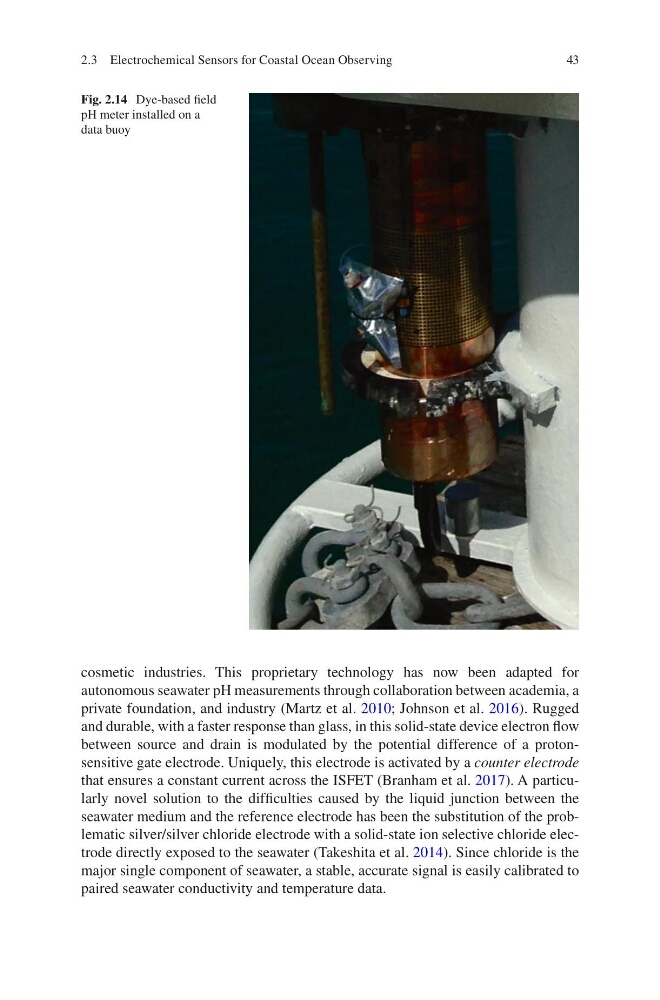
Fig. 2.14 Dye-based field
pH meter installed on a
data buoy
2.3 Electrochemical Sensors for Coastal Ocean Observing
cosmetic industries. This proprietary technology has now been adapted for
autonomous seawater pH measurements through collaboration between academia, a
private foundation, and industry (Martz et al. 2010; Johnson et al. 2016). Rugged
and durable, with a faster response than glass, in this solid-state device electron flow
between source and drain is modulated by the potential difference of a protonsensitive gate electrode. Uniquely, this electrode is activated by a counter electrode
that ensures a constant current across the ISFET (Branham et al. 2017). A particularly novel solution to the difficulties caused by the liquid junction between the
seawater medium and the reference electrode has been the substitution of the problematic silver/silver chloride electrode with a solid-state ion selective chloride electrode directly exposed to the seawater (Takeshita et al. 2014). Since chloride is the
major single component of seawater, a stable, accurate signal is easily calibrated to
paired seawater conductivity and temperature data.
Fig. 2.14 Dye-based field
pH meter installed on a
data buoy
2.3 Electrochemical Sensors for Coastal Ocean Observing